
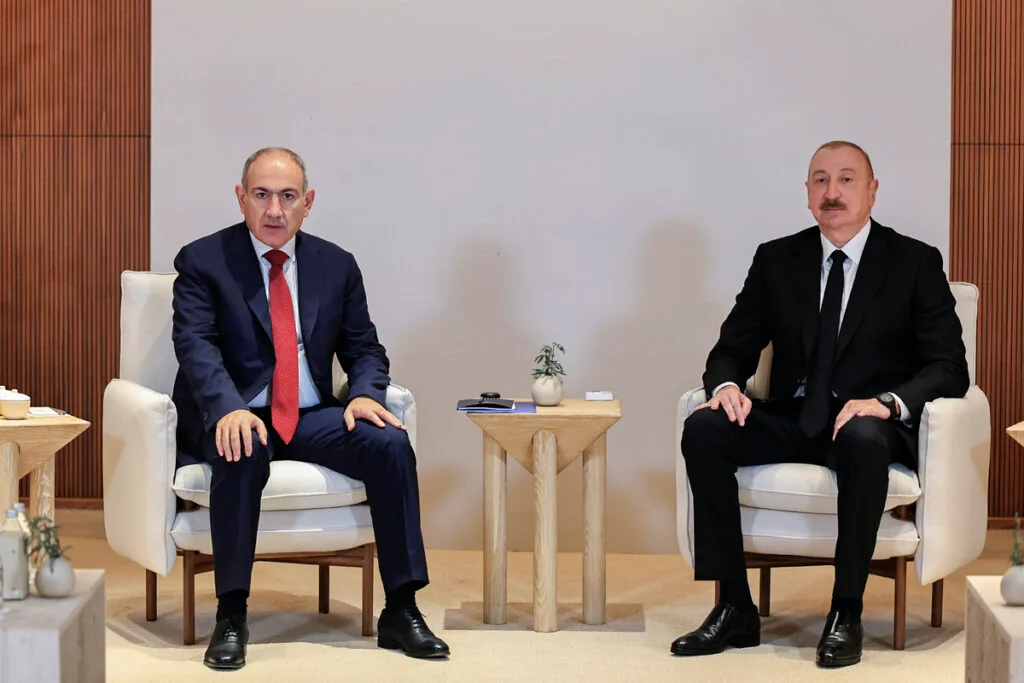
The incident involving the cultural heritage of Artsakh does not in itself indicate that new and serious disagreements have emerged in the Armenia-Azerbaijan negotiation process. According to political analyst Tigran Grigoryan, there is insufficient evidence at this stage to draw such a conclusion. At the same time, the incident exposed significant differences between the two societies’ perceptions of peace, which could negatively affect the atmosphere surrounding the negotiations.
No evidence of a new crisis in the negotiations
Following the Gandzasar incident, a view emerged in Armenia that Azerbaijan’s actions may have been linked to new problems arising in the negotiation process. The Azerbaijani side, in turn, portrayed Armenia’s reaction as coordinated and centrally directed.
According to Grigoryan, however, such an interpretation is difficult to substantiate. He notes that Azerbaijan may find it unusual to see different political and public groups — pro-government, opposition and neutral — independently and almost simultaneously criticizing Baku’s actions. Given Azerbaijan’s political system, such pluralism may naturally be perceived as a process directed from a single center.
In Armenia, meanwhile, public reactions may have different and independent causes. “The main issue here is the differing perceptions of peace in the two societies,” the political analyst says.
No serious new problems have emerged
Grigoryan recalls the nearly identical statements issued following the meeting between Nikol Pashinyan and Ilham Aliyev in Bishkek. In his assessment, had there been genuinely serious new problems between the sides at that point, they would hardly have been able to agree on the wording of statements summarizing the outcome of the meeting.
As another example, Grigoryan points to April 2025, when, despite reaching final agreement on the text of the peace treaty, the sides were unable to issue a joint statement on the matter. According to him, this indicated at the time that serious problems existed in the negotiation process.
After the Bishkek meeting, however, no similar signals emerged. The sides made no notable statements against each other, and at least in the public sphere there were no serious incidents that would justify speaking of a new crisis in the negotiations.
Azerbaijan’s concept of a “victor’s peace”
According to Grigoryan, the issue should be viewed from a different perspective. Azerbaijan continues to perceive the peace process through a hierarchical logic known in political science literature as a “victor’s peace.”
Over the past year, certain changes have indeed been visible both in the overall atmosphere and in rhetoric. Baku has also taken several symbolic steps, including decisions to allow transit through its territory toward Armenia and to begin direct trade with Armenia. According to the political analyst, however, Azerbaijan has not abandoned its traditional political discourse.
He notes that Azerbaijani discourse surrounding the idea of “Western Azerbaijan” has continued even recently. Armenia’s Foreign Intelligence Service also stated in its report that Azerbaijani rhetoric on the issue expanded following the agreements reached in Washington.
The same applies to the issue of the “Zangezur Corridor.” Although the term has been used less frequently over the past year, the idea continues to circulate in Azerbaijan. According to Grigoryan, Azerbaijani political and expert circles equate the “Zangezur Corridor” with several other routes, indicating that these approaches have not disappeared in substance.
The same is true of the Azerbaijani narrative portraying Armenian cultural and religious heritage as “Caucasian Albanian.”
Why the Gandzasar visit was perceived as a provocation in Armenia
According to Grigoryan, a certain expectation had developed in Armenia that, amid the positive atmosphere created after Washington, Azerbaijan would refrain from such actions and change its approach toward Armenian cultural and religious heritage.
That expectation, he says, may explain the reaction surrounding the visit to Gandzasar. In Armenia, the move was perceived not simply as another Azerbaijani initiative, but as a demonstrative action contradicting expectations that had developed around the peace process.
In Azerbaijan, however, the situation is viewed through a different logic: “You have accepted our conditions within this very vision of a victor’s peace, recognized Nagorno-Karabakh as part of Azerbaijan, stopped talking about Nagorno-Karabakh altogether, particularly about people’s rights, and the expectation was that you should remain silent on these issues as well.”
According to Grigoryan, this is the line Azerbaijan is pursuing. Under this approach, a “victor’s peace” means not only that Azerbaijan determines the political agenda of peace, but also that the Armenian side is expected to accept Azerbaijan’s positions and refrain from challenging them.
Public reaction cannot be controlled
According to the political analyst, Azerbaijan may have developed a perception that, as far as the Armenian authorities are concerned, the Armenian side has largely accepted this logic. On the Gandzasar issue, the Armenian authorities also refrained from making particularly harsh statements and limited themselves to responses on individual aspects of the issue.
However, expecting the same from Armenian society is unrealistic. Armenia’s public sphere, Grigoryan says, is far more diverse than Azerbaijan’s, and different political and public groups can independently assess ongoing developments.
In his view, it is precisely this difference that is generating a new wave of mistrust between the two countries.
Mistrust is already affecting the atmosphere of peace
According to Grigoryan, the most important consequence of the Gandzasar incident is not so much that it exposed a new problem at the negotiating table, but that it deepened mutual mistrust.
Its impact is already visible in the broader atmosphere surrounding the peace process. Some initiatives and meetings are being cancelled, while the rhetoric in statements from the sides is becoming more aggressive.
In this context, the political analyst also refers to Ilham Aliyev’s latest anti-Armenian statements, viewing them as a continuation of a process that could further deepen the tensions that emerged in Armenia-Azerbaijan relations following the Gandzasar incident.