
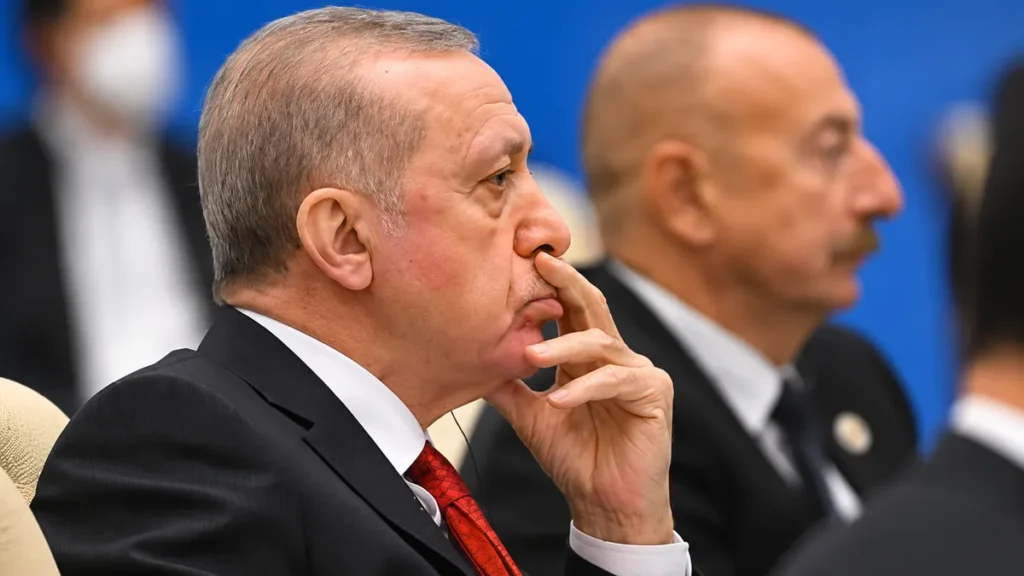
Turkish President Recep Tayyip Erdoğan’s planned visit to Baku on November 8 suggests that tensions between Ankara and Baku run deeper than officially acknowledged. Political commentator Artyom Yerkanyan believes Azerbaijani President Ilham Aliyev is dissatisfied with Turkey and is trying to limit Turkish influence in his country while using economic leverage against Ankara.
According to Yerkanyan, Erdoğan has effectively been forced to respond to Aliyev’s snub. The Azerbaijani president boycotted the summit of Turkic states held in Ankara, after which the Turkish president said he would travel to Baku personally to discuss relations between the two countries.
Speaking to journalists on his way back to Ankara from South Korea, Erdoğan said the visit would take place on November 8 unless unforeseen circumstances arose. The date was not chosen by chance: Azerbaijan marks “Victory Day” on November 8 in connection with the end of the 2020 Artsakh war. Asked about the current state of his relationship with Aliyev, Erdoğan said there were no obstacles that the brotherhood between Turkey and Azerbaijan could not overcome. “In this way, he indirectly confirmed that there are obstacles in those brotherly relations. They simply are not insurmountable,” Yerkanyan commented.
The political commentator also drew attention to another statement by Erdoğan: on the Turkish president’s instructions, Foreign Minister Hakan Fidan and National Intelligence Organization head İbrahim Kalın had traveled to Baku to discuss relations between the two countries. In Yerkanyan’s assessment, this means the crisis between Ankara and Baku began not in October, as had been assumed, but at least in early September. He added that it was perhaps the first time in history that a Turkish foreign minister had visited Baku twice within one month.
Turkish influence at the center of Aliyev’s concerns
Yerkanyan believes disagreements over the hijab and Ankara’s and Baku’s differing attitudes toward Israel are pretexts rather than the real causes of the tension. One underlying issue, in his view, is the expansion of Turkish influence in Azerbaijan.
Citing an article in Kavkaz Info, a publication he describes as working closely with Azerbaijan’s administration, the political commentator says Aliyev is particularly concerned about what the publication describes as a network of influence developed by Turkish intelligence in Azerbaijan through civic, religious, cultural and charitable organizations.
According to the publication, these organizations present themselves as humanitarian, cultural and charitable groups, but in fact serve Turkish state interests, gather intelligence and help strengthen a Turkish network of agents.
The article specifically mentions the Human Rights and Humanitarian Relief Foundation, the Youth Support Foundation, the Islamic Humanitarian Foundation and the Aziz Mahmud Hüdayi Foundation. The publication claims they are coordinated from a single center and serve the same purpose. Yerkanyan believes their activities are probably coordinated through the Turkish Cooperation and Coordination Agency, TİKA. He says the agency is linked to Turkey’s intelligence system and that Hakan Fidan once headed it.
The commentator also notes that, during Fidan’s latest visit to Baku, he met with leaders of the Youth Support Foundation. In Yerkanyan’s assessment, the public nature of the meeting could have been a political message to Aliyev that Ankara did not intend to conceal the development of its structures of influence in Azerbaijan. Yerkanyan also cites a report by the Swedish publication Nordic Monitor, according to which Aliyev discussed the possibility of banning these organizations.
Yerkanyan draws a parallel with earlier measures taken by the Azerbaijani authorities against organizations seen as vehicles of Russian influence. The Sputnik agency was banned from operating in Azerbaijan, while the Moscow House, the Russian House and other organizations perceived in Baku as instruments of the Kremlin’s soft power were closed. “In effect, Aliyev is trying to do the same with the instruments of Turkish soft power. On the one hand, he often says the Turks are his brothers; on the other, he looks for a conspiracy even among those brothers,” Yerkanyan said.
He also recalls the case involving Ramiz Mehdiyev, the former head of Azerbaijan’s presidential administration. Aliyev accused Mehdiyev of attempting to prepare an uprising on the Kremlin’s orders. The 89-year-old former official was sentenced to 14 years in prison. In Yerkanyan’s assessment, after addressing Russian influence, Baku is now trying to bring potential centers of Turkish influence under its control as well. To him, however, Aliyev’s actions in this process are beginning to resemble an obsession with pursuing conspirators and agents of foreign influence.
Aliyev’s economic leverage and Turkey’s financial vulnerability
Yerkanyan is convinced that Aliyev has additional tools for influencing Erdoğan, mostly economic ones. He says tensions between Turkey and Azerbaijan have coincided with a deterioration in Turkey’s financial position. Following another decline, the Turkish lira reached a record low.
The commentator recalls that Turkey’s central bank previously tried to intervene in such situations, stabilizing the national currency through foreign exchange injections. This time, however, Ankara was unable, in his view, to obtain the support it could once count on.
Yerkanyan points to 2022 as an example, saying Azerbaijan came to Turkey’s aid during a period of financial difficulty. Azerbaijan’s state oil fund announced at the time that it intended to place a deposit of several billion dollars with Turkey’s central bank, which helped stabilize the lira.
This time, however, Baku does not intend to provide similar support, according to the political commentator. He also believes Azerbaijan may look for economic means of exerting pressure on Turkey in the opposite direction.
In this context, Yerkanyan highlights an article in Day.Az, a publication he describes as close to Azerbaijan’s presidential administration. Its headline was itself a political message: “Azerbaijan’s budget is not a reserve fund for the Turkish economy.”
The commentator believes Aliyev is using his economic resources to secure a stronger position ahead of talks with Erdoğan.
As an example of those resources, he cites investments in Turkey by Azerbaijan’s state oil company SOCAR. According to Yerkanyan, SOCAR is Turkey’s largest foreign investor, with around $20 billion invested in the country’s energy, petrochemical and logistics sectors.
Thus, in Yerkanyan’s assessment, Erdoğan’s November 8 visit to Baku comes as Aliyev attempts both to limit Turkish political and intelligence influence in Azerbaijan and to use economic leverage to strengthen his position in relations with Ankara.
👉 Regional