
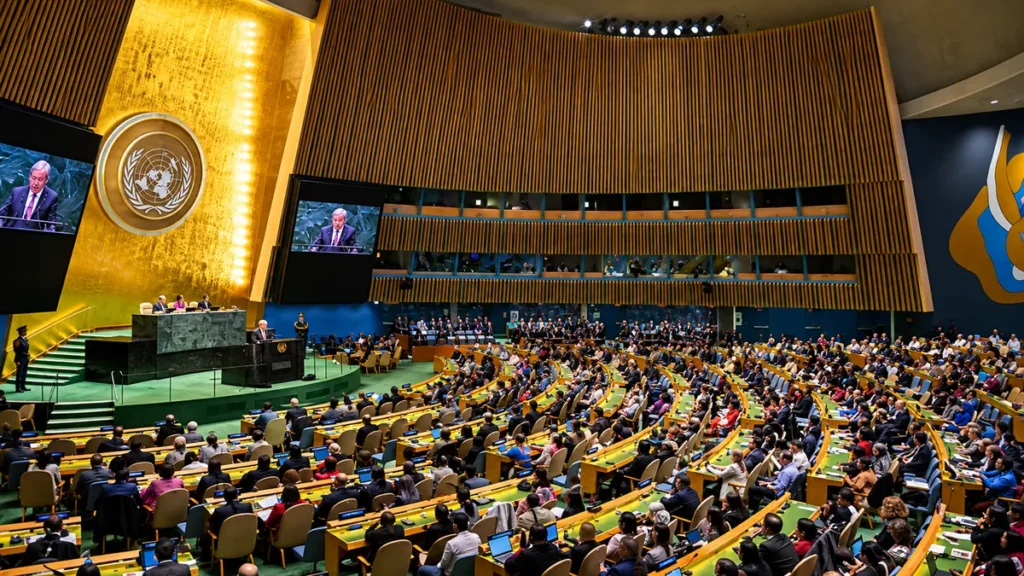
UN Security Council reform has become an urgent necessity. Armine Margaryan argues that the current system of permanent membership and veto power prevents the United Nations from managing conflicts and maintaining peace.
The Question of the UN Security Council’s Permanent Members Is a Key Part of the Problem
She noted that it was no coincidence that the overarching theme of this year’s General Assembly was “Restoring Trust and Managing Transformation.” According to her, restoring trust also means restoring confidence in the United Nations, while managing transformation means managing the changes taking place in the global order.
“The organization has long failed to demonstrate its viability according to the logic for which it was originally created, particularly to manage conflicts and bring peace to the world. Today, it is unable to fulfil that function,” Margaryan said.
According to her, one important part of the problem concerns the permanent members of the UN Security Council. For a considerable period, the Security Council has been unable to adopt resolutions addressing transformations in the global order, conflicts, armed confrontations and the peace agenda.
Margaryan recalled that discussions about the need to restructure the United Nations began long ago. She said many countries believed that they should also become members of the Security Council with veto power.
In her assessment, however, the issue has become more urgent this year. Through their discussions, the parties will attempt to determine how the United Nations should be restructured so that it can perform its primary function of ensuring global peace and security.
The UN Does Not Provide Security Guarantees to Small States Either
Addressing the question of what security guarantees the United Nations provides to small countries, including Armenia, under current conditions, Margaryan said that no such guarantees existed today.
“The United Nations currently provides no security guarantees to small countries. Nor does it provide any security guarantees to large or powerful states,” she said.
According to Margaryan, a trend towards developing strategic partnerships emerged after the Cold War. This was particularly relevant to small and vulnerable states and to countries that did not wish to join any particular bloc.
In her assessment, when international legal orders and mechanisms are not functioning and the United Nations cannot provide security guarantees, one of Armenia’s primary instruments should be the expansion of its network of strategic partners.
“In other words, Armenia should avoid dependence on a single strategic partner, establish interconnections with various power centres and strategic partners, and normalize relations with its neighbours. This could ultimately enable Armenia to address a variety of security challenges,” Margaryan said.
She emphasized that this involved a comprehensive understanding of security.
“Might Makes Right,” but International Law Remains a Tool
Margaryan agreed with the observation that the current geopolitical situation corresponded to some extent to the notion of a “jungle world.”
As examples, she cited the wars between Iran and the United States and between Russia and Ukraine, the Russia-Georgia war, the annexation of Crimea, the ethnic cleansing carried out by Azerbaijan in Artsakh, and the occupation of the sovereign territories of the Republic of Armenia.
“We can cite many such examples. And yes, for a considerable time, it has appeared that might makes right, that might makes right,” she said.
At the same time, Margaryan emphasized that despite the current situation, international law remained an accessible instrument for small states.
“Nevertheless, law — international law — continues to serve as a tool for small states. It depends on how effectively a particular state is able to use that tool,” she said.