
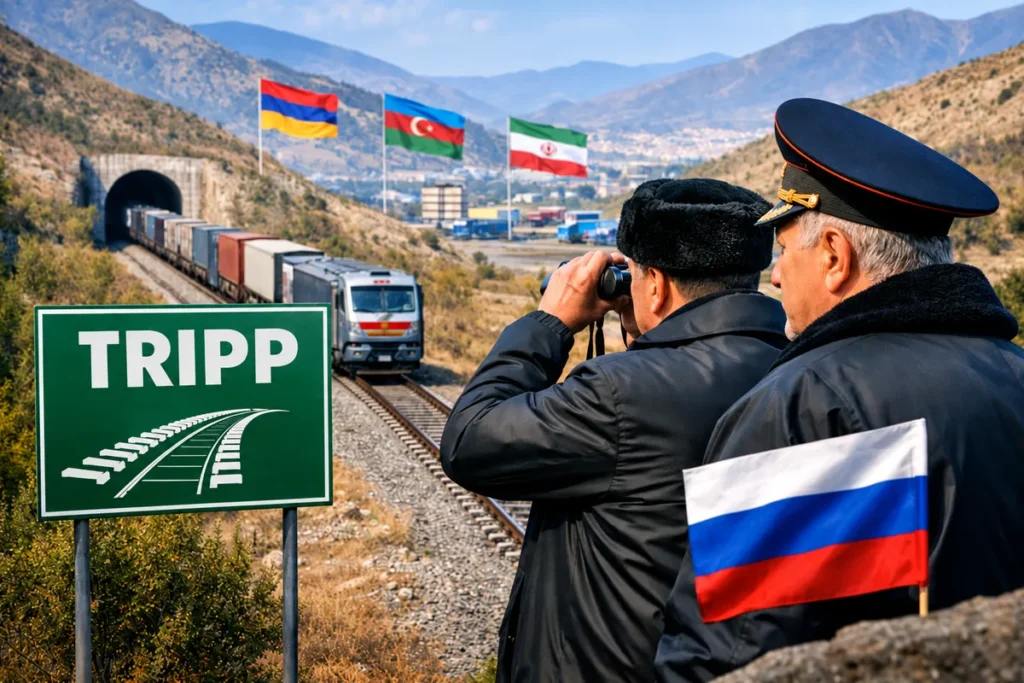
Armenia is exploring how the TRIPP project might connect with the Middle Corridor while raising a separate question about the Russian concession to operate its railway. Kazakhstan’s President Kassym-Jomart Tokayev has publicly proposed linking the two transport initiatives. Reports that Yerevan offered Kazakhstan and Kyrgyzstan shares in TRIPP, however, have not been confirmed by Armenia.
Following a call between Prime Minister Nikol Pashinyan and Tokayev, a Kyrgyz outlet reported, without naming an official source, that Kazakhstan and Kyrgyzstan had each been offered a 5% stake in TRIPP. In a written response to RFE/RL’s Armenian service, an Armenian ministry said an equity-for-investment arrangement was neither envisaged nor under consideration. Possible participation by other countries in a transport project should therefore not be presented as an agreed transfer of ownership. azatutyun.am
Separately, Pashinyan has questioned Russia’s continued role in managing Armenia’s railway. One scenario under discussion would involve transferring the Russian concession to a third country friendly to Moscow. The prime minister has said Yerevan would not object to Kazakhstan taking over management, but no such transfer has been agreed. azatutyun.am
Kazakhstan sees value in connecting routes
At the first Central Asia–Republic of Korea summit, Tokayev proposed considering a connection between the Trans-Caspian International Transport Route, known as the Middle Corridor, and TRIPP.
He set two distinct ambitions: raising total transit through Kazakhstan to 100 million tonnes and expanding Middle Corridor capacity to 20 million tonnes. Combining the routes, he suggested, could help form a transport chain from Korea through Central Asia to Europe. His remarks expressed interest in integration; they did not announce an agreed TRIPP ownership arrangement. news on Tengrinews.kz
Kazakh analyst Damir Kayumov describes Astana’s interest in practical terms. As a landlocked country, Kazakhstan benefits from having several reliable routes to foreign markets. The value of any new link would depend on its integration with the existing network, including coordinated tariffs, digital border procedures and predictable delivery times. Formal participation alone would bring limited benefit.
Political analyst Tahir Naumov points to another potential effect: countries using the same corridor acquire a shared interest in reliable agreements and in the stability of their partners.
New links could strengthen the Middle Corridor
Pashinyan has said that the Akhalkalaki–Kars railway and Azerbaijan’s rail network are available for Armenian foreign trade. The upgraded Baku–Tbilisi–Kars line has also entered full operation, with stated annual capacity rising from 1 million to 5 million tonnes. This is an increase for that railway, not a fivefold expansion of the entire Middle Corridor. 1tv.ge
Transport businesses are watching the changes. Iveta Dimitrova of Bulgaria’s Port of Burgas says shippers are seeking alternative links between Europe and Asia, increasing the Black Sea region’s importance. Christian Hirschmann of logistics company Azurite sees the potential for a change in transport geography, while stressing that substantial investment in railways and Caspian ports would be needed before the Middle Corridor could seriously compete with the northern route through Russia. Wochenzeitung Verkehr
TRIPP could provide another overland option after freight reaches Azerbaijan, continuing through Armenia. Freight moving from Kazakhstan along the Trans-Caspian route would still cross the Caspian Sea. Connecting TRIPP to that route would therefore not create an uninterrupted land journey from Central Asia to Europe.
More options do not imply ending trade with Russia
German Council on Foreign Relations expert Stefan Meister notes that the Russian market remains important for Armenian products. Jakob Wellenstein of the Konrad Adenauer Foundation likewise describes an Armenian preference for stronger Western ties without a complete break with Russia.
TVP World commentator Stuart Dowell views Armenia and Kazakhstan as countries seeking a broader choice of external partners. Their methods differ, but both are trying to reduce reliance on a single direction. Developing alternatives, in this reading, does not require an immediate abandonment of existing ties.
For now, connecting TRIPP with the Middle Corridor and changing the operator of Armenia’s railway remain distinct questions. Kazakhstan has publicly expressed interest in the former. Yerevan is examining scenarios for the latter, but no transfer of the rail concession has been agreed. Nor has an equity transfer in TRIPP to Kazakhstan or Kyrgyzstan been confirmed. The central question is whether Armenia can expand its transit options while preserving useful economic ties with Russia.
👉 Politics