
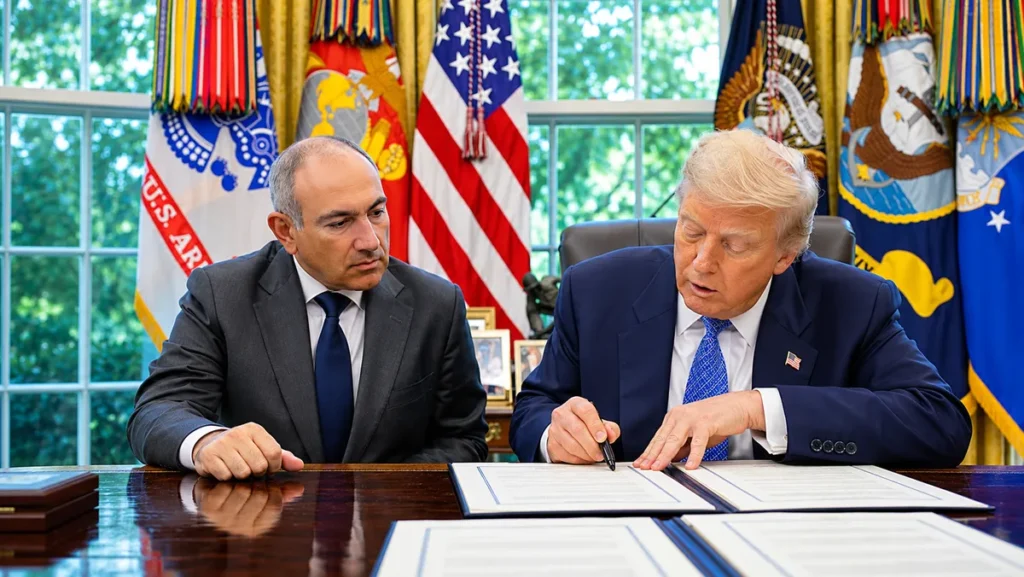
A Democratic victory in the United States will not mean a significant change in Washington’s policy in the South Caucasus. There is a bipartisan consensus on US policy toward Armenia, while regional projects serve long-term American strategic interests. Political scientist and US affairs expert Suren Sargsyan made this assessment while discussing Washington’s possible regional policy after the congressional elections.
Congressional elections will not change the approach to Armenia
In Sargsyan’s view, Iran and Russia may have a greater influence on the implementation of regional projects. Their progress could depend, in particular, on issues related to Iran and on questions about the use of Russian railway infrastructure.
“There is a consensus-based approach to Armenia that these projects must be implemented. Democrats may not like the name ‘Trump Route,’ but the idea is theirs as well: advancing American interests,” Sargsyan said. According to him, the project would remain even if the US administration changed in 2028. It might simply have another name or be presented under the new administration’s political brand. The political scientist stressed that the Trump Route should be seen as one part of a broader regional project that the United States has considered since the collapse of the Soviet Union.
The Trump Route: an idea dating back to the 1990s
According to Sargsyan, the policies of successive US administrations in the South Caucasus should be viewed in the context of a strategy developed over decades. He emphasizes that the project now called the Trump Route is not a new idea. The approaches underlying it were discussed as early as the 1990s, after the collapse of the Soviet Union.
“The Trump Route is the same phenomenon that the Bush administration spoke about beginning in the 1990s. There are clear records concerning this idea, including a transcript of a meeting with the Turkish president in which an exchange of Syunik for Artsakh with Azerbaijan was discussed,” Sargsyan said.
He says one of Washington’s strategic aims is to transport Central Asia’s energy and other resources to Europe through the South Caucasus, bypassing Russia and Iran. In his assessment, the United States also wants to prevent those resources from coming under Chinese, Russian or Iranian control. Sargsyan recalled that Washington has worked steadily with Central Asian countries, including Kazakhstan and Turkmenistan, since the 1990s to promote regional connections. He also mentioned the Goble Plan, which he considers part of the same strategic thinking.
“This is a US national interest that they have tried to advance for years. It is not the policy of one party or another; it is the policy of the United States government,” the political scientist said. In his view, the Trump administration has simply tried to advance long-standing ideas under current conditions. Similar proposals have previously come from political leaders, experts and other actors.
Washington’s view of the South Caucasus
Discussing the political and economic environment Washington would prefer in the South Caucasus, Sargsyan said the United States would like to see a region with a unified foreign policy and shared strategic goals. As an example, he cited the Baltic states — Latvia, Lithuania and Estonia. In the 1990s, they approached the United States together and expressed their shared aim of joining NATO and the European Union.
Creating a similar common approach in the South Caucasus is more difficult. The region’s countries have different interests, and several major outside powers influence them: Turkey, Iran and Russia. According to Sargsyan, Turkey is a strategic US ally and Iran is an adversary. Russia’s position is more complicated today, ranging from competition to confrontation. Georgia’s particular domestic and foreign policies also make it harder to view the region as a single whole.
“It is not possible today to regard the South Caucasus as one unified region. The countries have different interests, and there are also many major players around them,” he said. Sargsyan believes the United States must account for these complexities and shape its regional policy around both the interests of individual countries and the influence of outside powers.
👉 Politics