
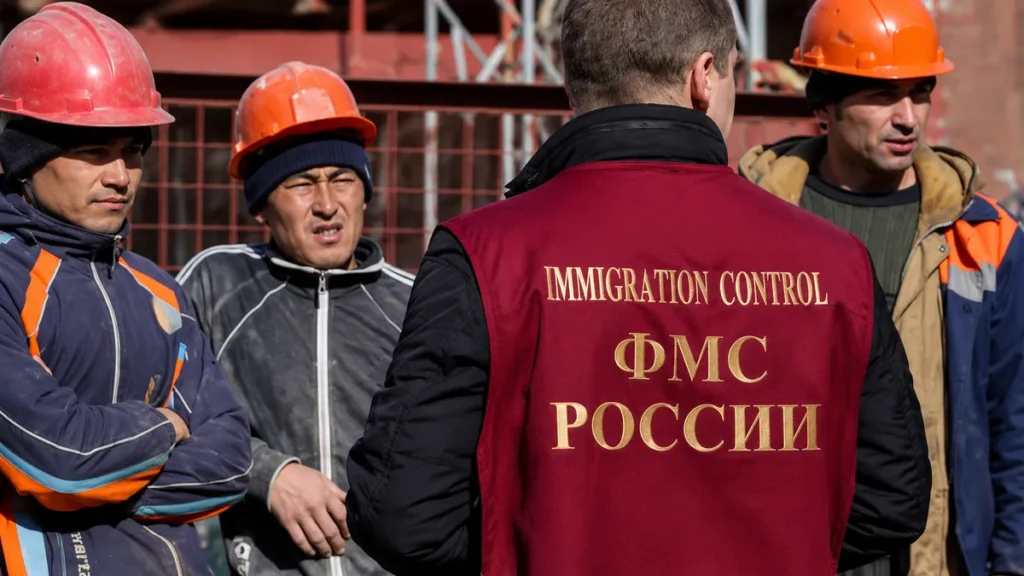
New rules tightening Russia’s migration legislation came into force on November 3. They significantly expand the grounds for the administrative expulsion of foreign nationals. The number of such grounds has risen from 22 to 45. Fines have also increased, while expulsion has become a mandatory penalty for some violations.
According to migration expert Tatevik Bezhanyan, the changes that took effect in November continue the steady tightening of migration policy pursued by Russia since 2025. In her assessment, Russia introduces new restrictions on foreign nationals’ presence, residence and employment almost every month.
The amendments have expanded the grounds both for administrative expulsion from Russia and for inclusion in the registry of monitored persons. “There are things that previously might have resulted only in a fine, but now, in addition to a fine, they can end in expulsion from the country. And the police can do this without a court decision,” Bezhanyan says. According to her, failure to obey the lawful demands of a Russian serviceman at the Russian border, for example, could lead to expulsion.
Bezhanyan also draws attention to the possibility that the new restrictions may, in practice, limit foreign workers’ ability to protest. For example, if an employer fails to pay wages and workers decide to organize a protest, their actions could be treated as a violation of migration law. The expert says that failing to consider the nature and reasons for such a protest could create legal problems for its participants.
An EAEU employment benefit that can become a risk
Discussing the status of Armenian citizens, Bezhanyan says she is regularly asked what advantages Armenia’s EAEU membership gives them in Russia. According to her, citizens of EAEU member states do not need a work permit to work in another member country. It is enough to conclude an employment contract or a civil contract for services with an employer. This gives them some flexibility: if relations between worker and employer do not work out, they can terminate the contract, and an Armenian citizen can move to another Russian region and sign a contract with a new employer. They have 15 days to do so.
The expert says this is an advantage compared with workers who require work permits, as those permits are tied to a particular area and job. For Armenian citizens, however, the right to remain in Russia legally depends to a considerable extent on having an employment contract.
Bezhanyan says cases have recently become more frequent in which employers terminate contracts unilaterally without informing workers. As a result, a person may discover only a month later that they have been placed in the registry of monitored persons because taxes were no longer being paid on their behalf and their employment contract had already ended. “The absurdity is that the employer is fined for this, while the worker is expelled. In other words, our citizen can be expelled straight from a police station; no court decision is needed,” the expert emphasizes.
In her assessment, the EAEU benefit of not needing a work permit can thus turn into a risk in some situations: a worker may lose the basis for remaining in Russia legally without learning about it in time.
Higher fines and harsher consequences
Bezhanyan also addresses the increase in administrative fines. Article 18 of Russia’s Code of Administrative Offenses covers matters related to violations of the rules for staying and residing in the country.
According to her, before November 3, fines for the relevant violations ranged from 2,000 to 5,000 rubles. Under the new rules, they range from 4,000 to 7,000 rubles. At the same time, the range of violations for which a fine may be accompanied by expulsion has expanded.
The expert recalls that Russia previously imposed different periods of entry bans depending on the length of an unlawful stay. In particular, an unlawful stay of up to 90 days could lead to a three-year ban; a stay of 90 to 180 days, a five-year ban; and a stay of 180–270 days or longer, a ten-year ban.
A provision also remains in force allowing an entry ban to Russia for two or more administrative offenses committed within three years. Bezhanyan says Armenian citizens should pay serious attention to this restriction as well.
Armenia should strengthen protection for citizens abroad
Discussing what Armenia should do in response, Bezhanyan stresses the importance of strengthening state mechanisms for protecting the rights of citizens abroad. She says Armenia’s Constitution obliges the state to protect its citizens’ rights both at home and outside the country, but in practice that protection is not always adequate.
In the expert’s view, because Russia remains one of the main destinations for labor migration from Armenia, the country needs a representative there whose direct responsibility would be to protect the rights and interests of Armenian migrant workers.
Bezhanyan does not rule out the need for similar labor attachés at Armenian embassies and consulates in other countries if labor migration to those destinations also increases. She believes, however, that priority should be given to places where the largest numbers of Armenian citizens are present.
She proposes drawing on other countries’ experience to establish an effective institutional mechanism for protecting migrant workers’ rights, rather than treating the current limits of consular services as a reason for inaction. “We do not protect a citizen’s rights merely by issuing a document. Those rights must also be protected on the ground,” Bezhanyan emphasizes.
According to her, Armenian consulates should do more than provide documentation services on migration and citizenship matters. The state should be able to offer meaningful assistance to its citizens abroad, including when they encounter problems in employment relationships, disputes with employers or difficulties arising from violations of migration law.
👉 Law