
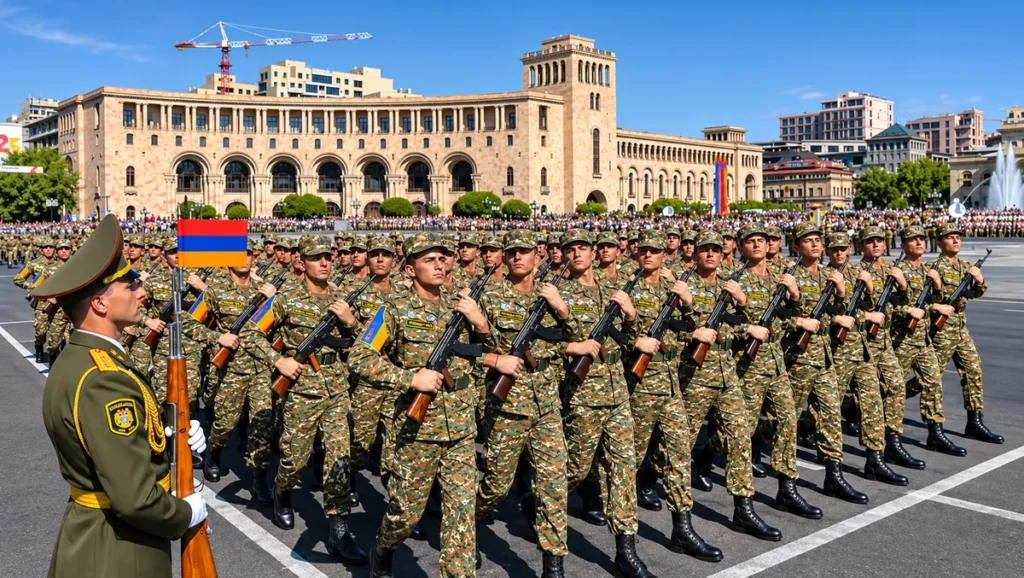
Armenia’s draft Constitution, published on November 23, proposes significant changes to how the country manages its defense and armed forces. It would make the prime minister commander in chief in peacetime as well as in wartime. The draft omits the provision on the Security Council and changes how decisions on the use of the armed forces are made. It also establishes peace as an objective of Armenia’s foreign policy.
The proposed changes raise several fundamental questions: how Armenia can maintain its ability to defend itself, who makes military decisions and bears responsibility for them, and what guarantees can help preserve peace.
A clearer chain of command could make military reforms more effective
Military expert Leonid Nersisyan said the effectiveness of the proposed constitutional changes would depend largely on how they are implemented. The prime minister, as a representative of civilian authority, cannot intervene in every minor decision that requires military expertise. Nor is there a need to do so. But giving civilian leaders more effective ways to push for change could improve the implementation of military reforms.
“When we’re talking about reforms, the ability to apply stronger political pressure can make them somewhat more effective. The question is how the process will actually unfold if this Constitution is adopted,” Nersisyan said. He said the draft sets out a clearer chain of command, from the prime minister to the defense minister and then to the chief of the General Staff of the armed forces. That hierarchy was less explicit in peacetime before, he said.
In his view, such a system makes it possible to set clearer requirements for reforms, including what they should address and when they should be carried out. Nersisyan added that most countries organize military command along broadly similar lines.
What could replace the Security Council?
Asked about the absence of a provision on the Security Council and how military, intelligence and foreign policy decisions might be coordinated, Nersisyan said it was too early to do more than speculate. The draft does not spell out those arrangements.
One option, he said, would be to create a national security adviser post and an accompanying office within the government. Another would be to appoint a national security adviser reporting directly to the prime minister. Nersisyan said many countries use such an approach.
He noted that although the Security Council is provided for in the current Constitution, its functions in practice have been fairly limited. At times, he said, it acted as little more than a formality. “Its main function, as we saw it, was to hold meetings that brought together everyone making decisions in this area. There were also attempts to draw up several documents, but for various reasons they were never published,” he said.
In his assessment, if a national security adviser post were created, the new body’s functions would not differ significantly from those the Security Council has performed, even in the worst case.
Parliament’s powers over the use of the armed forces
Nersisyan also sees no problem with the provision allowing the prime minister to decide on the use of the armed forces in an emergency without a proposal from the defense minister. The National Assembly’s consent would not be required to use the armed forces to defend Armenian territory.
He stressed that this applies to the defense of Armenia’s territory. Military operations outside the country, he said, would require the National Assembly’s consent. In his view, the aim is to avoid delaying decisions in situations that call for a rapid response.
“This isn’t such a major change. If anything, it adds a restriction. Even before, there was no need to convene a session of the National Assembly to begin defensive action at the border. But parliament’s permission wasn’t needed to maintain an Armenian military presence outside the country either, for example in Kosovo or anywhere else,” Nersisyan said.
The prime minister would bear primary responsibility for military decisions
Discussing how quickly military decisions should be made and who should answer for mistakes, Nersisyan stressed the need to define authority and responsibility clearly at each level of command.
He said that if a defense facility is attacked or an act of sabotage occurs, units on the ground must respond immediately. They should not have to wait for a decision from the prime minister, the defense minister or the chief of the General Staff.
In his view, those officials should make broader decisions at the operational level or above.
Authority and responsibility can be assigned years before hostilities begin through defense plans drawn up, agreed and signed in advance.
If Armenia comes under attack, such plans would allow the relevant units to carry out their assigned tasks without waiting for fresh decisions from senior leaders.
As for ultimate responsibility for military and strategic decisions, Nersisyan said it would rest with the prime minister.
“If the prime minister is the person in charge, then he also bears the greatest responsibility. That doesn’t mean mistakes can’t be made at other levels. But he is responsible for major strategic decisions,” the military expert said.
👉Law