
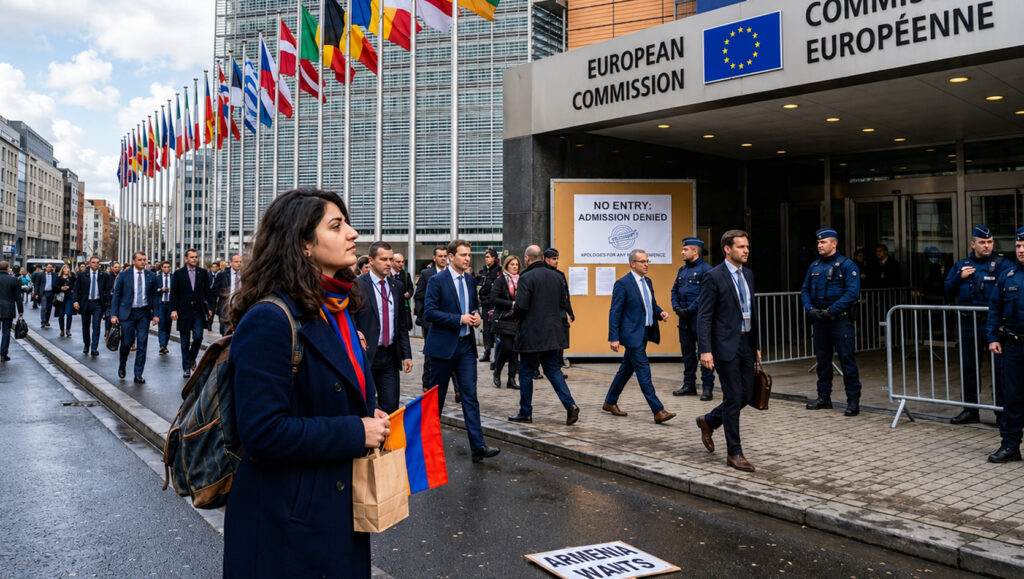
Armenia’s statements about joining the European Union are in reality political rhetoric rather than a realistic prospect, political scientist Alen Ghevondyan said. According to him, the EU currently not only lacks a clear enlargement agenda but is itself facing serious internal problems.
“Armenia’s statements about joining the EU are a thesis that provokes loud laughter,” Ghevondyan said, noting that serious disagreements exist within the European Union, including economic and political disputes as well as divisions over the war in Ukraine.
Europe Itself Is Facing Major Changes
The political scientist also draws attention to domestic political developments in the EU’s leading countries.
According to him, changes of government are expected in several European states, which could significantly affect the union’s policies.
As an example, he points to France, where, in his view, upcoming political developments could result in a change of government.
Ghevondyan also refers to Germany’s economic problems and the overall condition of the European economy.
In his assessment, Germany’s position has weakened considerably, while Poland has recently assumed a more confident role in regional and European politics.
According to the political scientist, the emerging new balance between Warsaw and Berlin indicates that Europe’s previous distribution of power is changing.
Ghevondyan also does not rule out the possibility of further escalation of the war in Ukraine.
At the same time, he believes the likelihood of Russia attacking NATO is low because modern Russia, in terms of its influence and resources, is not comparable to the Soviet Union.
“Russia does not have the influence in the modern world that the Soviet Union once had,” the political scientist said, also emphasizing changes in resources, the system of governance and the political elite.
Russia Wants an EU Membership Referendum to Take Place
Ghevondyan argues that Armenia’s statements about EU membership are in reality “fake” and that the Russian side understands this as well.
However, Russia continues to insist on holding a referendum on EU membership because, according to him, it is interested in such an act taking place in Armenia.
The political scientist explains that if a referendum is held, Moscow could present its possible subsequent actions as a response to the choice made by Armenian citizens.
“Russia needs the act of an EU membership referendum to take place so that its subsequent actions will be legitimate,” Ghevondyan said.
According to him, under this logic Russia could declare that Armenia had consciously decided to move toward the European Union and that Moscow’s response should therefore be viewed in the context of that choice.
At the same time, he considers this process dangerous in terms of its possible geopolitical consequences for Armenia.
Political Scientist Does Not Rule Out the Risk of Armenia’s “Partition”
According to Ghevondyan, if geopolitical tensions deepen, Armenia could find itself at the center of a clash of interests among different powers.
He warns that if the process gets out of control and Armenia falls into a serious geopolitical crisis, various actors could try to take advantage of the situation.
He refers to the possible danger of Armenia’s “partition” or “Adjarization,” in which different external actors could attempt to carve out zones of influence for themselves on Armenian territory.
In Ghevondyan’s assessment, this is precisely why Armenia’s foreign policy decisions should be evaluated not only in terms of their immediate political impact but also from the perspective of their possible long-term consequences.