
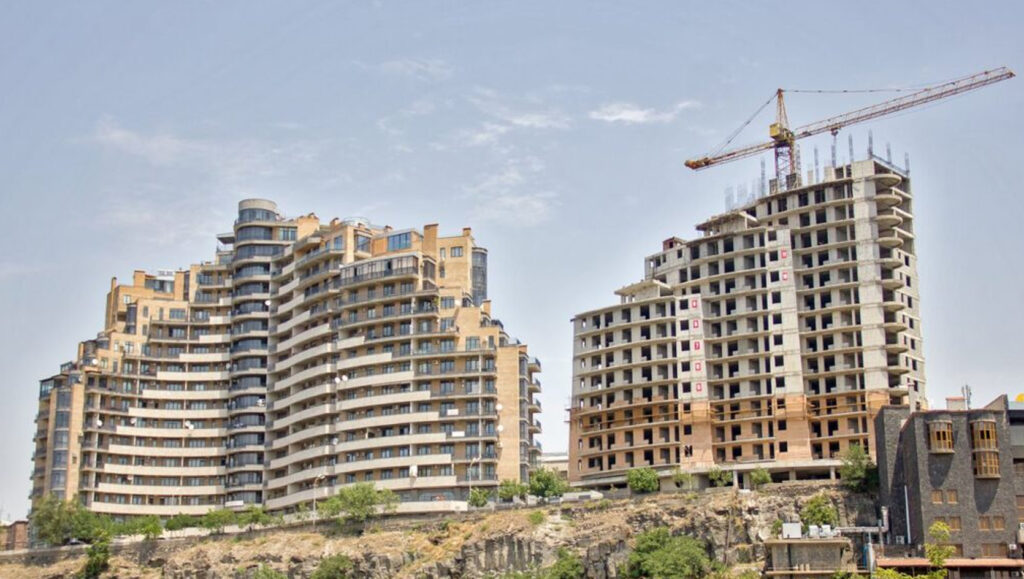
Real estate prices in Armenia are not only refusing to decline but continue to rise. In recent months, the number of transactions in the new-build market has roughly doubled, while prices have increased by around 15%. Despite earlier forecasts that the market “bubble” would burst after the flow of Russian relocants subsided and lead to a crisis, the market remains active.
According to Hakob Baghdasaryan, president of Aktsern Holding, a company operating in the real estate market, current market activity is driven by several factors, one of which continues to be the flow of people arriving from Russia.
He said the Russia-Ukraine war has still not ended. Moreover, new risks of escalation and another intensification of the war have recently emerged.
For this reason, the flow of relocants has not stopped. People continue to arrive in Armenia, some leave, but the overall movement remains.
Citing figures published by the media, Baghdasaryan said around 20,000 entries are recorded daily at the Armenian-Georgian border.
“This is somewhat similar to the flow seen in February 2022. In other words, the issue has not been resolved, and the situation related to Russia now looks almost as if the war had just begun,” he said.
Another important factor affecting the market, according to Baghdasaryan, is growing distrust toward savings kept in Russia.
Concerns over a possible default, the freezing of funds and the security of savings are gradually deepening, in his assessment.
He noted that one manifestation of this process is already visible in the form of increasing outflows of funds from banks.
Some of the money being moved out of Russia naturally ends up in Armenia as well.
The impact of the inflow from Russia is reflected primarily in the rental market.
The increase in rental activity and higher rents, in turn, affect the housing sales market.
“When the rental price of an apartment in the same category rises, it automatically puts pressure on the market and cannot fail to affect property that is already under construction or being sold,” Baghdasaryan said.
At the same time, he said a recent trend has emerged in which property in Armenia is being purchased not only by Armenians from Russia but also by ethnic Russian citizens of the Russian Federation.
Baghdasaryan also links this to the prolonged nature of the war.
The war is now in its fifth year, and under these circumstances Armenia may be viewed by Russian citizens as a reserve country for permanent or temporary residence, as well as for conducting business.
“The war has dragged on. It is already in its fifth year, and naturally, for people holding Russian citizenship, Armenia can serve as a reserve country, whether for permanent or temporary residence or for conducting business,” he said.
Baghdasaryan also confirms the increase in real estate prices and transactions recorded in recent months.
According to him, data from Aktsern Holding also indicate an approximately 15% rise in prices and an increase in the number of transactions.
However, he stresses that activity in Armenia’s real estate market is not driven solely by the Russian factor.
Iran Is Also Affecting the Real Estate Market
Another important factor, according to Baghdasaryan, is the Iranian market.
As Iran’s economic situation deteriorates and its national currency continues to depreciate, the Republic of Armenia is increasingly viewed by Iranian citizens as a country offering additional financial and business opportunities.
According to him, the flow from Iran to Armenia mainly involves business capital.
Iranian citizens are looking for opportunities to conduct business in Armenia, which in turn has a certain impact on the real estate market.
Baghdasaryan notes, however, that moving financial resources out of Iran is more difficult than moving them out of Russia.
In Russia’s case, he said, various mechanisms make the movement of funds easier.
New Economic Sectors Are Also Supporting the Market
Among the other factors contributing to market activity, he also highlights the development of air transportation and the emergence in Armenia of economic subsectors that either did not previously exist or were significantly less developed.
Thus, according to the specialist, the current growth of Armenia’s real estate market is not driven by a single factor.
Developments related to Russia and Iran, capital inflows, activity in the rental market, interest in Armenia as a place to conduct business and the development of new economic sectors together continue to support demand for real estate.