
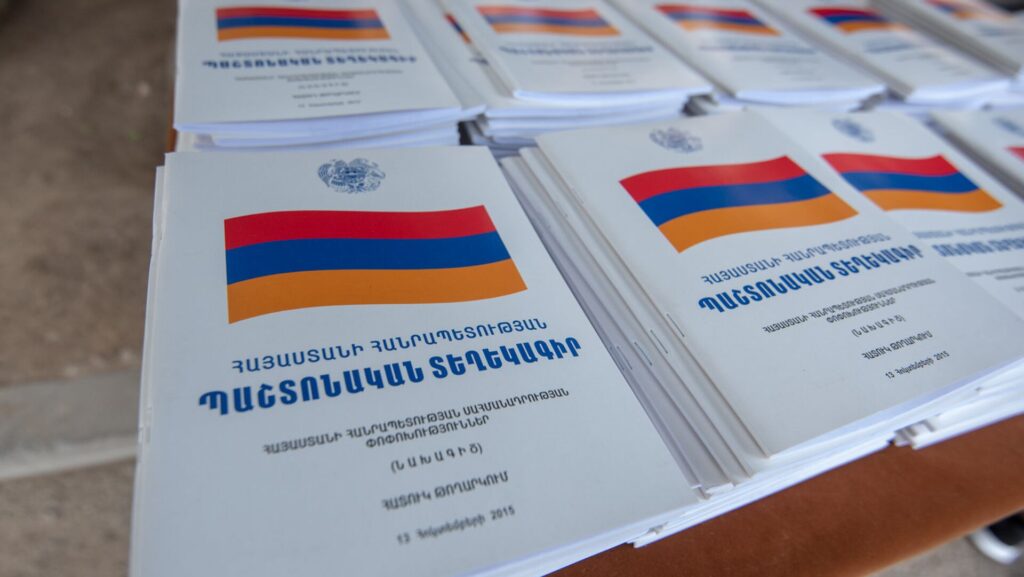
Amendments to the Constitution of the Republic of Armenia cannot be carried out under external pressure or dictate. This was stated by Arthur Sakunts, a member of the constitutional reform commission and a human rights defender. He stressed that such an approach is unacceptable from both legal and political perspectives.
According to him, no state — whether Azerbaijan, the United States, or the Russian Federation — has the right to impose constitutional changes on the people of Armenia. Sakunts described such a scenario as absurd. However, even the perception of external influence can seriously undermine public trust in the constitutional process.
He also emphasized the importance of maintaining trust in the referendum. In his view, society should not develop the belief that changes are driven by external forces. If these concerns remain unresolved, they could have serious consequences for the legitimacy of state institutions.
The Declaration of Independence as a foundation
Sakunts clearly stated that the reference to the Declaration of Independence must not be removed from the preamble of the new Constitution. He considers this important both for restoring public trust and for substantive reasons.
He recalled that the document adopted on August 23, 1990, is a foundational act of Armenian statehood. It enshrines key principles such as human rights, democracy, and state sovereignty.
Although some provisions of the declaration have lost practical relevance over time, it retains its legal and historical significance. According to Sakunts, Armenia’s legal system was built on this document. Its principles are already embedded in the current Constitution.
Discussion on substance, not external agendas
The human rights defender stressed that discussions on constitutional amendments should focus on substance. They should not become tools influenced by interstate relations.
He noted that there are attempts to shift public discourse by focusing on specific provisions while ignoring other essential parts of the Constitution. He finds it particularly concerning that only one issue dominates the discussion.
Sakunts also pointed out that the current Constitution was adopted under previous authorities. In his view, it does not ensure full democratic governance. Even after the 2018 changes, systemic issues remain unresolved.
Gaps in democratic governance
Sakunts highlighted structural problems in the system of governance. He noted that the balance between branches of power is insufficient.
He warned that the dominance of a political majority in a parliamentary system may lead to a situation where the legislature stops performing its oversight role. As an example, he referred to a period when the opposition boycotted parliament, yet the legislative process continued unaffected.
According to Sakunts, such a system cannot be considered a full guarantee of democracy. Constitutional reforms should aim to address these systemic issues rather than focus only on politically sensitive topics.