
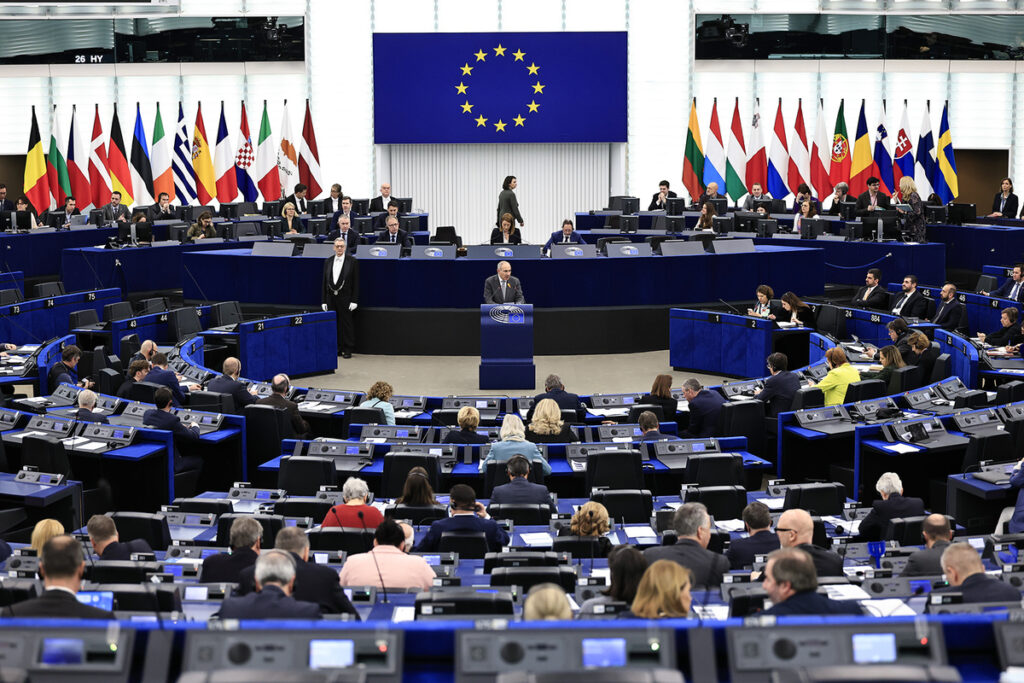
During his speech before the European Parliament in Strasbourg, Armenian Prime Minister Nikol Pashinyan spoke about the prospects of integration with the European Union. At the same time, he referred to a regional factor that, in his view, somewhat complicates that process. He mentioned relations between Georgia and the EU, which, according to political commentator Hakob Badalyan, appeared in Pashinyan’s speech not by accident.
The Georgian factor as a political “provider”
According to Badalyan, Georgia has recently become, in some sense, a “provider” of the Armenian-Azerbaijani process. It contributes to shaping the political and propaganda effect of that process for the Armenian authorities. As an example, he refers to the issue of Azerbaijani gasoline transit. Georgia announced that it had set a symbolic fee for the transit of that gasoline to Armenia.
According to the commentator, this raises questions. Why are such preferential conditions applied specifically to Azerbaijani gasoline, while similar approaches are not used for fuel imported from other directions? In his view, Georgia’s role here is obvious. It is possible that Tbilisi expects reciprocal support on European platforms.
The Georgian direction as an “alibi”
According to Badalyan, the emphasis on the Georgian theme also has another meaning for Pashinyan. It may serve as a kind of “alibi” in relations with the European Union. Despite mutual statements about deepening cooperation, distrust and doubts still remain between the sides.
Badalyan notes that in these circumstances the European Union holds a stronger position toward Armenia. According to him, Pashinyan attempts to use the difficulties in Georgia-EU relations as an argument in discussions with European partners. If Brussels expects greater progress from Yerevan, it should also consider its own problems with Tbilisi, which ultimately affect the prospects of regional integration.
The thesis of Armenia’s EU membership as a “fake”
Commenting on assessments that Pashinyan used this narrative for a domestic audience to justify not announcing the launch of the EU accession process in Strasbourg, Badalyan said he does not believe that the issue of European integration represents a serious electoral problem for the prime minister. Although some groups expected the announcement of the EU accession process, he believes those expectations do not create significant political risks for the government.
Moreover, he argues that even among those who hold such expectations, many understand that Armenia’s EU accession process currently has a largely “fake” character due to several political reasons.
For the EU the South Caucasus is a problematic enclave
According to Badalyan, the European Union itself is not particularly interested in having a new member from the South Caucasus. In his view, the region is perceived through an “enclave” logic, which limits its strategic value for Brussels.
“For the European Union, having a member state from the South Caucasus — whether a single country or the region as a whole — does not appear particularly practical. The region exists in a kind of enclave position. If we also consider the factor of Turkey, it can be said that the South Caucasus could realistically think about EU membership only if this issue is resolved for Turkey as well. In other words, when Turkey becomes an EU member. Otherwise, what would be the point for Europe to have such an enclave — taking on greater responsibility but without having equivalent opportunities or benefits,” he concluded.