
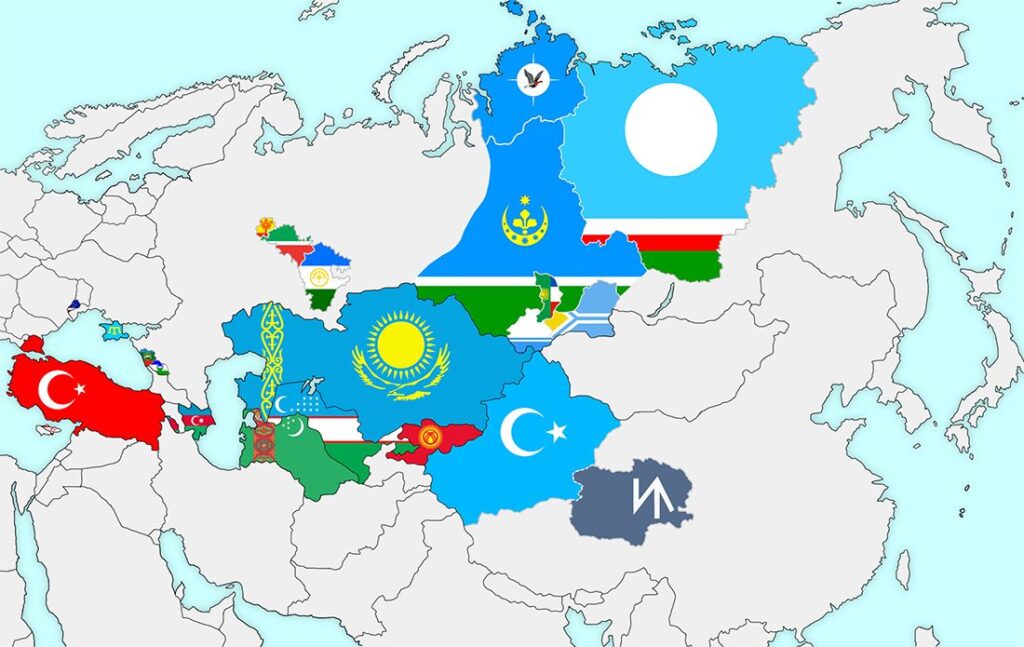
The idea of “Greater Turan” is not only part of Turkey’s strategic agenda. For a long time it has also fit into the plans of Western globalist circles, which is why it has been promoted by them. This opinion was expressed by Turkologist Tiran Lokmagyozyan. At the same time, he emphasizes that those same Western circles have never sought to see a fully formed “Greater Turan,” which could escape control and become an independent center of power.
The “key” lies in Armenia
According to Lokmagyozyan’s interpretation, Armenia plays a central role in this entire process. In his formulation, “whoever holds the key to Armenia also holds the key to Turan.”
He recalls that for a long time Armenia, despite being a small and relatively weak state, possessed significant geopolitical weight because of its location. The country stood at the crossroads of north–south and east–west routes. However, with its “own key” it effectively blocked the east–west route, which fully aligned with the plans of globalist circles to limit the project of “Greater Turan.”
Control of corridors in the hands of the United States
After the re-election of Donald Trump, anti-globalists came to power in the United States, and they had their own vision of how to limit the “Greater Turan” project. Against this background, public discussions about “Turan” in Turkey noticeably decreased. Lokmagyozyan believes the idea itself has not disappeared but has merely been temporarily “frozen,” as has happened at different moments in history.
According to him, the approach of the new American administration was reflected in the TRIPP project, under which the “key of Armenia” would pass into the hands of the United States. In his view, the TRIPP route will function according to a corridor logic, and its “opening and closing” will depend exclusively on decisions made in Washington.
Nevertheless, he notes that such a configuration, despite its negative aspects, currently reduces the risks around Syunik. According to his reasoning, if Turkey or Azerbaijan were to attempt direct control over Syunik, the need for external powers to manage routes passing through that territory would disappear, which would contradict US interests.
In this context, he suggests that the direct transfer of Syunik to other players does not appear to be part of the current American strategy, since that would reduce leverage in the region. However, he stresses that politics is dynamic and such assessments apply only to the present configuration of circumstances.