
Since Armenia’s independence, one dominant thesis has long prevailed in the country’s political field: the global West has no real interests in the South Caucasus or the post-Soviet space — neither economic nor security-related — and its sole purpose is to create problems for Russia. As a result of this perception, the only possible path for Armenia’s security and development was seen in the security architecture and economic cooperation offered by Russia. This is the view held by Yuri Avagyan, director of the Restart Foundation.
According to him, this thesis formed the foundation of both public and political thinking for many years. However, the events of recent years have blown up this political construct.
Failure to fulfill obligations and a crisis of trust
The 2020 war, the ethnic cleansing of Armenians from Artsakh in 2023 in the presence of Russian peacekeepers, as well as the well-known incidents along the Jermuk direction, demonstrated that Russia failed to fulfill its obligations — both within the CSTO framework and under the bilateral allied treaty with Armenia.
Avagyan pays particular attention to the issue of arms supplies. According to him, Armenia had paid the Russian side, but the corresponding weaponry was not delivered. This was officially or semi-officially justified by the war in Ukraine, yet recently the President of Russia publicly stated that Russia had carried out military supplies to more than 30 countries.
“This clearly showed that the problem was not general, but was being created specifically in Armenia’s case,” Avagyan notes.
Diversification — belated and forced
Only after this situation did the Armenian authorities begin searching for alternative paths, including arms procurement from India, France, and other countries. In Avagyan’s assessment, this was not a deliberate balancing policy, but rather a belated and forced step.
He is convinced that it is precisely this logic that led to the freezing of Armenia’s participation in the CSTO. Other actors feared that military technologies shared with Armenia could end up under Russian control.
“The entire diversification process, to put it bluntly, once again followed the logic of ‘hindsight is 20/20’ for Armenians — after tragic consequences had already occurred,” Avagyan emphasizes.
Narratives built on fears and the Iran topic
According to Avagyan, any process aimed at reducing Armenia’s dependence on Russia encounters active resistance. This resistance is often expressed by playing on public fears.
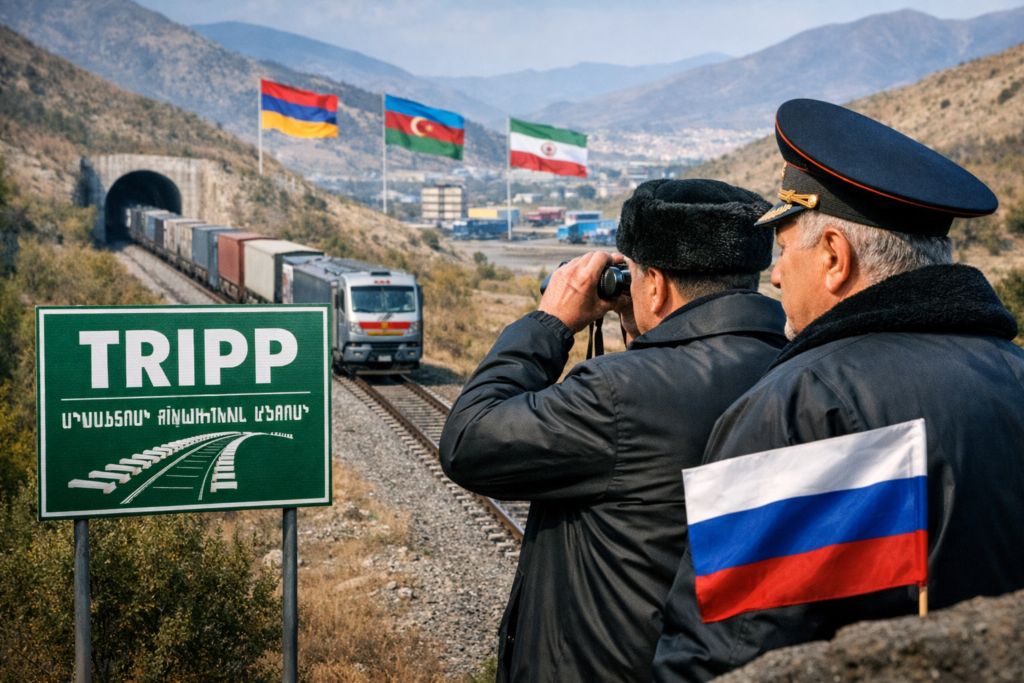
Recently, a new narrative has been circulating claiming that the goal of certain initiatives, including the TRIPP infrastructure project, is to initiate anti-Iran processes and endanger the Armenian-Iranian border.
However, in Avagyan’s view, these interpretations do not correspond to reality. He notes that both the European Union and the United States have for years clearly understood that Armenia already has problems with two of its four immediate neighbors and that neither has any interest in dragging Armenia into processes that could create problems with Iran as well.
Consensus within the global West
“There is generally no demand or expectation in the US or the EU for Armenia to participate in anti-Iranian processes,” Avagyan states. According to him, the position that Armenia neither wants nor is capable of engaging in such scenarios is a consensus view across the global West and is not even a subject of discussion.
Thus, in Avagyan’s assessment, the fears circulating around security and foreign policy diversification are largely the result of information manipulation and do not reflect real geopolitical calculations.