
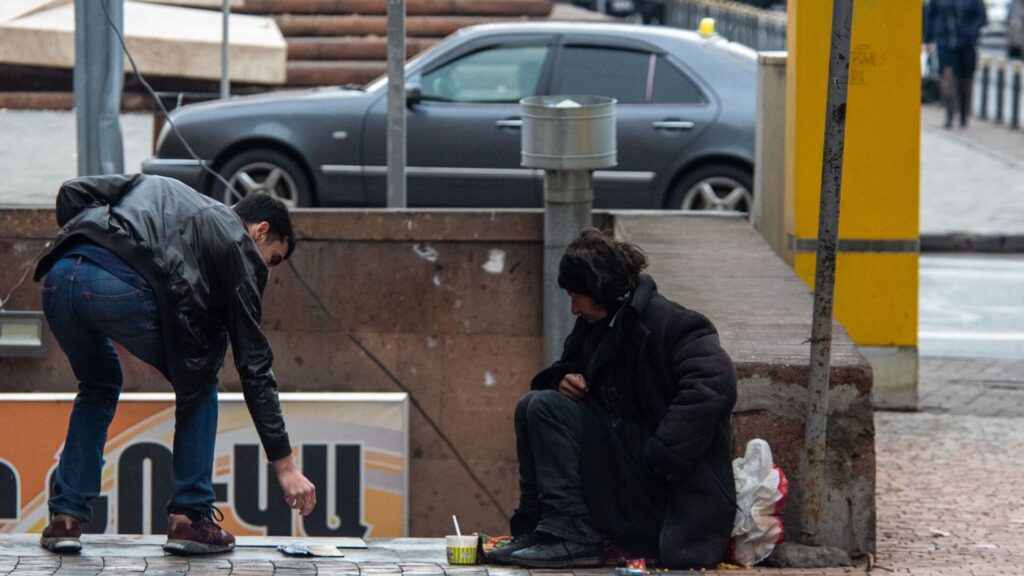
The World Bank, together with Armenia’s National Statistical Committee, has recently published a new assessment of poverty levels — and its findings are far more alarming than expected. The data reveal a deepening social divide and show that a significant share of the population continues to live in conditions of instability and vulnerability.
Almost Half of Armenians Live on the Edge of Poverty
The published figures highlight four key categories of the population. Moderate poverty, measured by the national poverty line, affects 21.7% of the country’s residents — meaning that one in five Armenians lives below the minimum standard of well-being. At the same time, subjective poverty — the share of people who personally consider themselves poor — is only 6.4%. This suggests that many Armenians have adapted to low incomes and do not always perceive their situation as critical, reflecting a cultural and psychological adjustment to hardship.
Particularly notable is the category of vulnerable individuals — 19.8% of the population, whose income is above the official poverty line but below 60% of the median. These people are not formally classified as poor, yet any economic shock — job loss, price increases, illness, reduced remittances from abroad, or an economic slowdown — could easily push them below the poverty threshold. Extreme poverty remains minimal at 0.6%, indicating that few citizens live in critical conditions, though this does not diminish the overall systemic vulnerability.
Taken together, the poor and the vulnerable make up 41.5% of the population — nearly half the country. These figures show that Armenia is still within a zone of broad social and economic instability rather than in a state of sustainable growth.
Rural Poverty in Armenia Remains Higher Than Urban Poverty
A comparison of poverty levels by place of residence reveals a persistent social disparity. In 2024, poverty in urban areas stands at 19.3%, whereas in rural regions it reaches 26% — meaning that one in four villagers lives below the minimum standard of well-being. Extreme poverty is rare and shows almost no difference between rural and urban areas (0.6% vs. 0.7%). This indicates that the disparity between city and village is rooted primarily in moderate poverty.
The high level of rural poverty is driven by systemic factors: lower household incomes, limited economic opportunities, seasonal employment, higher hidden unemployment, and reduced access to essential services — including education, healthcare, and infrastructure. The 6.7-percentage-point gap between urban and rural poverty is a troubling signal, demonstrating that investments and resources remain concentrated in cities, while rural communities are left in a vulnerable position.
The Gap Between Income and Consumption: Armenia’s Hidden Inequality
Armenia’s income Gini coefficient in 2024 stands at 0.339, significantly higher than the consumption-based Gini. This level of inequality is comparable to Georgia, Bulgaria, Serbia, and Greece, and indicates substantial differences in income across the population. The contrast between relatively even consumption levels (0.232) and far more unequal income distribution (0.339) suggests that poor households are forced to spend nearly all their earnings, while wealthier households do not display their income through consumption.
This pattern is partly explained by the presence of undeclared or informal income, savings behavior, and limited opportunities for broader consumption. The overall Gini coefficient shows that Armenia remains a country with moderate inequality, yet the real gap in incomes is significantly wider than consumption data may suggest. Formal indicators make inequality appear lower than it actually is — a key point to consider when evaluating the country’s socio-economic situation.