
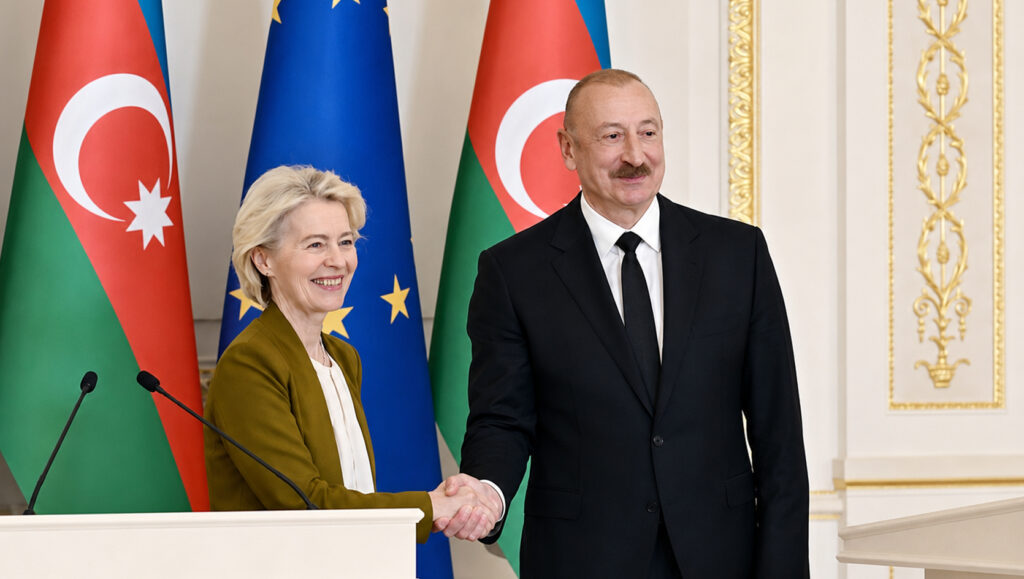
Azerbaijani President Ilham Aliyev’s speech at another media forum in Shushi again demonstrated that Baku’s foreign policy agenda has not changed substantially.
Although Azerbaijan continues to speak about peace with Armenia, reopening regional communications and economic cooperation, it simultaneously maintains its previous demands toward Yerevan and takes an increasingly confrontational position toward international organizations.
This assessment was offered by Armine Margaryan, head of the Women and Global Security Center.
According to her, Azerbaijan’s policy should be assessed not through individual statements but as part of a broader strategy.
“Audiences and emphases may change, but Azerbaijan’s agenda does not,” Margaryan said.
She noted that Armenia continues to promote the peace process and is preparing to sign a peace agreement, while Azerbaijan presents initiatives involving road openings, petroleum exports and other forms of cooperation but continues to advance demands against Armenia.
Baku Seeks to Remove Karabakh From the International Agenda
Margaryan views Aliyev’s criticism of the Council of Europe and other European institutions within this broader context.
The Azerbaijani president has raised the possibility of leaving those institutions, criticized France and simultaneously emphasized the importance of relations with the United States.
According to Margaryan, Aliyev’s statements are intended to reshape international perceptions of Azerbaijan’s actions.
“We should view this in the context of changing attitudes toward international legal institutions. We are currently witnessing a crisis of international organizations. Different countries are taking advantage of this situation, and Azerbaijan is also attempting to use it for its own benefit,” she said.
The expert argues that Baku is particularly seeking to revise discussions surrounding restrictions imposed by European institutions in connection with the depopulation and ethnic cleansing of Nagorno-Karabakh.
“When Aliyev says that Azerbaijan is already building peace with Armenia and asks why international actors continue to act against Baku, he is trying to suggest that the previous problems no longer exist,” Margaryan said.
In her assessment, Azerbaijan’s objective is to remove the events in Nagorno-Karabakh from the international political agenda.
“He is trying to demonstrate that after relations with Armenia are normalized, all remaining issues should be closed,” she noted.
Leaving the Council of Europe Could Weaken External Oversight
Addressing whether withdrawal from the Council of Europe would genuinely benefit Azerbaijan, Margaryan said such a move could limit certain mechanisms of international oversight.
“In that case, Azerbaijan could attempt to avoid some processes involving human rights, the impact of European Court of Human Rights rulings and other instruments,” she said.
At the same time, Baku is using such statements to send a warning to European institutions.
“Aliyev is showing that if critical resolutions against Azerbaijan continue, Baku is prepared to reconsider its relationship with those organizations,” Margaryan said.
She stressed, however, that energy remains a central factor behind Azerbaijan’s confidence.
“Azerbaijan’s energy resources and Europe’s needs allow it to pursue this policy. For the European Union, Azerbaijan remains an important energy partner,” she said.
Energy Interests Do Not Eliminate the Human Rights Agenda
Despite economic and energy cooperation, issues involving human rights, democracy and the rule of law remain important for European institutions, Margaryan emphasized.
“The fact that it is currently impossible to exert the same degree of pressure on Azerbaijan does not mean those instruments have disappeared. They remain available and may be used under different circumstances,” she said.
According to the expert, there is also a distinction within the European Union between political statements and practical policy.
“The European Parliament may adopt critical resolutions while executive institutions continue cooperation because of energy interests. This is the logic of realpolitik,” Margaryan explained.
Armenia Must Preserve Its Distinction From Azerbaijan
Margaryan believes Armenia must continue emphasizing the differences between the two countries regarding democracy and the rule of law.
“Armenia presents itself as a democratic country that values the rule of law. This is precisely where the distinction between Armenia and Azerbaijan lies, and that distinction is also important for European partners,” Armine Margaryan concluded.