
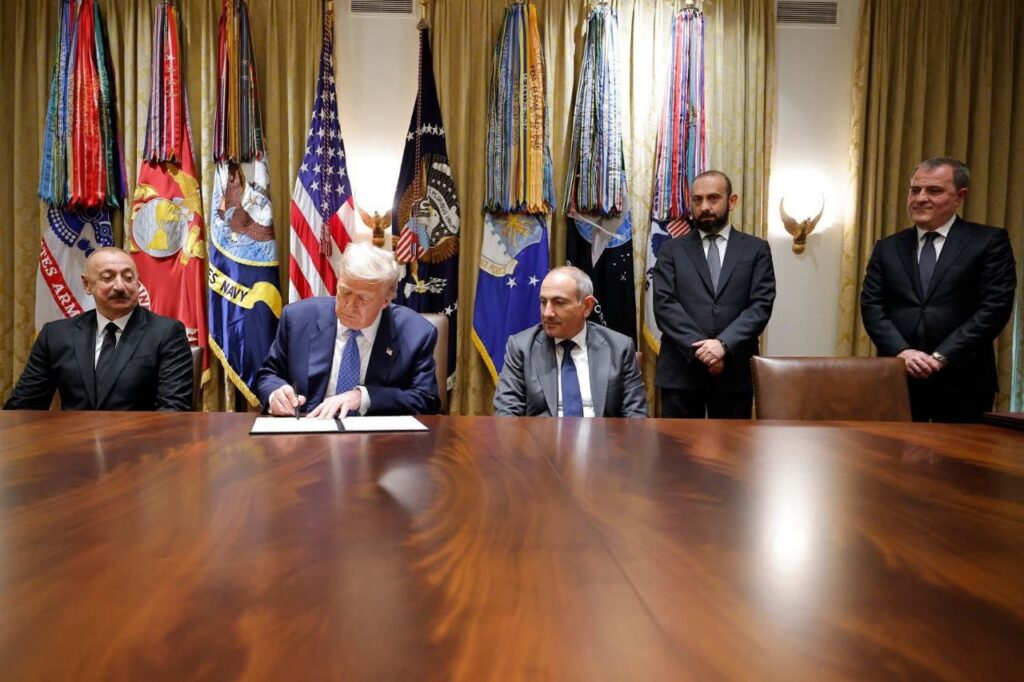
Armenian–American working groups have begun implementing and expanding the Washington Agreements. This became known from the official statement about the meeting between the Prime Minister of Armenia and U.S. Deputy Secretary of State Elizabeth Hooker.
Practical implementation has begun
This marks the transition to the practical phase of previously agreed steps. The Armenian PM recently expressed concern that the overloaded U.S. administration might delay progress. However, the process has already started.
Political analyst Emil Ordoukhanian says the initiative fully aligns with U.S. strategic interests.
Trump Administration speeds up its approach
According to him, immediately after President Donald Trump took office, Washington accelerated its engagement with the region.
“The trilateral peace statement and the TRIPP program clearly confirm this,” Ordoukhanian said. The program is now being finalized, and field operations will begin soon.
The US is committed to advancing the project
Even if timing questions remain, the U.S. demonstrates clear interest. Ordoukhanian notes that the initiative comes not only from Armenia but also from Washington:
This is the best opportunity for the U.S. to enter the region after the conflict under a peace agenda.
Azerbaijan’s reaction shows growing concern
Recent statements from Baku reflect growing anxiety, which, according to the analyst, indicates rapid U.S. progress. As the process advances, these reactions may intensify but remain within the logic of a peace agenda.
Russia’s weakened leverage opens space for the US
The expert explains that U.S. activity is partly due to Russia’s reduced influence.
“The US positions itself comfortably because the conflict has been largely overcome, at least on paper, and there is no rising tension,” he said.
Peace agenda opens the region
Previously, the region was a closed conflict zone dominated by one actor. Partial stabilization opened new opportunities, enabling the U.S. to enter.
The US sees major economic potential
American economic interests are “extremely large,” and in today’s geopolitical environment, economics itself becomes a tool of geopolitics.
By relying on sovereignty, territorial integrity, and jurisdiction, the U.S. is entering the region “very quickly and intensively” with its economic programs.