
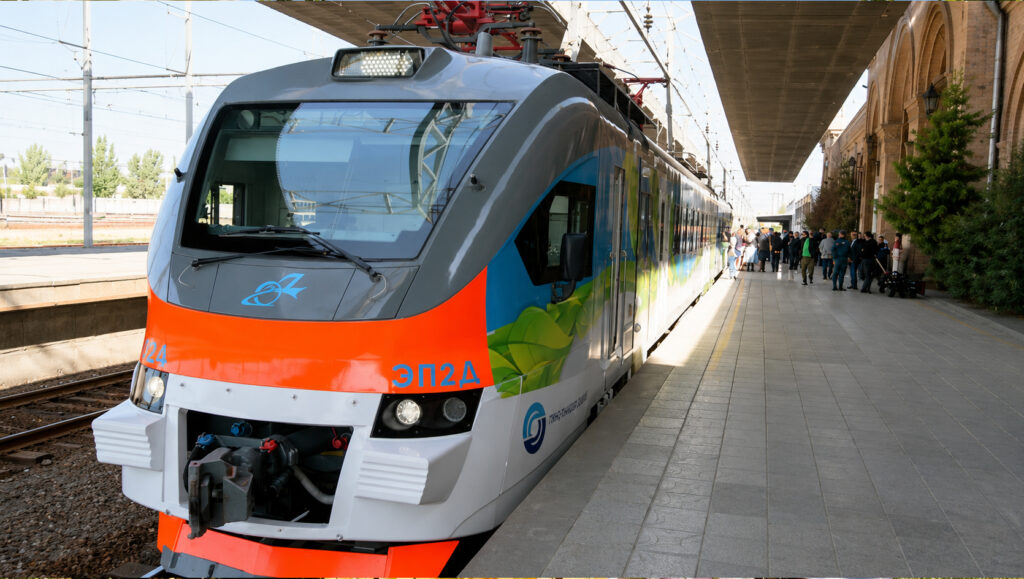
Recent statements by Armenian Prime Minister Nikol Pashinyan indicate that disagreements between Yerevan and Moscow over the concession agreement governing Armenia’s railway system are entering a new phase. The prime minister has not ruled out taking the dispute to international arbitration if the Russian side continues to fail to meet its contractual obligations.
Political commentator Artyom Yernkanyan believes Pashinyan’s statement indicates that negotiations with Russia have produced no tangible progress on this issue. At the same time, Yerevan appears to be developing legal instruments to increase pressure on Moscow.
Negotiations Continue Without Results
According to Yernkanyan, the possible early termination of the concession agreement has been actively discussed for several weeks.
Pashinyan confirmed that the matter is being discussed with the Russian side at different levels, although he said it was not raised during his latest telephone conversation with Russian President Vladimir Putin.
At the same time, the prime minister made an important reference to the legal dimension of the dispute. He said the issue could be considered by an international arbitration court and that Armenia might present substantial financial claims related to circumstances for which it had sought no compensation over the past three decades.
The political commentator described this as a direct signal that Yerevan is prepared to pursue legal action if the negotiations reach a dead end.
The TRIPP Project Changes the Situation
Yernkanyan recalled that Nikol Pashinyan had previously stated that Armenia was prepared to finance the reconstruction of the Yeraskh–Nakhichevan and Akhurik–Turkish border railway sections with its own resources.
However, such a scenario would effectively return control over those railway assets to Armenia, since the investments are formally the responsibility of the Russian side under the existing concession agreement.
According to the commentator, Pashinyan had also said that Russian concession management reduces the investment attractiveness of the TRIPP project. He suggested that if the current concessionaire is unable to fulfil its obligations, responsibility could be transferred to another partner country.
China and the United Arab Emirates have been mentioned in the media as possible alternatives. Moscow, however, has publicly stated that such an option is out of the question.
Where the $2 Billion Figure Comes From
Yernkanyan believes the figure mentioned by the prime minister is most likely connected to provisions of the 30-year concession agreement signed in 2008.
Under the agreement, if Armenia emerges from its transport blockade and the reopening of regional communications begins, the concessionaire is required to increase its total investments to approximately $2.15 billion.
The commentator argues that the signed document concerning the TRIPP project already demonstrates that the process of reopening communications has begun. Consequently, the relevant investment obligation should be regarded as having entered into force.
The main question, however, is whether Russian Railways is financially capable of making investments on that scale under current conditions.
Yernkanyan noted that the company is experiencing serious financial difficulties, has obligations amounting to approximately $50 billion and is attempting to sell some of its assets.
He said Armenia needs a clear answer as soon as possible on whether the Russian side intends to meet its investment obligations. If it does not, alternative options are most likely already under consideration.
Armenia’s Possible Legal Arguments
Yernkanyan recalled that after the change of government in 2018, Armenian law enforcement agencies began examining the implementation of the concession agreement.
Searches were conducted during the investigation, and numerous violations were reportedly identified. Allegations included approximately $60 million in concealed revenues, unpaid taxes and the misuse of funds. Criminal cases were also initiated.
According to information circulating at the time, Moscow proposed closing the issue in exchange for additional investments. At one stage, the Russian side allegedly even threatened to terminate the concession agreement unilaterally if Armenian law enforcement agencies continued interfering in the company’s activities.
The dispute was eventually resolved temporarily through political means.
In the commentator’s assessment, a substantial legal basis may have been developed during this period and could be used by Armenia in international arbitration.
He recalled that the Russian side had committed under the agreement to invest at least $572 million, including $220 million during the first five years. However, he believes there are sufficient grounds to argue that these obligations were not fully implemented.
As one example, he cited the failure to construct the 31-kilometer Vanadzor–Fioletovo railway section, which would have shortened the Yerevan–Tbilisi route by 112 kilometers.
A railway connection to the airport was not built, the Meghradzor tunnel was not reopened, and several other important infrastructure projects were not implemented.
A Political Settlement Remains More Likely
Despite the prime minister’s firm rhetoric, Artyom Yernkanyan believes the reference to international arbitration is primarily intended as an instrument of diplomatic and political pressure.
Although legal proceedings cannot be ruled out entirely, he considers it more likely that Yerevan and Moscow will attempt to resolve their disagreements through political negotiations.
The final settlement, therefore, is more likely to be reached through political compromise than through a court ruling.