
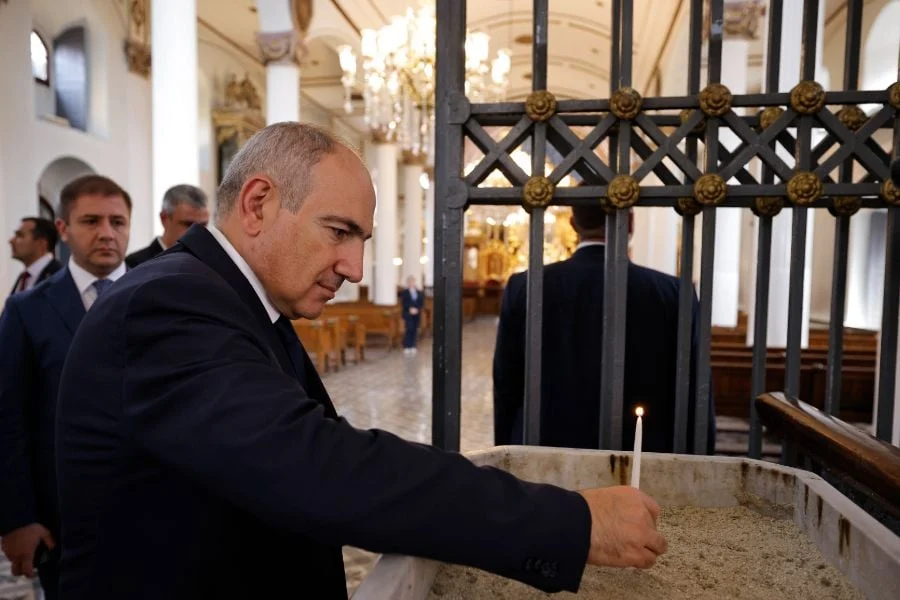
According to political analyst Suren Surenyants, a statement made by Prime Minister Nikol Pashinyan in the courtyard of the Holy Mother of God Church following the “Ukhtert” procession crosses the boundary clearly defined by Armenia’s Constitution between a secular state and a religious institution.
He stresses that the phrase “the church and the state are now together” cannot be interpreted as an emotional or symbolic remark. In his assessment, it is a political statement that calls into question the fundamental principle of a secular state.
Secularism and institutional neutrality
“A secular state does not mean an anti-church position. It means institutional neutrality of state power and an obligation not to interfere in the church’s internal life, governance, or liturgical order,” Surenyants emphasizes.
According to him, this principle is violated when the head of the executive branch publicly calls on believers to intervene in religious services, influence the conduct of clergy, and advance politically driven demands within the church environment.
“This is no longer about expressing a political opinion. It is an attempt by the state to exert direct influence over a religious institution,” he notes.
A dangerous legal precedent
Surenyants considers the legal dimension of these statements particularly alarming. In his view, a call for organized interference in church rituals crosses the line of legal permissibility and enters a domain that criminal law defines as obstruction of a religious organization’s activities or its rites.
“When such a call comes from the prime minister himself, it becomes a serious precedent that effectively legitimizes legally problematic behavior,” the analyst warns.
Allegations without evidence
Another concern, according to Surenyants, is Pashinyan’s claim that the Armenian Apostolic Church is allegedly “being used as a support base for actions against the Republic of Armenia.”
“Without pointing to any specific facts, countries, or evidence, such wording does not meet even the minimum standards of state discourse. A head of government cannot operate on assumptions and anonymous accusations, especially when addressing a fundamental national institution,” he says.
Foreign policy implications
The analyst also highlights the foreign policy context of this rhetoric. In his assessment, the authorities are attempting to present an anti-church line to European political circles as a “fight against hybrid threats,” circulating the thesis that the Armenian Apostolic Church is supposedly an instrument of influence of external centers, particularly Russia.
“This thesis is not only unsubstantiated but also dangerous from the standpoint of state interests. Discrediting national institutions cannot be compensated by foreign policy assurances,” Surenyants concludes.