
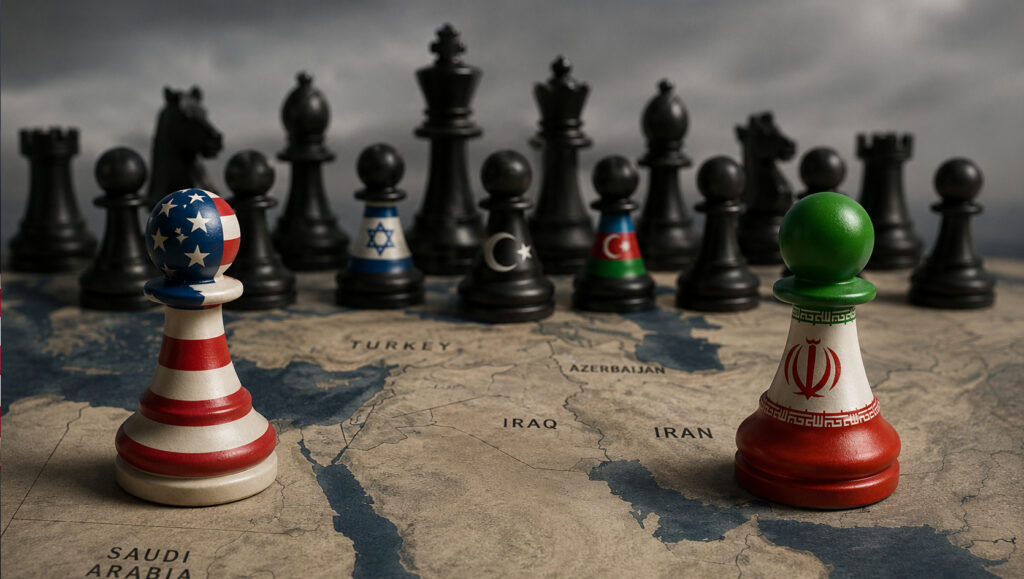
The continuing conflict between the United States and Iran could develop under two possible scenarios, each carrying consequences not only for the region but also for the wider world, according to expert Vardan Khachatryan.
Under the first scenario, he says, the United States could declare that it has already achieved its objectives and withdraw from the active phase of the confrontation.
“The United States may announce that it has already won and is leaving the region, while international organizations should resolve the remaining problems. It will say that no fees should be charged to ships entering or leaving the Persian Gulf and that there should be no obstacles in the Red Sea or the Bab el-Mandeb Strait. All of this will be presented as an American victory, and a political show will be built around it in the United States,” he said.
Fundamental Questions Would Remain Unresolved
Khachatryan argues that even after such a declaration, several fundamental issues would remain open.
It would still be unclear whether the Bab el-Mandeb Strait would fully reopen, how the Persian Gulf would operate and what developments would follow regarding Israel’s security.
According to the expert, Washington could transfer responsibility for resolving those issues to international organizations.
However, if that scenario fails, he believes the United States will attempt to assemble all forces that could be used against Iran as part of a proxy war.
Azerbaijan and Iranian Azerbaijanis Could Become Part of the Proxy Strategy
Khachatryan says Azerbaijanis living in northern Iran could play an important role in such a scenario, together with the state of Azerbaijan, which maintains close relations with Israel.
“We saw the nature of that cooperation during the Karabakh war and are well aware of the processes that took place. Azerbaijan continues to transform its military today. Officials say the armed forces must meet NATO standards, but the question is why. I am deeply convinced that this is being done so that, if necessary, the Azerbaijani and Turkish armies can operate against Iran as one integrated system,” he said.
In his assessment, the military integration of Turkey and Azerbaijan could acquire a new purpose if the conflict surrounding Iran expands.
Turkey Could Be Drawn Into a NATO-Iran Conflict
The expert also recalled a statement by former Turkish military attaché Colonel Ihsan Sepa, who warned that Turkey was being drawn into a possible conflict between NATO and Iran.
Khachatryan considers the statement significant because it came from someone who served for many years within NATO structures and understands the logic behind decisions made there.
“He is effectively warning that everyone must remain vigilant because Turkey could be drawn into this war. If such an assessment comes from someone who worked with NATO for many years, it cannot be ignored,” the expert stressed.
The NATO Summit in Ankara May Have Included Undisclosed Commitments
Khachatryan also connects the statement with recent political developments, particularly the NATO summit held in Ankara.
He does not rule out the possibility that Turkish authorities assumed certain obligations during those meetings that have not yet been publicly disclosed.
As a possible indicator of preparations for such a scenario, the expert points to reports that Turkey may sell the S-400 air defense systems it purchased from Russia.
“Turkey says it is ready to sell the S-400 systems and purchase Patriot systems instead. This means Ankara has already come under serious pressure. Turkey acquired the S-400s after a major struggle. If it is now prepared to abandon them, that is a very serious signal,” he said.
In Khachatryan’s assessment, giving up the S-400 systems could indicate a broader restructuring of Turkish defense policy and renewed integration with NATO’s military architecture.
Azerbaijan’s Military Potential Must Also Be Considered
If Turkey becomes involved, Khachatryan says, Azerbaijan’s military capabilities must also be taken into account.
“Azerbaijan says it has a 150,000-strong army and has purchased around $5 billion worth of weapons. If we add Turkey’s possible participation, then Iran must prepare for the possibility of a military strike,” he said.
The expert believes the combined Turkish and Azerbaijani capabilities could form an important element of a strategy aimed at pressuring Iran without a direct large-scale deployment of American troops.
Turkish-Iranian Rivalry Is Not Only Religious
Khachatryan stresses that tensions between Turkey and Iran are not based solely on religious differences.
“This is not only about the Sunni-Shia divide. The two countries have historically competed for influence in the region. If Iran strengthens its international position, Turkey, as a NATO member, cannot remain indifferent because this also affects its strategic interests,” he said.
In his view, the longstanding rivalry between Ankara and Tehran could intensify under current conditions and make Turkey more receptive to American proposals for participating in a broader regional pressure campaign against Iran.
Khachatryan therefore believes that if Washington chooses not to engage in direct large-scale intervention, it may turn to an extensive proxy strategy involving regional states, ethnic groups and allied military structures against Iran.