
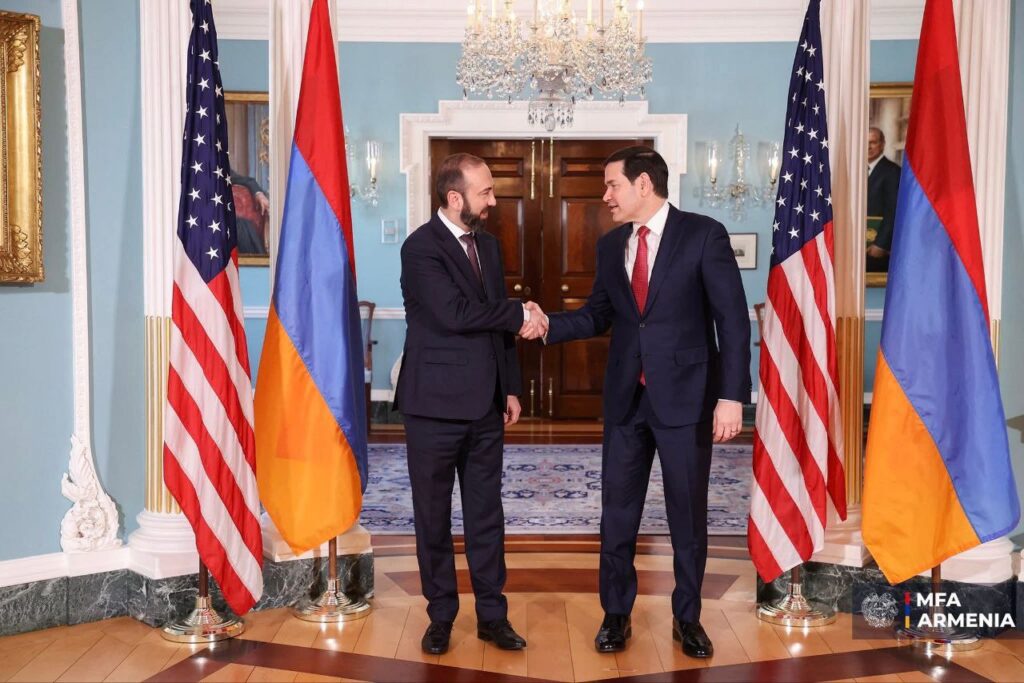
The document signed in Washington between Armenia’s Minister of Foreign Affairs Ararat Mirzoyan and US Secretary of State Marco Rubio has no legal value and poses serious risks to Armenia’s sovereignty and security. This assessment was voiced by political scientist and former Speaker of the National Assembly Tigran Torosyan.
Not a document, but a list of wishes
Discussing the substance of the signed text, Torosyan raises a fundamental question: can it be considered a legal document at all?
“To answer this, it is enough to read the very first sentence,” he notes. The text explicitly states that it merely outlines the framework for implementing Donald Trump’s initiative “The Road to International Peace and Prosperity” (TRIPP) and is not intended to create any legal obligations or commitments for either Armenia or the United States.
“This means we are dealing not with a document, but with a simple sheet of wishes,” Torosyan stresses. Such memoranda, he argues, cannot have legal consequences, which naturally raises the question of why they are signed at all.
He recalls that a similar memorandum was signed on August 8, also without creating any legal obligations. Overall, three memoranda have recently been signed between Armenia and the United States — on cooperation in artificial intelligence, in the energy sector, and now within the framework of this initiative.
“If this were a genuine process, these memoranda should have been followed by agreements containing clear obligations and legal consequences. But there are no agreements. There are only memoranda that bind no one,” Torosyan notes.
A possible explanation: propaganda
Under these circumstances, he sees only one explanation — a propaganda motive. In his view, the document was signed in the context of upcoming parliamentary elections in order to demonstrate to the public an alleged deepening of relations with the United States.
“This allows the authorities to say: look, we have signed a document with the US. But in reality, there is no document, and people must clearly understand this. It is deception,” Torosyan says, adding that any future agreement may have a completely different content and bear no relation to this memorandum.
Torosyan also addresses why the United States agrees to sign such texts. According to him, two factors are at play. The first is the US president’s constant rhetoric about peace. However, as he points out, these ‘peaces’ do not actually exist.
No connection to peace or sovereignty
The second and more important factor, Torosyan argues, is geopolitical interest. The document speaks about creating “unhindered multimodal transit connectivity” on Armenia’s territory, allegedly for the sake of regional peace, stability, and integration. Yet the text, he says, has no real connection to peace, stability, or respect for state sovereignty.
“This is a purely commercial memorandum with a clear geopolitical objective: to establish a practical US presence in Armenia and the region,” Torosyan states.
He recalls that as early as the 1990s, oil and gas pipelines were built from Azerbaijan through Georgia to Turkey, creating a tested and secure route that allows Azerbaijan to connect with Turkey without involving Armenian territory.
Armenia gains nothing in return
“If such a route exists, why abandon it and choose Armenia’s territory? The only explanation is that under this document Armenia receives virtually nothing, while granting the United States unlimited opportunities to control this area,” Torosyan emphasizes.
According to him, the issue is not merely a road but an entire territory. The details of the text suggest that the initiative could gradually expand across Armenia, with effective control over borders potentially shifting to the American side.
He draws particular attention to the provision linking mainland Azerbaijan with Nakhichevan and turning the route into a vital segment of the Trans-Caspian trade corridor. In Torosyan’s view, Azerbaijan and Turkey gain advantages without assuming any obligations.
“What benefit does this create for Armenia? There is no clear answer. The Trans-Caspian route will be used by the United States, not Armenia,” he stresses.
As a result, Torosyan concludes, Armenia is offering its territory so that the US gains leverage over Azerbaijan and Turkey, while that leverage should have served Armenia’s own interests.
“We are getting nothing more than photographs with American officials, which have purely propaganda value,” he says, adding that in exchange Armenia is granting the United States a full-fledged presence on its territory.
Iran’s reaction
Torosyan also emphasizes the importance of Iran’s reaction. He notes that the harsh statements made by Iran’s ambassador are exceptional in diplomatic practice and indicate that the issue is far deeper than routine expressions of concern.
“This is about the risk of Armenia turning into a platform directed against Iran. That is a serious threat to Armenia’s security and sovereignty,” Tigran Torosyan concludes.