
The Rojava region — a Kurdish self-administrated territory born out of the ruins of Syria’s civil war and long seen as an alternative political experiment in the Middle East — is once more under mounting pressure. Talks on Syria’s future are taking place without its participation, solutions are being drafted from above, and the language of force is increasingly replacing dialogue.
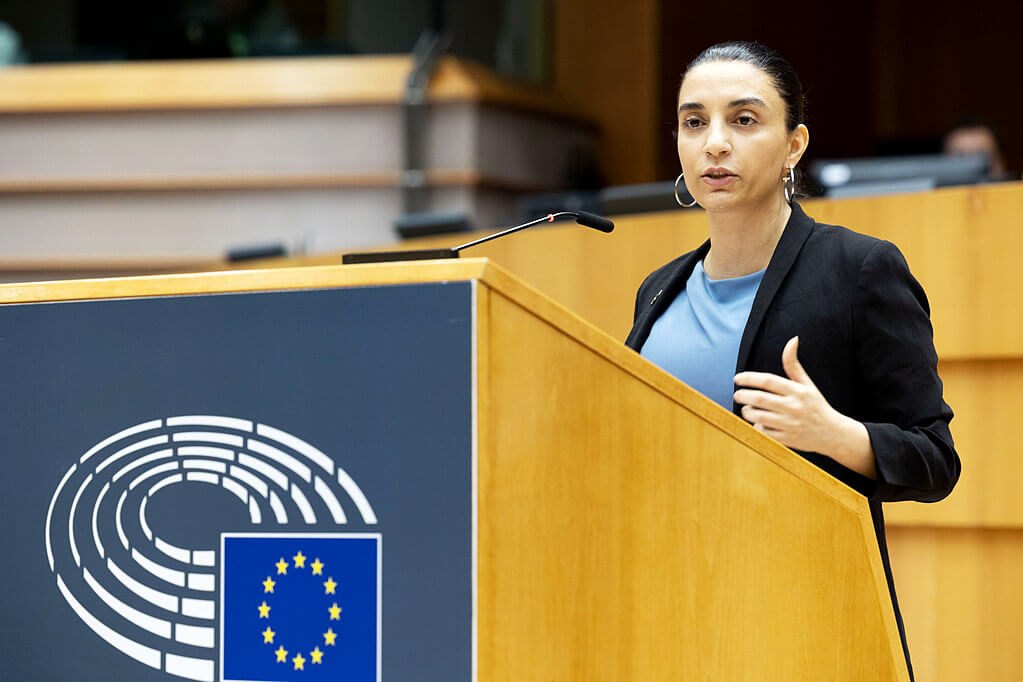
In the European Parliament, voices are growing louder warning that what is unfolding in Syria is not a local crisis, but a potential trigger for a new wave of regional destabilization. One of those voices is Swedish MEP Evin Incir. In an interview with VECTORS, she speaks bluntly about the risks of forced integration of Kurdish regions, Europe’s illusions regarding Syria’s new authorities, and why the EU must move beyond diplomatic gestures and “bags of money” — and start using real leverage, including pressure on Turkey..
Where is the situation in Rojava heading, and how far could it expand? What are the risks of a further widening of this conflict?
What we are witnessing is an escalation in a region that desperately needs de-escalation. What is needed is an approach that ensures all populations across different countries are seen, represented, and included, rather than further polarization. What we see in Syria today is a very dangerous development.
Do you accept the idea of integrating the Kurdish regions into Syria under the current political and military conditions? Given the deep mistrust — and in fact the lack of trust — toward the Syrian military, do you think this is even possible?
Integration, if it is to mean anything, must involve those it concerns. It requires dialogue with the people directly affected, not decisions imposed on them about what “integration” should look like. Forced integration is not integration.
The Rojava region has been very clear about this: they want to find political solutions to the current situation. But what we see now is that they are being told what the solution is, rather than being included in genuine negotiations. For example, I would of course welcome the declaration of Newroz as a public holiday, as Jolani has announced. But we also know that this day is already a holiday in Syria — it is Mother’s Day. Symbolic gestures are not enough.
If the Syrian authorities genuinely and sincerely want to find a solution, they cannot exclude the Rojava region and its legitimate representatives from the talks and then assume they can simply impose a solution on them. I believe this is essential.
Given what is already happening on the ground, and given Europe’s illusions about the Syrian authorities, what can the EU realistically do — and what do you actually expect from it?
I believe that whoever you negotiate with, whoever you speak to, you must bring your values and your principles into the discussion — not just a bag of money with no conditions attached. This is precisely where the European Union, once again — not only in this case, but in many others — shows why people are losing confidence in its political weight and credibility. If our representatives truly understood the power that lies in the unity of the European Union and in what it can contribute, they would act differently. Instead of coming with nothing but money in both hands, they should come with money in one hand and values in the other — and put both on the table. They should say clearly: we are here, and we are ready to support the country and its people, but this support requires a Syria that is democratic, inclusive, and fully respects international law. That is why conditionality is essential.
You mentioned during the press conference the need for the EU to put pressure on Turkey. What exactly would you expect in that regard?
As we know, the accession process — Turkey’s potential membership in the European Union — has been de facto frozen since 2016 and formally frozen, if I recall correctly, since 2018.
Yet it remains important for Turkey because the Turkish population still wants closer ties with the European Union, and the membership process can be a vital tool to support political reform and strengthen the opposition. Right now, the opposition is being systematically weakened, with many members imprisoned. In this context, the European Union has the opportunity to do much more — to act decisively without being intimidated by Erdogan or his threats.