
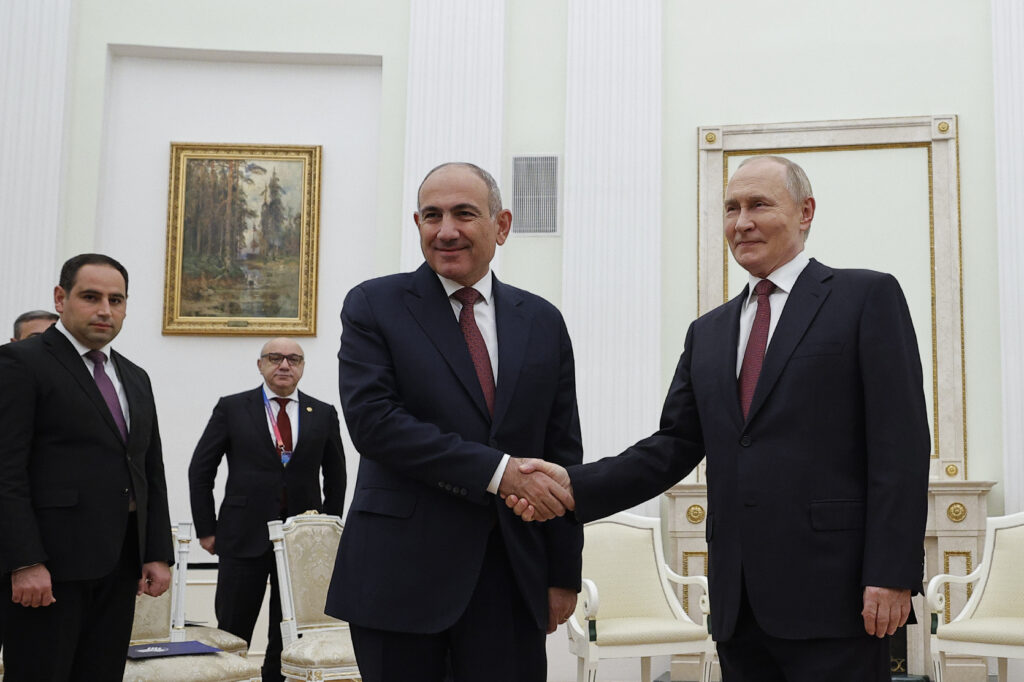
The Russian Ministry of Foreign Affairs has issued a statement regarding the deepening of relations between Armenia and the European Union. The statement expresses concern over Yerevan’s intensified cooperation with the EU and notes that such developments could have a negative impact on Armenia–Russia alliance relations. The situation is commented on by political analyst Tigran Grigoryan.
The Economic Factor as the Basis of Relations
According to him, since 2022, the economic factor has become dominant in Armenian–Russian relations. Previously, the focus was primarily on the military-political component, and Armenia had certain expectations and hopes in this area in its ties with Russia. However, following the escalation in 2022 and the depopulation of Artsakh, the relations entered a deep crisis.
He notes that since that time, Armenia has effectively suspended its membership in the CSTO, while military-political and military-technical cooperation has been reduced to a minimum. As an example, he points out that in recent years, joint Armenian–Russian military exercises have not been conducted, whereas until 2020 they were held annually.
A New Model of Interdependence
Grigoryan emphasizes that the growing importance of the economic factor is also due to Russia’s current situation. Under Western sanctions, Moscow has in recent years sought to diversify its foreign trade, and in this context even small countries like Armenia have acquired certain significance for Russia.
While previously economic dependence was largely one-sided, the analyst says it can now be described as mutual. Armenia continues to need Russia as a large market and trade partner, but at the same time Russia also needs Armenia as a link for maintaining and diversifying trade with other countries. In this respect, according to Grigoryan, not only the South Caucasus but also Central Asian countries have become economically significant.
The EAEU as Moscow’s “Red Line”
The analyst draws attention to the fact that Russia’s reaction varies significantly depending on the sector. In the military-political sphere, particularly regarding the CSTO, while there is some dissatisfaction with Armenia’s position, there is little active pressure. According to Grigoryan, the parties appear to have adapted to the existing status quo: Armenia formally does not leave the organization but also does not actively participate in its activities.
However, in matters of economic integration, especially within the framework of the Eurasian Economic Union, Russia’s reaction is much more sensitive and active. Grigoryan notes that in the short and medium term, it is unlikely that Armenia will leave the EAEU, and full EU membership is also difficult to imagine.
He also points to changes in the rhetoric of Armenian authorities: Prime Minister Nikol Pashinyan now speaks not about EU membership, but about the importance of the process of aligning with European standards, acknowledging that membership is a secondary issue. According to the analyst, this reflects the realization that a realistic EU membership agenda for Armenia does not currently exist.
Nevertheless, in Grigoryan’s view, it is precisely on these issues that Moscow seeks to send clear signals to Yerevan, implying that any change in the course regarding the EAEU or a broader geopolitical direction could have far stricter consequences than today.