
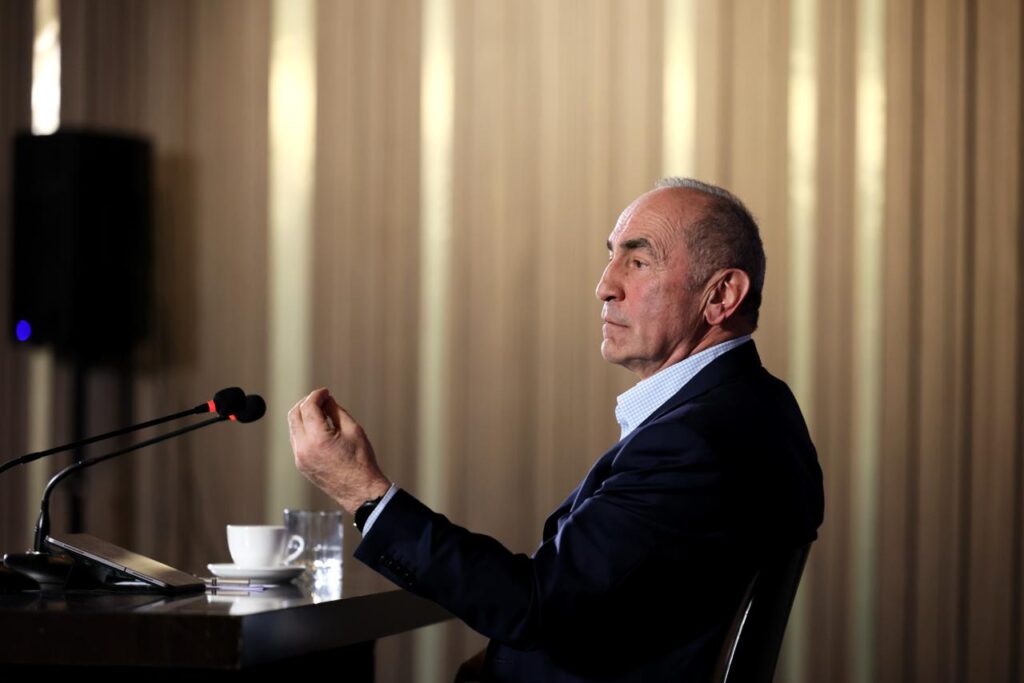
The press conference of Armenia’s former president Robert Kocharyan once again demonstrated that he remains a master of political rhetoric built on a revisionist narrative and the selective use of facts.
“It was better under me (1998–2008).”
This is one of the core theses of the second president. Here, he skillfully plays with statistics, referring to a reduction in unemployment, a large volume of Western investments, and a higher trade turnover with the European Union compared to today. At the same time, he deliberately omits several key points.
First, trade turnover was higher in nominal terms largely because commodity prices — the main category of exports at the time — were significantly higher. This was the period of a global commodities boom, when the West was actively searching for raw materials worldwide. Over time, global interest in small and medium-sized mountainous resource assets declined. Kocharyan thus compares incomparable things: capital-intensive projects of the commodity boom era with today’s knowledge- and technology-based economy, where investments are less visible at first glance. Many modern Western companies do not even register legal entities in Armenia, instead operating through acquisitions of local startups, opening R&D centers as branches, or contracting local IT firms.
“There was security under me.”
This is perhaps the strongest — but also the most controversial — argument for today’s Armenia, traumatized by the recent war with Azerbaijan. It appeals directly to the sense of security. However, this security was illusory and dangerous. It was based not on real strength or a long-term conflict settlement, but on a frozen status quo. It was a temporary truce that accumulated problems for years instead of resolving them.
His administration failed — or chose not — to move the negotiation process into a framework that could have led to a sustainable peace. The result was the April 2016 “Four-Day War,” the largest military escalation since 1994. Notably, this occurred eight years after the end of Kocharyan’s presidency. Although he does not include this period in his “era of stability” (power was then held by his successor Serzh Sargsyan), it clearly proves that the threat of war existed well before Nikol Pashinyan came to power in 2018 and long before the 2020 explosion.
In addition, Robert Kocharyan conveniently forgets that his presidency began in 1998 amid a severe political and security crisis — including the assassination in parliament and a change of power — and that his first term was marked by instability and internal shocks.
“There was no such super-power under me.”
The criticism of the prime minister’s excessive power reveals the main contradiction. The Constitution that created this system was adopted under his successor and ally Serzh Sargsyan, with one clear goal: to entrench the power of the ruling Republican Party. At the time, it was presented as a progressive transition to a parliamentary republic. Today, when this same system is used by a political opponent, it is declared “bad.”
Although Kocharyan tried to distance himself from his successor, on the issue of the Constitution he could not maintain consistency and stated that “the authors of the 2015 Constitution could not have foreseen” how it would function under current conditions. This is pure situational criticism, demonstrating that for Kocharyan the issue is not the system itself, but who controls it. If he returns to power, the Constitution — or at least the procedure for appointing judges — would certainly be changed.
The question that has been relevant in almost every Armenian election — whether the opposition will unite against the authorities and act as a single front — once again disappointed supporters of consolidation. Kocharyan made it clear that full unification will not happen, effectively legitimizing fragmentation. His message was honest but cynical: there will be no single front; instead, 3–4 blocs will compete in the elections.
This means that even at a critical moment of confrontation with the ruling authorities, opposition leaders prioritize their own ambitions and mutual grievances over the common goal. Instead of consolidating votes, they divide the electorate, increasing the ruling party’s chances of victory through fragmentation. Kocharyan not only predicted this split — he normalized it politically.
It must be understood that this strategy is not aimed at a common victory, but at ensuring that his bloc becomes the strongest among the opposition, even if that is insufficient to take power. In the end, it is not the opposition that wins, but the ruling team, while voters are once again left choosing between several bad options, none of which looks like a truly consolidated alternative.
Summarizing Robert Kocharyan’s pre-election posture, one can say that he has chosen a strategy aimed not at uniting the opposition, but at leading its largest fragment by playing on nostalgia and fear. His main weakness, however, is an unprocessed past and obvious contradictions in his criticism of a system created by his own political allies. He has taken responsibility for none of the events or situations that occurred between 1998 and 2008.
A telling example: criticizing the current authorities for failing to raise pensions despite their promises, Kocharyan stated that during his own campaign he never promised such things — and therefore there is nothing to hold against him.
Foreign Policy: Security Above All
The former president’s foreign policy framework is also centered on security, which in his understanding consists of several key elements.
Do not provoke Russia.
Kocharyan reminded the audience that Russia is very patient, but can respond very harshly if a red line is crossed. As an example, he cited the case of a Georgian journalist who insulted the Russian president, after which Moscow suspended trade and air travel with Tbilisi.
TRIPP and Trump provide no security guarantees.
Kocharyan considers the TRIPP project to be purely political and anti-Iranian. To make it beneficial for Armenia, he proposes extending it beyond the current 42 kilometers all the way to Yeraskh and involving China or Russia. He is convinced that agreements can be reached with Trump, recalling that when Armenia was negotiating a gas pipeline with Iran, Washington initially opposed it, but he managed to persuade the U.S., even offering joint participation. The U.S. declined but did not obstruct the project.
Perhaps the most interesting statements concerned the European Union, especially against the backdrop of intensified Yerevan–Brussels contacts and negotiations on visa liberalization.
First, in Kocharyan’s view, a united Europe is a structure that not only cannot guarantee security for a small country like Armenia, but may actually push it into confrontation with Russia. He argued that Europe encouraged Ukraine to enter into war with Russia, and that in April 2022 — a month and a half after the war began — negotiations in Istanbul collapsed with active European involvement. This process, he claims, has now dragged on for four years.
Kocharyan then stated:
“I am convinced that in five years the EU, in its current form, will cease to exist. Europe has two paths: either deepen integration and form its own armed forces, or take two steps back and become more of an economic structure. I am sure it will choose the second path. Brussels will remain as an economic entity because that benefits everyone, but the political component will be significantly weakened.”
To support his claim, Kocharyan cited the Belgian prime minister:
“The prime minister of Belgium said in Davos: we face a choice — to be a happy vassal or an unhappy slave.”
What Bart De Wever actually said was something quite different. He spoke about the need for European unity:
“Europe is at a crossroads where it has to decide. Until now, we tried to appease the new president in the White House… We were lenient, hoping to get his support for the war in Ukraine. We are in a very bad position at the moment… But now so many red lines are being crossed that you have the choice between your self-respect — being a happy vassal is one thing, being a miserable slave is something else.”
If Kocharyan intended to connect this quote to his thesis about Europe’s transformation, he deliberately — or not — omitted the first part of De Wever’s message, where he states: under pressure, we either come together or explode.
Europe is not being offered a choice between being a vassal or a slave. It is being forced to decide whether it will remain united or fragment, with all the consequences that entails.
In Kocharyan’s version, however, the quote serves as confirmation of his thesis: Europe is a U.S. vassal, politically weak, and therefore doomed to decline. Where De Wever’s words are a mobilizing call, Kocharyan turns them into proof of Europe’s inevitable weakening.
When discussing the future of the EU, Kocharyan analyzes Europe less than he projects his own worldview onto it — a world of blocs, vassals, and power centers — selectively choosing quotes that serve this model and ignoring realities in which Europe appears as an actor capable of self-strengthening.
Thus, when Kocharyan claims that the EU will step back two paces, it is important to understand that it is politically convenient for him to portray Europe as doomed to weaken — and he tailors his arguments accordingly.
In short:
De Wever says, if we do not unite, we will perish.
Kocharyan translates this as, we will not unite anyway.
This is not a slip of the tongue, but a worldview: disbelief in solidarity as a force. Both the crisis of the EU and the fragmentation of the Armenian opposition are seen by him not as challenges to overcome, but as a natural state of systems defined by hierarchy and competition for dominance. In this logic, unity is a utopia; fragmentation and internal rivalry are the only reality.