
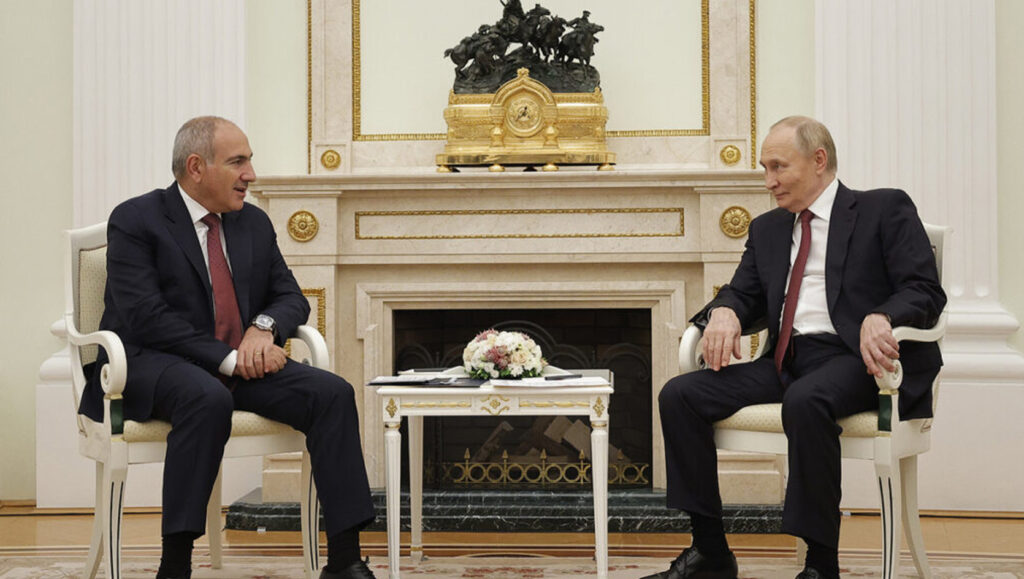
Even if a meeting between Armenian Prime Minister Nikol Pashinyan and Russian President Vladimir Putin takes place, it will not by itself resolve the deep-seated problems that have accumulated in Armenian-Russian relations. This view was expressed by political analyst Armen Baghdasaryan.
According to him, the issue is not merely about personal or diplomatic contacts, but about the opposing strategic interests of the two countries.
Baghdasaryan recalls that before the elections, Nikol Pashinyan stated that he intended to travel to Moscow and meet Vladimir Putin. However, that meeting has not yet taken place, and even its timing remains unclear.
“Russia did not even hurry to congratulate Nikol Pashinyan on his re-election as prime minister. They are probably waiting until the election results are finally confirmed by the Constitutional Court. But even after that, I do not think that Pashinyan’s trip to Moscow will allow all the problems in Armenian-Russian relations to be solved through negotiations,” the political analyst noted.
The Problem Is Not Trust but Opposing Interests
According to Baghdasaryan, the crisis in Armenian-Russian relations is caused not only by mutual distrust but primarily by the incompatibility of the two countries’ interests.
In his assessment, Russia seeks to preserve and even expand its presence in Armenia, while Armenia’s current authorities are trying to move the country in a Western direction and gradually reduce Russian influence.
“In politics, the concept of ‘trust’ is relative. In reality, there are interests, and today the interests of Armenia’s authorities and Russia simply do not coincide,” Baghdasaryan emphasized.
Mutual Distrust Has Developed Over Years
According to the political analyst, trust has also been seriously damaged at the level of societies.
He recalled that trust toward Russia in Armenia began to decline during the April 2016 war, suffered a stronger blow after the 44-day war, and, in his view, has now essentially collapsed completely.
At the same time, Baghdasaryan believes that distrust toward Armenia in Russia emerged earlier. It formed during the period when Armenia spent several years declaring its intention to pursue European integration, but soon changed its foreign policy course and joined the Eurasian integration processes.
“Under these circumstances, it is difficult to speak about mutual trust, and this distrust will remain for a long time both between the states and between the societies,” he noted.
The Regional Architecture Has Not Yet Fully Changed
Addressing the balance of power in the South Caucasus, Baghdasaryan believes that the regional security system has not yet been fully reshaped.
According to him, Armenia formally remains a member of the CSTO, while the Russian military base continues to be stationed on Armenian territory. Therefore, it is still too early to speak about a complete rupture in relations.
However, in the political analyst’s view, the two sides are currently moving in opposite directions. Armenia’s authorities are trying to make this process irreversible and reduce Russia’s presence, while Moscow is trying to preserve its influence by demonstrating that its weakening would harm not only Russian interests but Armenian interests as well.
“Economic restrictions, political signals, and attention to Armenia’s domestic political processes are all part of the same logic,” Armen Baghdasaryan concluded.