
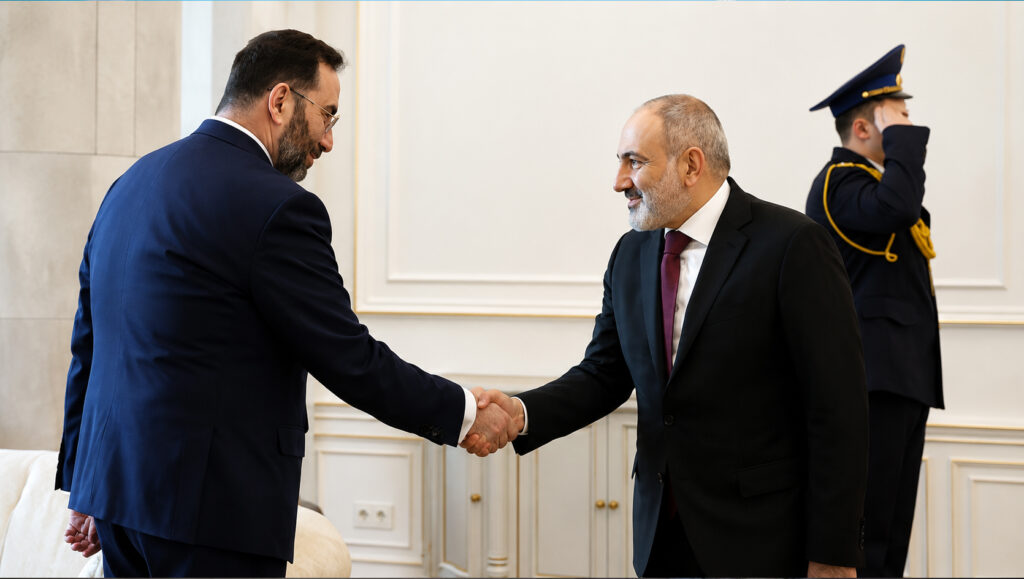
Chicago-based private capital investor Konstantin Sokolov has been appointed chairman of TRIPP+, a new entrepreneurial fund established by the US Department of State. According to The Guardian, the fund will manage more than $200 million intended for transport, energy and strategic infrastructure projects across the South Caucasus and Central Asia.
The State Department has emphasized that the fund will operate through accountability mechanisms and independent audits while financing strategic private-sector initiatives in the region.
Commenting on Sokolov’s appointment and the TRIPP+ initiative, international affairs expert Grigor Balasanyan argues that this is not an entirely new project but a reformulated version of the trilateral statement signed on November 9, 2020.
TRIPP as a “Rebranding” of the November 9 Agreement
Balasanyan believes Konstantin Sokolov’s appointment as head of the TRIPP+ fund demonstrates that the November 9 trilateral agreement has undergone a form of political rebranding.
According to him, only the name has changed, while the core principles and mechanisms established in the 2020 document remain intact.
The expert says that if the project is implemented, the procedures envisaged by the November 9 statement will continue to apply.
This would mean Russian border guards remaining on Armenia’s border, cargo undergoing inspections both upon entry and exit, and a full passport control regime remaining in force.
Balasanyan also stresses that all Eurasian Economic Union rules would continue to apply, including provisions governing the origin of goods from third countries and the status of EAEU products.
In his assessment, TRIPP+ does not alter the essence of the system but simply presents it through a different political and organizational framework.
TRIPP Cannot Be Implemented Without Russia
Balasanyan is convinced that the project cannot be implemented without Russia’s participation and consent.
If the procedures established by the November 9 agreement are preserved, Russia’s role will inevitably remain because that document defined the corresponding control and security mechanisms.
The expert argues that the emerging regional initiative is therefore being built on previous agreements rather than on entirely new principles.
Even if an American fund manages the investment component, the route’s practical operation would continue to depend on the existing legal, customs and security architecture.
For this reason, he says, Russia cannot be removed from the project merely by changing its name or its sources of financing.
Armenia Rejected a More Advantageous Option
Grigor Balasanyan argues that Armenia had an opportunity in 2020 to implement the mechanisms now being presented under TRIPP+ on significantly more favorable terms.
In his view, if the November 9 statement had been implemented in its original form, Armenia could have found itself in a more advantageous position.
He even suggests that such a development might have prevented several serious consequences, including the loss of Artsakh.
According to the expert, Armenia’s authorities followed the global anti-Russian political trend and rejected the option that offered the country greater benefits.
As a result, he says, a document was later signed in Washington whose core substance had already appeared in the Moscow agreement, but which now provides Armenia with less favorable conditions.
Balasanyan believes the political effort to change the project’s external framework weakened Yerevan’s economic and institutional position.
Armenia Will Receive Only 26%
According to Balasanyan, the most significant difference concerns the distribution of economic benefits.
He argues that if the November 9 agreement had been implemented in its original format, Armenia could have retained the full share of transit revenues attributable to its territory.
Under TRIPP+, he claims, Armenia would receive only around 26%.
Moreover, he doubts that even this amount would reach the Armenian side in full.
In his assessment, part of the revenue could be classified as payments for consulting services, reimbursement of investment expenses, administrative charges or other costs, leaving Armenia with significantly less economic benefit than publicly suggested.
Balasanyan argues that under such a structure Armenia would formally participate in the project but would not independently control the main financial flows.
The country would effectively move from being the owner and principal beneficiary of the infrastructure to becoming a participant with a limited share and minimal influence over revenue distribution.
The American Fund Changes the Form, Not the Substance
The expert notes that the creation of a fund managing more than $200 million and the appointment of a private investor as its chairman may create the impression of a completely new model.
In his view, however, American financing and private-capital involvement primarily change the organizational structure surrounding the project.
The transportation regime, inspection system, border status, passport and customs procedures, and the role of existing regional mechanisms would remain unchanged.
Balasanyan therefore argues that TRIPP+ should be assessed not by its new name or fund structure but by the rules governing the route.
If those rules reproduce the mechanisms contained in the November 9 statement, he says, there is little basis for describing the project as an entirely new regional model.
Moscow and Washington Have Reached an Understanding While Armenia Remains Marginal
Concluding his assessment, Grigor Balasanyan argues that Moscow and Washington are the principal actors shaping the process around TRIPP+.
In his view, the two centers have achieved a degree of mutual understanding, while Armenia is barely visible as an independent actor in the larger process.
He believes the regional infrastructure model is being formed primarily through coordination between major powers, with Yerevan assigned the role of providing the territory through which the project will pass.
Balasanyan doubts that Armenia’s influence will increase substantially during the next stages.
He argues that the country risks remaining in a secondary position without meaningful influence over strategic decisions, control mechanisms or the distribution of the principal financial benefits.
The expert therefore views TRIPP+ not as a new Armenian infrastructure opportunity but as a redistribution of an existing model between external centers of power.