
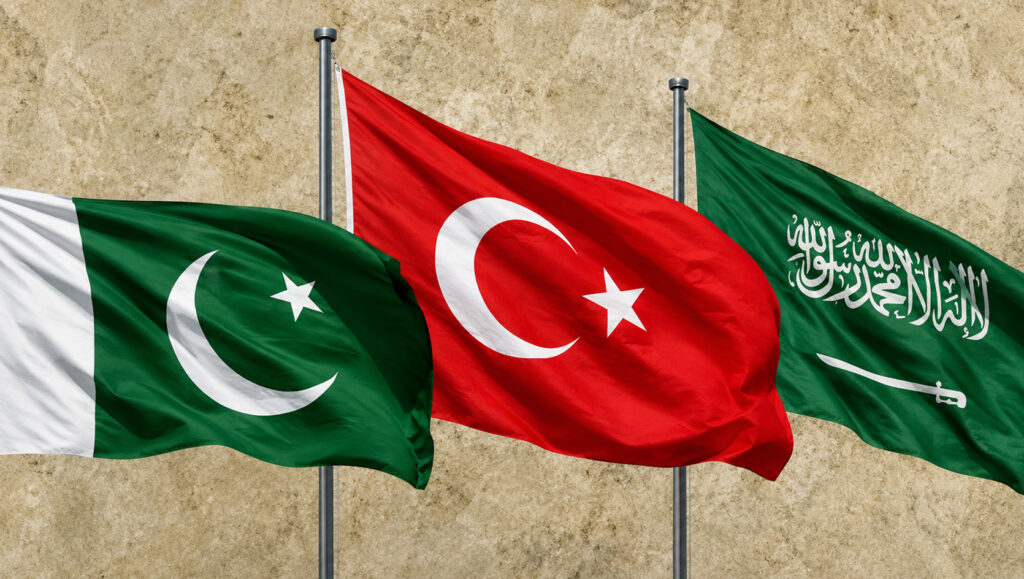
The trilateral alliance formed by Turkey, Saudi Arabia and Pakistan should be viewed not as a bloc directed against any particular country, but as an attempt to adapt to the emerging situation in the Middle East and diversify their own security arrangements. This assessment was offered by Turkologist Ruben Safrastyan.
Two Years of Secret Negotiations
According to him, negotiations among the three countries were conducted secretly for around two years, which is noteworthy in itself.
At one stage, there were also reports that Egypt had been involved in the negotiation process, but Cairo later dropped out. There is also information suggesting that Saudi Arabia opposed Egypt’s participation.
According to Safrastyan, one of the main strategic reasons behind the formation of the alliance may be linked to a possible reduction in the US presence in the Middle East.
“The United States has announced that it will reduce its presence in the Middle East. And these countries, by creating this trilateral alliance, are essentially preparing for the vacuum that may emerge after the American presence in the Middle East is reduced,” he noted.
According to the Turkologist, Turkey, Saudi Arabia and Pakistan are seeking to assume a greater role in balancing regional developments.
He said this is also connected to the process of a new world order taking shape. Safrastyan believes that through the trilateral alliance, the three countries are trying to diversify their security systems.
All three are connected to the United States as allies to varying degrees, but amid the prospect of a reduced American presence, they want to rely more heavily on their own capabilities.
“These three countries, by creating the trilateral alliance, are trying to diversify the process of ensuring their security, relying not only on the United States but also on their own forces,” he said.
The Turkologist also draws attention to the alliance’s symbolic significance: all three are Sunni Muslim states.
In his assessment, this may also be viewed as an attempt by three important countries in the Islamic world to deepen cooperation in the field of security.
Turkey’s Domestic Political Calculation
Safrastyan believes that the creation of the alliance also reflects the domestic political calculations of each country.
In Turkey’s case, he points to the domestic political challenges facing President Recep Tayyip Erdoğan’s government.
The Turkologist recalled that in the local elections held two years ago, Erdoğan’s Justice and Development Party received fewer votes than the main opposition force.
Under these circumstances, according to Safrastyan, it is important for the Turkish authorities to consolidate the Islamist-oriented electorate and demonstrate that Ankara is increasing the role of the Islamic world in regional and international affairs.
In his assessment, this is also a domestic political calculation for Erdoğan that could receive a positive response from his electorate and strengthen his position to some extent.
In Saudi Arabia’s case, according to the expert, the domestic political factor is less significant.
Pakistan, meanwhile, is going through a difficult domestic political period and continues to face the problem of terrorist attacks. For Islamabad, therefore, the security component is also important from the standpoint of addressing internal challenges.
Is the Alliance Directed Against Israel?
Following the formation of the trilateral alliance, one widely circulated interpretation was that it was primarily directed against Israel.
Safrastyan considers this view exaggerated.
According to him, the three countries may indeed seek to limit Israel’s capabilities in the Middle East, but this does not mean that the alliance’s main purpose is to prepare for military action against Israel.
The Turkologist considers the three countries’ relations with the United States especially important.
Turkey and Saudi Arabia remain important partners of Washington, while Pakistan, although a more complicated partner, is also among US allies.
According to Safrastyan, this factor reduces the likelihood that the alliance was formed with the aim of preparing direct military action against Israel.
And Against Iran?
Another widespread view is that the alliance of three Sunni states could be directed against Shiite Iran.
Safrastyan considers this interpretation understandable to some extent, but again warns against drawing definitive conclusions.
In particular, he emphasizes the specific nature of relations between Turkey and Iran.
Historically, the two countries have had disagreements and competing interests in various areas, but for roughly the past century their relationship has not escalated to the level of direct military confrontation.
“Turkey is doing everything it can to preserve that balance, that very fragile balance that has existed between these two countries for decades,” the Turkologist said.
In his view, Ankara will seek to maintain that balance even amid the Israeli-Iranian conflict.
According to Safrastyan, the same can be said of Saudi Arabia and Pakistan.
Both countries have at various stages acted as intermediaries between the United States and Iran, which also indicates that their objective is not direct confrontation with Tehran.
The Goal Is Not “Against Someone,” but a New Balance
Safrastyan concludes that the main purpose of the trilateral alliance is broader than confrontation with Israel or Iran.
In his assessment, Turkey, Saudi Arabia and Pakistan are preparing for a situation in which the United States reduces its presence in the Middle East to some extent as a new world order takes shape.
Under these conditions, the three countries seek to assume responsibility for managing and balancing part of the regional processes by developing more autonomous security mechanisms.
Safrastyan also draws attention to a provision in the alliance agreement that technically bears some resemblance to Article 5 of NATO’s North Atlantic Treaty, providing for the possibility of mutual assistance if one of the members is attacked.
However, in his assessment, at this stage that provision remains more of a theoretical possibility than an operational military mechanism.
Thus, according to the Turkologist, the trilateral alliance should be viewed as a step toward preparing for a new balance of power in the Middle East.
Its members are seeking not so much to unite against a specific adversary as to increase their own security autonomy amid a declining US presence and participate in shaping a new regional balance.