
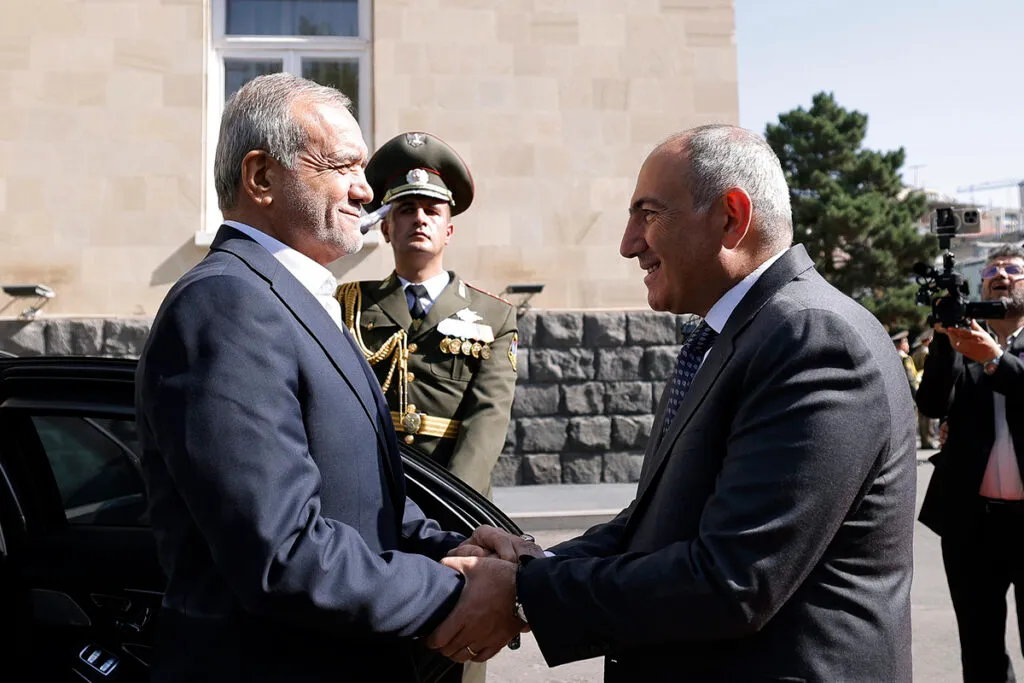
The war against Iran has again highlighted the strategic importance of ties with the South Caucasus and Central Asia for Tehran, Alireza Khoda Gholipour said in Yerevan. The director general of the Iranian Foreign Ministry’s Center for Political and International Studies said new documents are expected to be signed soon, raising relations with Armenia to the level of a strategic partnership.
According to Khoda Gholipour, ties between Iran and Armenia have developed and expanded year by year. Every country in the region matters to Iran, he said, but the level of each relationship differs according to complementary needs, shared interests and common concerns.
TRIPP cannot replace other routes
Discussing regional connectivity, the Iranian expert said security and development are closely linked. He described the project known as the Trump Route, or TRIPP, as just one of the region’s transport routes. New projects should complement one another rather than exclude existing routes, he argued.
“Iran’s route and its position are irreplaceable,” he said. Iran has historically connected the Persian Gulf with Central Asia, the Caucasus, the Black Sea and Europe. In his view, any attempt to leave Iran outside the region’s economic system by developing new routes would be “a serious misunderstanding” and unacceptable.
In this context, Khoda Gholipour drew particular attention to the North–South corridor, calling it one of the world’s most important projects. He said only a short section remained to be completed in Iran and expected that work to finish soon. Once fully operational, the project could bring substantial economic growth to the region, he said.
He also warned that actors from outside the region could use such projects for political purposes. According to Khoda Gholipour, this concern has been conveyed to the Armenian government.
Iranian gas supplies to Armenia are feasible, he says
Khoda Gholipour said Iran was prepared to help meet Armenia’s energy needs and that technical talks were already under way.
“Such a prospect is quite realistic,” he said. Although Iran’s main gas reserves are in the south, its oil and gas network covers almost the entire country, leaving no technical obstacle in his assessment. He cited long-standing supplies to Türkiye and Iraq as examples. The main issue is calculating the costs, he said, while political will and the necessary capacity are in place.
Russia cannot be removed from the regional balance
Asked about a possible weakening of Russia’s position in the South Caucasus, Khoda Gholipour said it remained an influential actor. He regarded the idea of excluding Russia from the regional balance as unrealistic.
“Common sense suggests that countries seek to diversify their ties rather than replace one partner with another,” he said, adding that he believed Armenia’s leadership understood this.
👉 Politics