
Railway officials from Uzbekistan, Kyrgyzstan, Turkmenistan, Azerbaijan, Georgia and Türkiye recently signed a six-party protocol in Tashkent to develop the CASCA+ international multimodal route. Their cooperation aims to agree on practical conditions for carrying freight from Asia to Europe. The issues include cargo flows, tariffs, the availability of rail platforms and shorter delays at ports.
Armenia is not among the initiative’s participants. Its absence raises questions about the country’s involvement in regional transport projects and its ability to turn foreign policy relationships into economic gains.
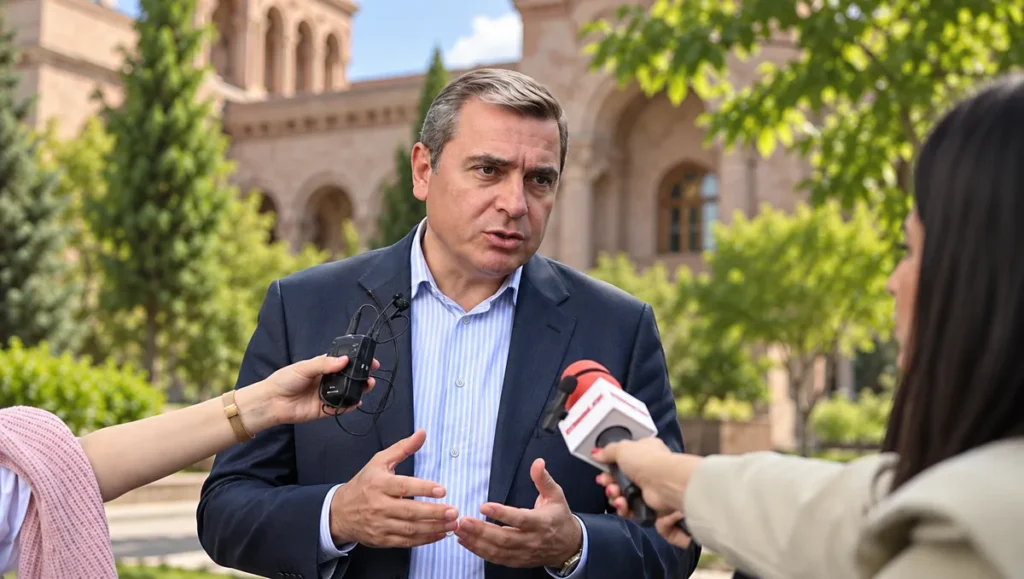
Economist and former State Revenue Committee chairman Davit Ananyan says the development of CASCA+ shows that countries in the region are taking practical steps to align their economic interests. Armenia’s participation in that process has not been secured, he argues.
Armenia remains outside regional economic cooperation
Ananyan recalls that an earlier format of the CASCA+ route was established in 2019 and that Türkiye joined in 2021. According to him, the “+” in the initiative’s name officially signals openness to new participants. Yet Armenia has not become part of this cooperation as it has developed over the years.
The economist contrasts the situation with the Armenian authorities’ statements about an era of peace and the country’s role as a regional crossroads. “On October 9, the prime minister declared, ‘We have achieved the impossible.’ During the preceding two days, six countries were engaged in something thoroughly productive: aligning their economic interests,” Ananyan says.
He also points out that Nikol Pashinyan met the presidents of Uzbekistan and Turkmenistan on October 8. Official statements mentioned deeper economic ties and regional cooperation, but no agreement on Armenia’s involvement in CASCA+ has been made public.
Foreign policy ties should produce economic results
In Ananyan’s view, foreign policy should be judged not only by political meetings and declarations of partnership, but also by tangible economic results.
He notes that Armenia and Georgia have a declaration of strategic partnership, while Armenia maintains political contacts with Central Asian states. What needs to be established, he says, is whether a proposal for Armenia’s inclusion was prepared, which partners supported it and what economic case was presented.
“If work was done, the public should know its results and the obstacles it encountered. If it was not done, there should be an explanation of why,” the economist says.
Ananyan acknowledges that Armenia’s absence from CASCA+ may not, by itself, be enough to assess the quality of its relations with those countries. At a minimum, however, he believes it warrants an answer as to why those ties have not secured Armenia’s participation in the initiative.
Transit routes have long-term economic consequences
Ananyan stresses that the issue extends beyond transit fees. In his view, warehouses, processing businesses, insurance services, investment and jobs will later gather around the routes being shaped today.
The economist argues that once economic links become established along routes bypassing Armenia, joining those systems later will be more difficult and more expensive.
Open borders, restored infrastructure and competitive tariffs are not enough without practical work, he says. Armenia must also convince its partners that its participation would benefit every side.
“The name ‘Crossroads of Peace’ alone will not do that work,” Ananyan says. In his view, the authorities should explain what place they have secured for Armenia in regional economic decision-making. Until then, he argues, claims of historic success do not match the published results.
Ananyan considers Armenia’s absence from decisions on regional transport development a serious problem. Presenting that situation as an achievement, he argues, means failing to recognise political responsibility or avoiding the issue.
👉 Economy