
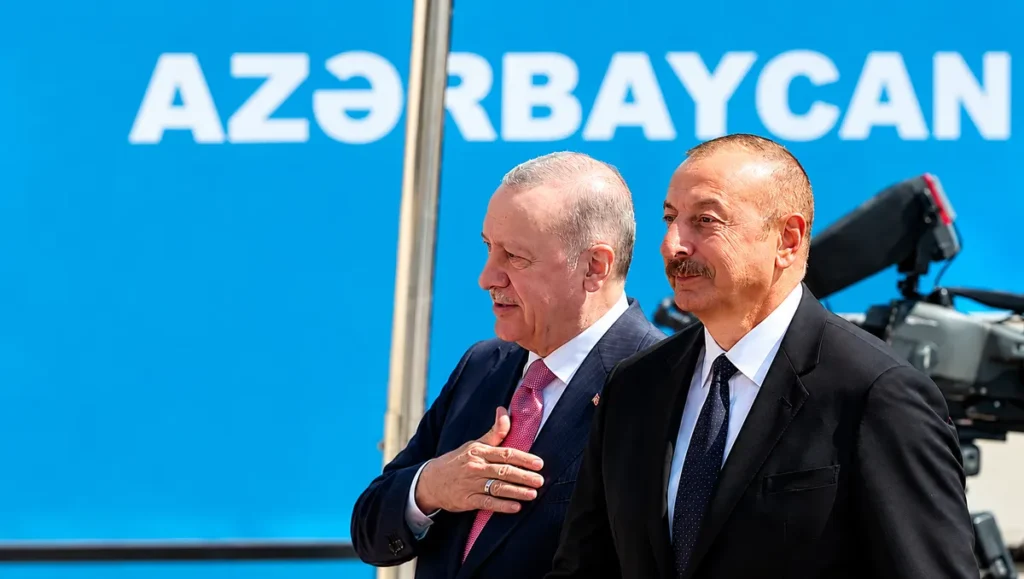
Turkey’s growing influence in the South Caucasus and Azerbaijan’s ambition to become a regional middle power are creating geopolitical differences between Ankara and Baku. However, the depth of their relationship makes it unlikely that the current disagreements will lead to a breakdown of their alliance. Turkey specialist Ruben Safrastyan offers this assessment in his analysis of developments between the two countries.
Turkey and Azerbaijan seek stronger regional positions
Safrastyan says understanding the situation first requires considering the changing balance of power in the South Caucasus. Russia’s weakening influence in recent years has strengthened Turkey’s position. Ankara is consequently seeking to establish a new regional status quo that better serves its interests.
A similar process is taking place in Azerbaijan. Baku is trying to increase its role in the South Caucasus and secure a new position in the regional balance of power.
The expert draws particular attention to Aliyev’s speech at his party’s congress, where the Azerbaijani president described the country as a middle power.
In Safrastyan’s assessment, this wording represents more than a change in rhetoric. It expresses Azerbaijan’s ambition to redefine its place in the international system, particularly at the regional level.
“Azerbaijan seeks to act as a state holding a dominant position in our region — the South Caucasus — compared with Georgia and Armenia,” the expert says.
According to him, Turkish and Azerbaijani ambitions are developing along somewhat parallel lines. By strengthening its influence in the South Caucasus, Ankara seeks to become one of the region’s geopolitical leaders. Turkey also has broader international ambitions and wants to consolidate its position as a major center of power.
Azerbaijan, meanwhile, is trying to move from the status of a small state to that of a middle power, increasing its political weight in the region.
Yet this is precisely where Safrastyan sees a clash of interests. Although Turkey and Azerbaijan are allies, each seeks to expand its own influence. While Ankara wants to strengthen its leadership in the South Caucasus, Baku is attempting to establish itself as an independent and dominant regional actor.
Aliyev wants to portray Azerbaijan as having won independently
A second important part of the expert’s analysis concerns the reshaping of national identity within Azerbaijan.
Safrastyan says Aliyev is trying to build Azerbaijani society’s identity around the idea of victory, presenting Azerbaijanis as a victorious people and the state as a country that achieved victory through its own efforts.
In his assessment, an important part of this process is how Turkey’s role in the 2020 Karabakh war is portrayed.
“We know very well how important Turkey’s role was in Azerbaijan’s victory in the last Karabakh war. But years have now passed, and Aliyev is trying not only to downplay Turkey’s role but to consign it to oblivion altogether,” Safrastyan says.
In his interpretation, Azerbaijan’s president wants to convey to his people that the country won through its own efforts, without emphasizing the decisive role of external support. This approach allows the victory to be presented as the result of Azerbaijan’s national and state capabilities.
Safrastyan also highlights the personal factor. In his assessment, Aliyev wants to enter Azerbaijan’s history as a victorious president who achieved that outcome through his own efforts, without relying on Turkish assistance.
The expert therefore sees symbolic and domestic political significance in the differences between Ankara and Baku.
The Israel factor and disagreements over political Islam
Safrastyan notes that the disagreements in Turkish–Azerbaijani relations also have more visible causes. One is the Israel factor; another concerns the role of political Islam.
He includes both among the principal reasons that, in his assessment, have led to the current state of relations between Ankara and Baku.
Erdogan’s call to Aliyev: using personal standing to ease differences
The expert also attaches considerable importance to the telephone conversation between Erdogan and Aliyev. He points out that Turkey’s president initiated the call and invited his Azerbaijani counterpart to the Organization of Turkic States meetings scheduled in Turkey on October 29–30, involving foreign ministers and national leaders.
Safrastyan interprets Erdogan’s initiative as an attempt to intervene personally in the difficulties between the two countries and ease their differences.
He believes Erdogan is seeking to use his personal standing to help smooth relations. In this context, Safrastyan also considers it significant that neither the Turkish nor the Azerbaijani official account of the call addressed the recent developments in relations between the two states.
In the expert’s assessment, this silence is deliberate. It may indicate that neither side wants to reveal the depth of the disagreements publicly or acknowledge that they are being discussed at the highest level.
Safrastyan is convinced that Erdogan and Aliyev also discussed the problems in their relationship during the call, but preferred not to make public statements about them.
In his view, both leaders are trying to avoid a further escalation of differences and move toward resolving the difficulties in their relationship.
Differences will not break the alliance
Safrastyan’s overall assessment is that, despite the disagreements that have emerged, Turkey and Azerbaijan have such deep ties that a rupture resulting from current developments is unlikely.
The expert believes a meeting between Erdogan and Aliyev within the Organization of Turkic States framework could become the next stage in easing relations. He expects that the leaders could take more concrete steps during their meeting to address the problems and continue cooperating.
“My overall assessment is that the two countries have such extensive ties with each other that I do not think either is prepared to sever them as a result of these events. They will try to smooth relations and move forward as allies,” Ruben Safrastyan concludes.