
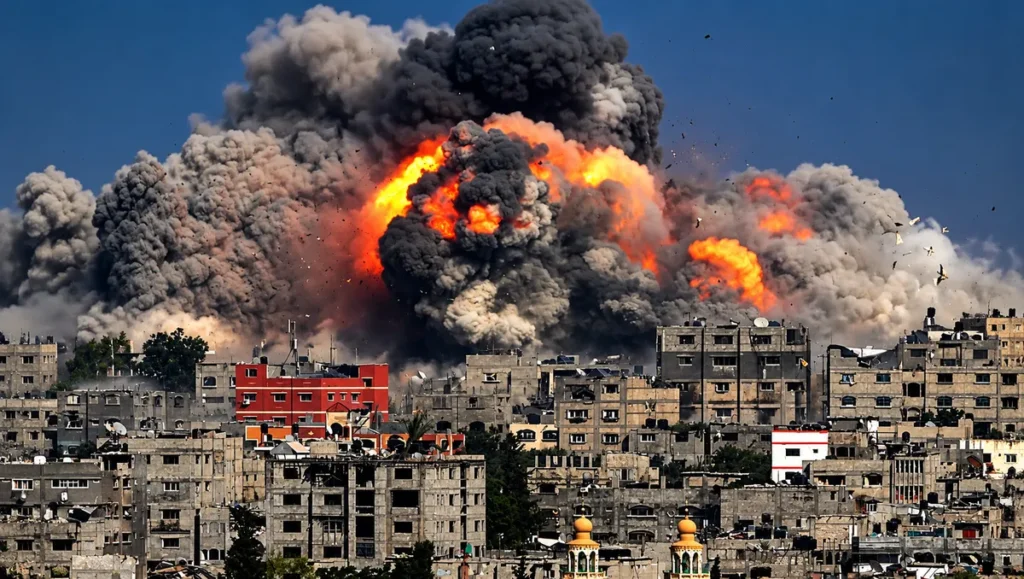
During the war against Iran, the United States and Israel have managed to establish air superiority. However, Iran’s missile capabilities and unmanned systems continue to pose challenges for their adversaries, military expert Leonid Nersisyan said.
Iran is outmatched in the air but continues missile strikes
“In practice, the Iranian side can destroy a certain number of drones. But that amounts to almost nothing given the number of systems being deployed,” the expert said. He noted that some components of Iran’s air defenses remain operational.
According to Nersisyan, Iran’s air force cannot match the air capabilities of the United States and Israel. The country’s naval forces have also suffered heavy strikes. Nevertheless, Iran retains certain capabilities, particularly in the use of drones. The geography of the Iranian coastline and its numerous natural hiding places also make countering these systems more difficult.
Nersisyan also drew attention to Iran’s missile capabilities. He said the intensity of missile strikes had declined during the war, but the attacks had not stopped. The expert highlighted reports of the use of missiles with a range of approximately 4,000 kilometers. That capability, he noted, could come as a surprise to Iran’s adversaries.
“Iran had objectively reached a fairly advanced level in missile development,” he said.
Reopening the Strait of Hormuz does not mean the problem is solved
Control of the Strait of Hormuz and the restoration of shipping remain important aspects of the war. According to Nersisyan, one possible objective of operations against Iran is to establish control over Kharg and Qeshm islands. This could be considered one way of reopening the strait.
The expert stressed Kharg Island’s particular importance to Iran’s oil exports. According to the figures he cited, approximately 90 percent of the country’s oil exports pass through the island. It has the infrastructure needed to handle large oil tankers.
Qeshm Island is also strategically important because of its location near the Strait of Hormuz.
However, Nersisyan argued that even gaining control of the islands would not guarantee the full restoration of shipping through the strait.
“One or two missiles or drones falling into the water near ships each week would be enough to stop vessels from using the strait. Insurance companies would simply refuse to insure the ships, and the ships would refuse to enter,” he said.
Thus, even if the United States manages to secure control of certain strategic territories through military action, Iran could retain some ability to influence shipping and global energy markets.
The end of the war does not necessarily mean the end of the conflict
According to Nersisyan, the war could end through a variety of scenarios. The United States could declare military victory and withdraw from the conflict. Iran, however, could continue striking American bases in the region. Washington would then have to decide whether to continue military operations or try to reach an agreement with Tehran.
Another possibility is further escalation, including more extensive ground operations. But the expert believes such steps would carry significant risks, particularly if the war becomes prolonged.
“A great deal can be achieved in the short term. But when all of this turns into a prolonged process, it usually ends badly for major powers conducting military operations far from their own countries,” Nersisyan said.
He cited Iraq as an example. A rapid military victory, he stressed, does not mean that subsequent developments will also be predictable or manageable.
The expert said Iran’s internal stability would remain an open question after the war. It would be necessary to determine whether the country could preserve its unity and whether newly influential players could reach an understanding with one another.
“I do not think anyone knows the answers to those questions. What I see suggests that the United States does not have a clear understanding of what will happen inside Iran either,” he said.
Destruction of Iran’s civilian infrastructure could have lasting consequences
Nersisyan warned that Iran’s long-term prospects could deteriorate seriously if the war continues and its civilian infrastructure becomes a target.
He singled out water supply systems, emphasizing that access to drinking water is a major concern for Iran. Serious damage to that infrastructure could deepen the country’s internal problems. Further strikes on oil infrastructure, including facilities on Kharg Island, could also have severe consequences.
According to the expert, such a scenario could affect more than the future of the current government. It could threaten the stability of the state itself and the conditions necessary for its continued existence.
At the same time, Nersisyan did not rule out the possibility that the war could end unexpectedly, without further military strikes by either side or a comprehensive political agreement.
“There are hundreds of different scenarios for how all of this could end. The war could end tomorrow, with neither Iran nor America launching any more strikes,” he concluded.