
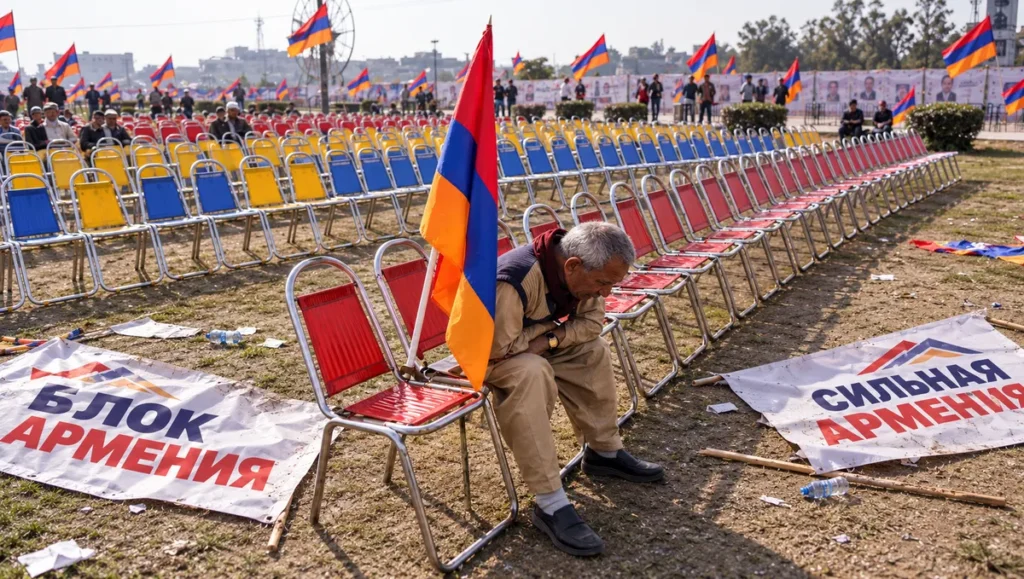
In several Armenian communities, Civil Contract won local government elections with 80–90% of the vote, facing almost no resistance. Yet just a few months earlier, in the June 7 parliamentary elections, opposition forces had achieved fairly impressive results in those same communities. What explains this change: the government’s authoritarian policies or the opposition’s inability to mount serious resistance?
Former Armenian Prime Minister and former National Assembly Speaker Khosrov Harutyunyan believes the result is primarily a consequence of deep public disappointment with the opposition’s political conduct. “There is clearly deep disappointment with the opposition’s political conduct,” Harutyunyan said, stressing that opposition forces had failed to meet public expectations even after the parliamentary elections.
According to him, the problem began with unrealistic expectations formed before the elections, largely centered on a change of government. Harutyunyan believes that replacing those in power should not, by itself, be the goal of political struggle. The central question should be what steps a political force proposes to ensure Armenia’s security, regardless of who leads the government.
“For me, as a citizen of the Republic of Armenia, whoever is in power — Nikol Pashinyan, Samvel Karapetyan, Robert Kocharyan or someone else — the demand will be the same: through your political actions, guarantee the security of this state, not only of my family but of all of us,” the former prime minister said.
The opposition, he argued, should have presented the public with a clear political roadmap to neutralize or at least reduce security threats. That roadmap should have addressed Armenia’s territorial integrity, the inviolability of its borders and the safety of its citizens.
Parliamentary elections became a choice of savior
In Harutyunyan’s assessment, the election campaign centered largely on who should become prime minister rather than on programs and approaches to governing the country. He says there was almost no discussion of which team would run the state, who would serve as finance or foreign minister, and what policies would follow if the opposition came to power.
Harutyunyan also agreed that polarization, mutual hostility and hatred between the government and the opposition played an important role in political developments. He believes, however, that this atmosphere could not produce an effective political outcome. “Hatred is a sign of weakness,” he said, adding that political forces should have built public demand around ensuring Armenia’s security rather than simply changing the government.
According to him, the opposition needed to demonstrate that its aim was not revenge, but to make peace based on the norms of international law practically irreversible. Such a program, Harutyunyan believes, needed to be acceptable both to Armenian society and to external actors.
The opposition missed a chance to strengthen its position in parliament
The former prime minister also believes the opposition missed an opportunity after the parliamentary elections to secure institutional guarantees for its work.
He recalled the debate over whether opposition parties should take up their parliamentary mandates. Harutyunyan argues that the decision to accept those seats should have been tied to an agreement with the authorities on clear demands.
“Even if you intend to take your mandates, at least present the authorities with demands concerning the legal guarantees the opposition must have to ensure its political viability,” he said.
Harutyunyan’s proposals included strengthening parliamentary oversight and reserving key positions for the opposition. In particular, he had proposed assigning the chairmanship of the committee on financial and budgetary affairs to the opposition to strengthen oversight of budget discipline and the effective, targeted use of public funds.
He also considered opposition representation in the offices of the Human Rights Defender and the head of the Audit Chamber important as a possible way to strengthen checks and balances.
In a parliamentary system, Harutyunyan said, the government is an extension of the political majority within the executive branch. An effective system of counterweights between the majority and minority is therefore necessary.
Harutyunyan acknowledges that opposition lawmakers sometimes deliver forceful, well-reasoned speeches that expose manipulative statements by government representatives. Yet he says criticism alone is insufficient to generate a political process. “I see that, but we have no result. None of it generates a political process within the opposition,” the former prime minister concluded.