
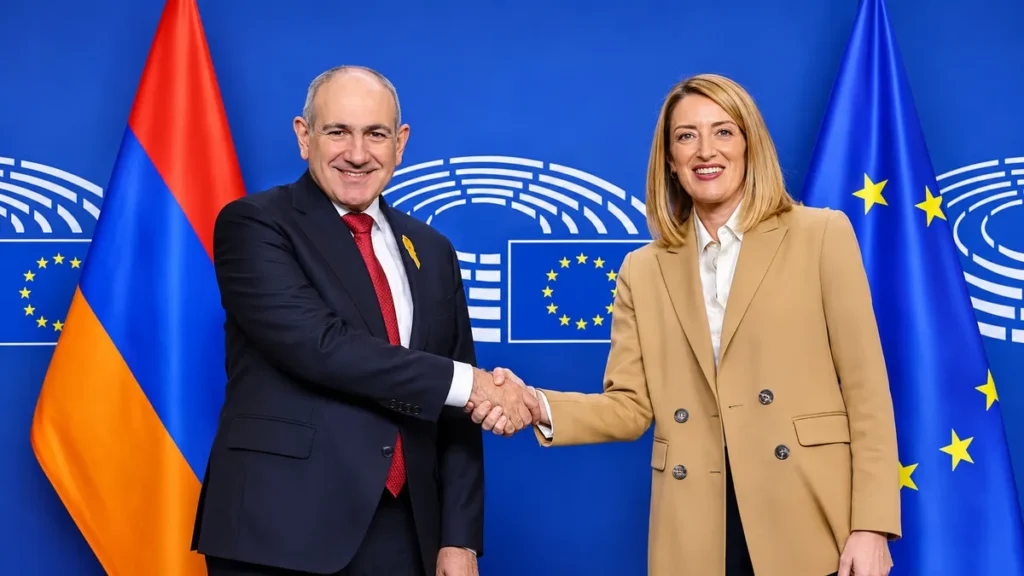
Armenian Prime Minister Nikol Pashinyan’s statement about applying for European Union membership in 2027–2028 has unsettled Brussels itself rather than irritated Moscow.
Political commentator Hakob Badalyan believes Europe has yet to receive what it most expects from Armenia: a signed peace agreement with Azerbaijan. Talk of Yerevan applying for EU membership now places new responsibility on Brussels. In Badalyan’s assessment, Pashinyan’s visit to Brussels did not produce the result he expected, as shown, in his view, by the subsequent use of coercive measures against the opposition. “For the European Union, Armenia’s wish or application, if formally submitted, will be a significant burden and a source of responsibility,” Badalyan says.
According to him, the EU already bears responsibility toward Armenia, but that responsibility has not produced the desired result. Europe’s principal expectation is the signing of a peace agreement between Armenia and Azerbaijan. In his view, meeting the conditions set by Azerbaijan is necessary for that to happen.
Badalyan recalls that Europe placed its regional hopes on the signing of that agreement amid the circumstances created by Armenia’s defeat and the departure of Armenians from Artsakh. In December 2024, Azerbaijani President Ilham Aliyev received Charles Michel, then president of the European Council, in Baku and thanked him for shaping the agenda of the Armenian-Azerbaijani peace process through the Brussels format. Badalyan says this episode shows how important the process was to the European side.
The agreement has not been signed, however, so Europe has not obtained the outcome it expected. Under these circumstances, Armenia’s intention to apply for EU membership, in the commentator’s view, does not encourage Brussels but confronts it with new obligations.
Europe also continues to bear the financial, economic, social and psychological burden of the war in Ukraine. Badalyan argues that the EU is unlikely to want additional responsibility in the Caucasus under these conditions, particularly before its principal expectation has been met.
Europe wants Armenia to close its doors to Russia
In Badalyan’s assessment, what matters more to Brussels today is for Armenia to sever ties with Russia than to knock on Europe’s door.
“What satisfies Europe now is simply for Armenia to slam shut as many doors connected to Russia as possible. That is what matters to Europe: shutting the doors connected to Russia, rather than knocking on Europe’s door,” the political commentator says.
He also links the process to deepening tensions between the United States and the European Union. According to Badalyan, Europe can no longer rely on Washington’s geopolitical backing and must carry the full weight of its goals and ambitions itself. The disagreements between Trump and European elites, he says, are reflected in the South Caucasus as well.
As an example, Badalyan points to an article published after the August 8 declaration by James O’Brien, an assistant secretary of state under a Democratic US administration. According to the commentator, O’Brien urged Trump to implement the “Trump Route” together with the European Union. Trump did not heed that appeal, Badalyan says, and the EU was effectively left out of a significant part of the developments in the Caucasus.
Under these circumstances, Brussels considers it more important to complete the Armenian-Azerbaijani peace process begun in its own format. As long as the agreement remains unsigned, Armenia’s intention to knock on Europe’s door cannot, in Badalyan’s view, satisfy the European side.
Pashinyan’s proposal did not win approval in Brussels
Badalyan also judges the outcome of Pashinyan’s visit by the events that immediately followed it. He says that after returning from Brussels, the prime minister turned to coercive and law enforcement measures instead of working with the opposition through political proposals and discussions.
Before the visit, Pashinyan had said that snap elections might be held if he could not persuade the opposition on the constitutional issue. Later, he changed his tone, saying snap elections would most likely be unnecessary because he intended to make the opposition an offer it could not refuse. The offer concerned voting in favor of the draft constitution.
Badalyan believes Pashinyan was trying to reassure the EU with that statement and discuss the proposal in Brussels. Yet, in his assessment, the use of coercive measures against the opposition immediately after the visit showed that this approach had not won approval.
“The fact that immediately after Brussels Nikol Pashinyan goes to the opposition’s door not with a proposal, not with a political proposal, but with coercive law enforcement tools indicates that in Brussels either his idea was not approved and did not inspire confidence, or they expected precisely the opposite from him: tougher actions rather than political discussions with the opposition,” Badalyan says.
He also connects these developments to the Democrats’ success in the US congressional midterm elections. According to Badalyan, Pashinyan, who several months earlier had expressed dissatisfaction with Democratic policy and emphasized progress with Trump in the Armenian-Azerbaijani process, is now trying once again to win the favor of Democratic circles and Europe.
In the commentator’s assessment, Pashinyan’s statements about snap elections in Armenia also unsettled groups with pro-Western and anti-Russian positions. The leader of one such group said snap elections would make no sense if the parliamentary opposition were allowed to take part and its participation were not blocked. Badalyan says this was a warning not only from that group but also from European or Western liberal-globalist circles. Those circles, he argues, have placed their hopes on the signing of an Armenian-Azerbaijani peace agreement and want Armenia’s domestic political developments to align with their expectations.
Azerbaijan has obtained what it wanted without signing the agreement
Badalyan also questions the claim that Azerbaijan is interested in signing the peace agreement as soon as possible. According to him, an unsigned agreement gives Baku opportunities no less valuable than those it would gain from signing it.
The commentator says Baku has already obtained the minimum it needed in exchange for the agreement’s initialing. He points to what he describes as Armenia’s unilateral concessions on the unhindered use of the road, the dissolution of the OSCE Minsk Group co-chairmanship, and the Armenian authorities’ accommodating stance toward Azerbaijan’s demand concerning the Declaration of Independence.
According to Badalyan, Armenia’s authorities themselves portray the Declaration of Independence as illegitimate in political and politico-legal terms, thereby satisfying Azerbaijan’s demand. “Unfortunately, Azerbaijan has obtained all this and, in essence, has no particular motivation to sign the peace agreement at the earliest opportunity,” he says.
In his assessment, the failure to sign the agreement could become a problem for Pashinyan. But if the prime minister can keep the process stable, it could become an exceptional instrument for domestic political use. He could continue to create an impression of progress in the peace process without signing the agreement.
Badalyan believes the only center that has truly staked its position on the agreement being signed is the European Union or, more broadly, the Euro-Atlantic liberal-globalist wing. Progress in some areas of the process has already occurred through other political actors, including Trump, but there has been no progress toward signing the agreement. That, in the commentator’s view, is Brussels’s main unresolved problem.
👉 Politics