
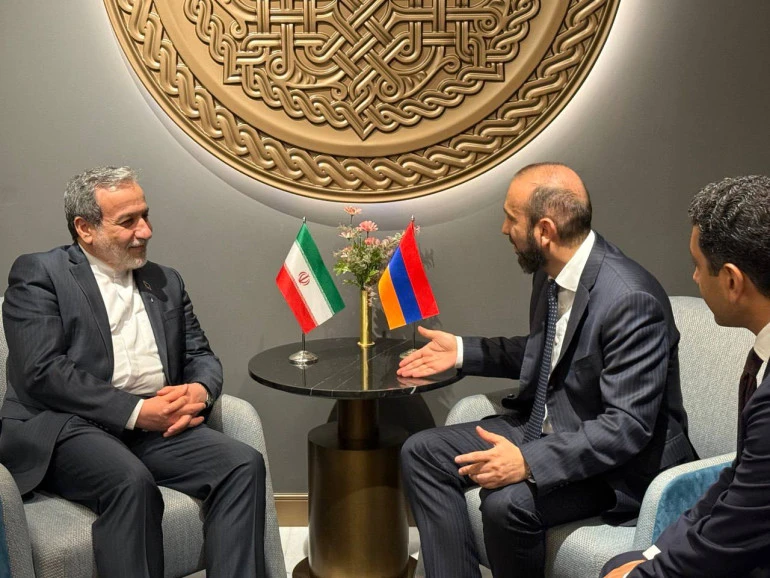
Ali Akbar Velayati’s criticism of Armenian Prime Minister Nikol Pashinyan is a political message, Iran expert Tigran Davudyan says. Velayati is an international affairs adviser to Iran’s supreme leader.
According to Davudyan, one feature of Iran’s political system is that two centers of government operate in parallel: the presidency and the office of the supreme leader. Their powers and spheres of influence sometimes overlap.
“Imagine: Iran has a foreign minister, while the supreme leader also has a foreign affairs adviser. Iran has a culture minister, and the leader has a cultural adviser. It is almost as though there are two governments: one belonging to Mr. Pezeshkian and the other to the supreme leader,” the Iran expert said.
In his view, this difference is also visible in Tehran’s approaches to Armenia. Foreign Minister Abbas Araghchi says Iran trusts its Armenian partners, while the supreme leader’s international affairs adviser sharply criticizes Armenia’s prime minister and his policies.
Davudyan recalled that on November 17, Araghchi again affirmed Iran’s position of trusting statements by its Armenian partners.
The sequence of events is also striking, he said. Just two days after Velayati’s strong statements, a high-level Iranian delegation led by an official at vice-presidential level arrived in Yerevan for the 19th meeting of the Armenia–Iran intergovernmental commission.
“These developments are happening in parallel. On one side, we see Iran’s official views in statements by President Pezeshkian and the foreign minister. On the other, we have Mr. Velayati’s statements, and this is not the first time he has made them,” Davudyan said.
Davudyan also does not believe the timing of Velayati’s critical message was accidental. He said it was published about 24 hours after Donald Trump’s party lost and the Democrats won the US congressional midterm elections.
The Iran expert also examined the content of the 25-point open letter addressed to Armenia’s prime minister. Having read it, Davudyan said, he had the impression that it was drafted in haste. In his view, contradictions between some of its points suggest Velayati did not write the entire text himself and that his aides also helped prepare it.
As an example, Davudyan pointed to a passage criticizing the renaming of the “Zangezur Corridor” as the “Trump Route.” That wording could give the impression that the Iranian side accepts the term “Zangezur Corridor.” Yet another passage cites the supreme leader’s position that no “Zangezur Corridor” can exist.
Addressing Iran’s concerns, Davudyan stressed that Tehran has historically viewed any project connected with the United States with deep suspicion.
He said the Islamic Republic of Iran has been at odds with the United States since its founding. This explains its sensitivity to American influence in neighboring countries.
“They know that some of their 16 neighbors are officially allies of the United States. Turkey, for example, is a NATO member; Pakistan is one of the United States’ closest friends; and there are also the Arab countries to the south. They are very concerned about Azerbaijan too, because they say there are Israeli bases there,” the Iran expert said.
According to Davudyan, Tehran does not want new security concerns to emerge in its relations with Armenia. He emphasized that Armenia is Iran’s only Christian neighbor and that the two countries have always had good relations.
“That is why they do not want another cause for concern involving a northern neighbor, Armenia, with which they have always had very good relations and want to preserve them,” Davudyan said.
Davudyan also discussed whether Iranian freight operators could use the Trump Route. He said no provision prohibits Iranian businesses from using it.
“Let us put the question this way: does it say anywhere that an Iranian truck or an Iranian businessperson has no right to use the Trump Route? There is no such clause,” he said.
According to the Iran expert, Iran actively transports goods to Europe, sending thousands of trucks in different directions every day to carry exports and imports. At present, those trucks generally reach Europe through Turkey, including via Iran’s historic Maku region, or enter Nakhchivan from Julfa before continuing to Turkey. Some freight bound for Northern Europe travels through Azerbaijan. Iranian trucks use the route through Armenia relatively rarely.
Davudyan said some Iranian businesspeople are already interested in the Trump Route and are considering using it because freight traffic at the Iran–Turkey border crossings is heavy.
In his assessment, this is another consideration when evaluating Iran’s position: Tehran’s political concerns do not preclude Iranian economic interest in the route.
👉 Regional