
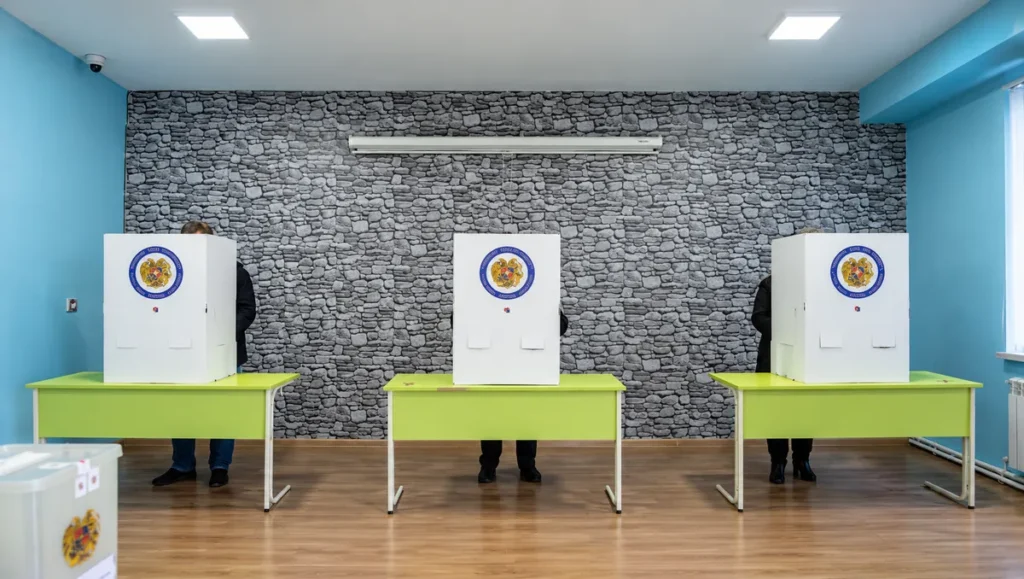
Civil Contract’s landslide victory in the October 25 local elections, the opposition’s non-participation and a sharp decline in voter turnout point to deeper problems in Armenia’s electoral processes. This assessment comes from Varuzhan Hoktanyan, an anti-corruption expert at the Transparency International Anticorruption Center.
In Hoktanyan’s assessment, the electoral process is affected by the misuse of administrative resources, pressure on the opposition and voters’ perceptions of their ability to influence election outcomes.
Commenting on the local election results, Hoktanyan emphasized that the opposition’s non-participation and Civil Contract’s overwhelming victory must be considered alongside the sharp fall in turnout.
According to him, no more than half of eligible voters went to the polls in most communities, while turnout in some places fell below 40%. The highest turnout was recorded in Stepanavan, at around 69%. The expert believes turnout is another important factor in understanding what actually happened during the elections.
Misuse of administrative resources and selective justice
Hoktanyan considers unequal opportunities among major political forces a serious electoral problem, manifestations of which were also visible during the campaign.
He noted that the Anti-Corruption Committee actively responded to cases of vote buying by opposition forces. Meanwhile, widespread misuse of administrative resources, which he believes occurred during both the parliamentary elections and the October 25 local elections, has not received adequate attention.
Hoktanyan described this as an approach characteristic of authoritarian systems: government representatives receive lenient treatment, while the law is applied to political opponents with maximum severity. He said this situation, together with the main opposition forces’ defeat in the parliamentary elections, could have influenced the opposition’s subsequent decisions.
He explained this through the logic of what is known as rational choice. If political forces have already spent substantial amounts on an election and lost, they may question whether investing comparable resources in the next campaign makes sense. In his assessment, this situation became more pronounced in local elections, particularly on October 25.
Voters stayed away because they saw no way to influence the outcome
The expert does not rule out that voter behavior also had a significant impact on the election results. He said studying electoral behavior is important for understanding why people participate or do not participate in elections and what circumstances shape their choices.
In Hoktanyan’s assessment, some voters may have concluded that voting against the government under the existing conditions would achieve nothing. They may therefore have seen no point in participating or supporting another political force. He also said he takes seriously reports that some citizens were warned they could lose their jobs if they supported the opposition.
“I do not rule it out, and I consider it highly likely that there were many such cases. Naturally, under these conditions, especially when a voter does not know whether their vote is genuinely secret, this can affect their behavior,” Hoktanyan said. He noted that, although ballot secrecy is declared, voters’ confidence that this principle is actually upheld also matters.
In Hoktanyan’s assessment, opposition forces may have decided under these circumstances to stop spending large sums on elections. Some voters, in turn, may have felt that their votes could not change the outcome.
The expert also recalled developments following the 2021 local elections. According to him, representatives of opposition forces that won in certain communities subsequently faced pressure. He specifically mentioned Gyumri and Vanadzor.
Hoktanyan believes these circumstances show that the problem extends beyond the results of individual elections. The deeper question is whether citizens and political forces in Armenia have a genuine opportunity to influence the formation of government and local governance through elections.