
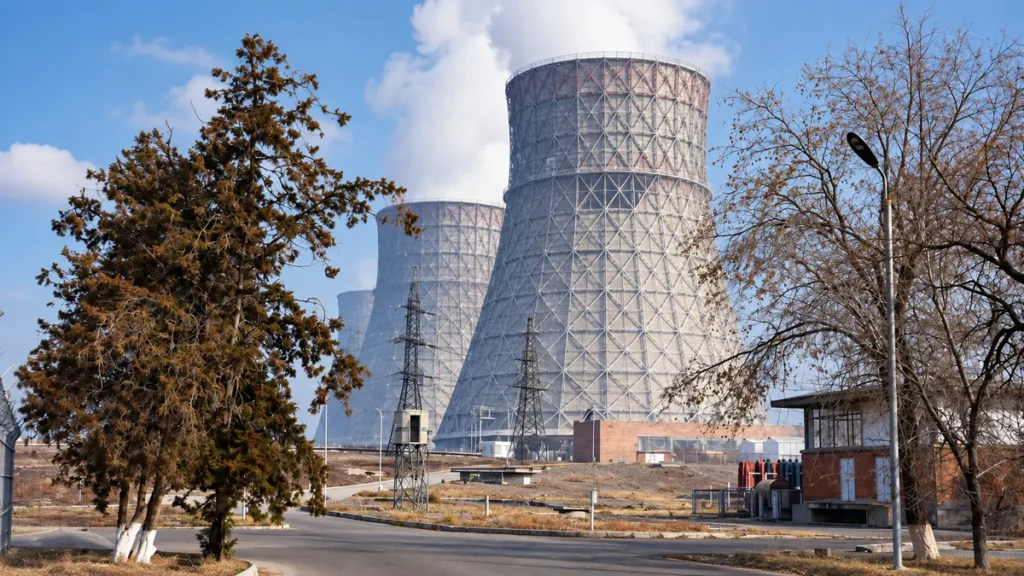
Armenia does not have much time left to choose the technology for its new nuclear power plant. Ara Marjanyan, a UN expert on energy issues, said this.
Building a New Nuclear Power Plant Will Require at Least 10–12 Years
According to him, constructing a new nuclear power unit usually takes approximately 10–12 years, while the guaranteed operating life of Armenia’s existing nuclear power plant is expected to be extended until 2036.
Marjanyan said that after the technology for the new nuclear power plant is selected, a number of other important decisions will still have to be made. The design and construction process itself will also require considerable time. “It usually takes approximately 10–12 years. This means that we do not really have much time,” he said.
At the same time, the expert added that the operating life of the existing unit could theoretically be extended again. According to Marjanyan, an additional study must be conducted in 2031, including an examination of the reactor’s metal condition. Only then will it be possible to determine whether the unit can continue operating.
“Theoretically, VVER-type reactors can operate for up to 80 years,” he said, noting that the Armenian reactor was commissioned in 1980. Therefore, another extension of the existing nuclear power plant’s operating life after 2036 cannot be ruled out. However, this possibility must be assessed following the relevant technical studies.
What Options Are Available?
In his assessment, the most likely option is to build the new reactor at the site of the existing Metsamor Nuclear Power Plant. In this case, he said, the project would involve constructing a new reactor at the Armenian Nuclear Power Plant.
Pressurised water reactors are among the main technological options under consideration. They account for the overwhelming majority of nuclear reactors currently operating worldwide. According to Marjanyan, approximately three quarters of operating reactors are pressurised water reactors, while more than three quarters of the new reactors currently under construction also use the same technology.
“Pressurised water reactors are technologies that have proven their reliability and demonstrated their efficiency,” Marjanyan said. At the same time, he noted that other technological solutions also exist, including boiling water reactors, fast-neutron and breeder reactors, as well as small modular reactors.
Global Experience with Modular Reactors Remains Limited
According to Marjanyan, the main advantage of small modular reactors is their relatively low initial capital cost. Compared with a large 1,200 MW pressurised water reactor, the investment required for their construction at the initial stage is substantially lower. In theory, the first such unit could also be built within a shorter period of approximately five to seven years.
However, modular reactors have one significant problem: operational experience remains extremely limited. Only two such reactors are currently operating worldwide—one in Russia and the other in China—and both were commissioned only recently.
According to him, under these circumstances, it is difficult to claim that sufficient practical experience has already been accumulated regarding the safety of modular reactors. In particular, it cannot simply be stated that evacuation zones would not be required in the event of an accident.
Marjanyan believes that such a claim is based on a misunderstanding. The need for evacuation zones is determined by analysing actual accidents and their consequences, while global experience with modular reactor operations remains far too limited to support such conclusions.
A 600 MW Reactor Is Not Too Small for Armenia, but Demand Could Increase
According to Marjanyan, Armenia sometimes discusses whether a 600 MW pressurised water reactor would be too large for the country. In his assessment, this capacity would not be excessive for Armenia. He drew attention to the fact that the country’s future electricity demand could rise substantially.
In particular, data centre construction projects are developing, and new, significantly higher demand is expected in this area. According to Marjanyan, this could involve approximately 100 MW of guaranteed additional capacity. He identified the development of Syunik’s mining and metallurgical cluster and the possible expansion of advanced processing industries as another source of increased electricity demand.
Therefore, Marjanyan believes that determining the capacity of the new nuclear power unit requires consideration not only of Armenia’s current consumption but also of the industrial and technological developments that could substantially increase the country’s electricity demand in the coming years.