
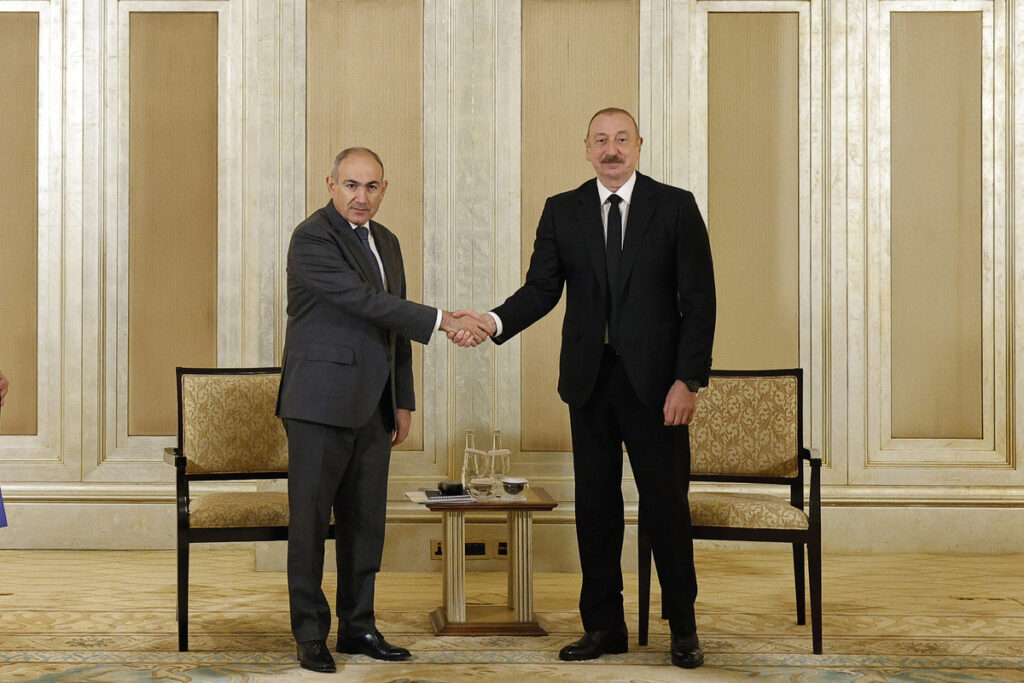
Despite claims that all points of a peace treaty have been agreed upon, the settlement process between Armenia and Azerbaijan has effectively reached an impasse. The parties are not taking concrete steps toward the final stage—signing the agreement or initiating its implementation. Amid this diplomatic pause, statements filled with ambiguous phrasing continue to emerge. In this context, every word becomes a subject of political analysis and speculation, and the process increasingly resembles a game marked by zero trust.
Peace in Words, Challenges in Reality
Against this backdrop, a statement by Hikmet Hajiyev, Assistant to the President of Azerbaijan, made in late July 2025 in an interview with the German publication Berliner Zeitung, drew particular attention. Hajiyev emphasized that “military confrontation or escalation between Armenia and Azerbaijan is not currently on the agenda” and assured that the parties are continuing work on finalizing the peace agreement.
“Only a few contentious issues remain, which is natural, but they can be resolved through diplomacy and dialogue. There is real peace in the South Caucasus,” he stated.
Hajiyev also noted that the constructive nature of the current dialogue stems from the process being entirely in the hands of the parties themselves. “Neither Russia, nor the European Union, nor the United States were present at these negotiations. The room contained only Armenians and Azerbaijanis. We engaged in a civilized dialogue. We don’t need anyone dictating how to live in peace,” he stressed.
Additionally, he highlighted the risk of a so-called “new wave of revanchism” in Armenian society and reiterated Azerbaijan’s dissatisfaction with Armenia’s Constitution, which Baku perceives as containing “territorial claims against Azerbaijan.”
What Lies Behind the “Peaceful” Rhetoric?
Beneath the outwardly conciliatory rhetoric lie several key signals that raise concerns, particularly in the context of the ongoing diplomatic stalemate.
First, the phrasing that “military confrontation is not on the agenda” does not rule out the military option entirely. It reflects the current situation rather than a long-term strategic stance. The temporal qualifier—“not now”—leaves room for pressure and maneuvering, especially given the persistent tension along the line of contact and recurring border incidents.
Second, Hajiyev once again explicitly links the signing of a peace treaty to constitutional reforms in Armenia, effectively setting this as a precondition for Baku. This framing suggests that Yerevan is the one delaying the process, placing the responsibility for the deadlock on the Armenian side.
Third, the deliberate exclusion of international mediators is significant. Hajiyev emphasizes that only Armenians and Azerbaijanis were in the negotiation room, seemingly sidelining the EU, the US, and Russia. While this may appear as a sovereign approach, in practice, it limits external influence and reduces international guarantees, which benefits Azerbaijan’s reluctance to commit to an agreement.
Azerbaijan’s ostensibly moderate rhetoric conceals a rigid logic of pressure. The stalled negotiations, ongoing border tensions, and attempts to shift responsibility onto Yerevan indicate that the path to peace remains fraught with challenges. For Armenia, maintaining diplomatic momentum, engaging international partners, and developing a clear strategy to counter pressures and achieve sustainable peace are critical.