
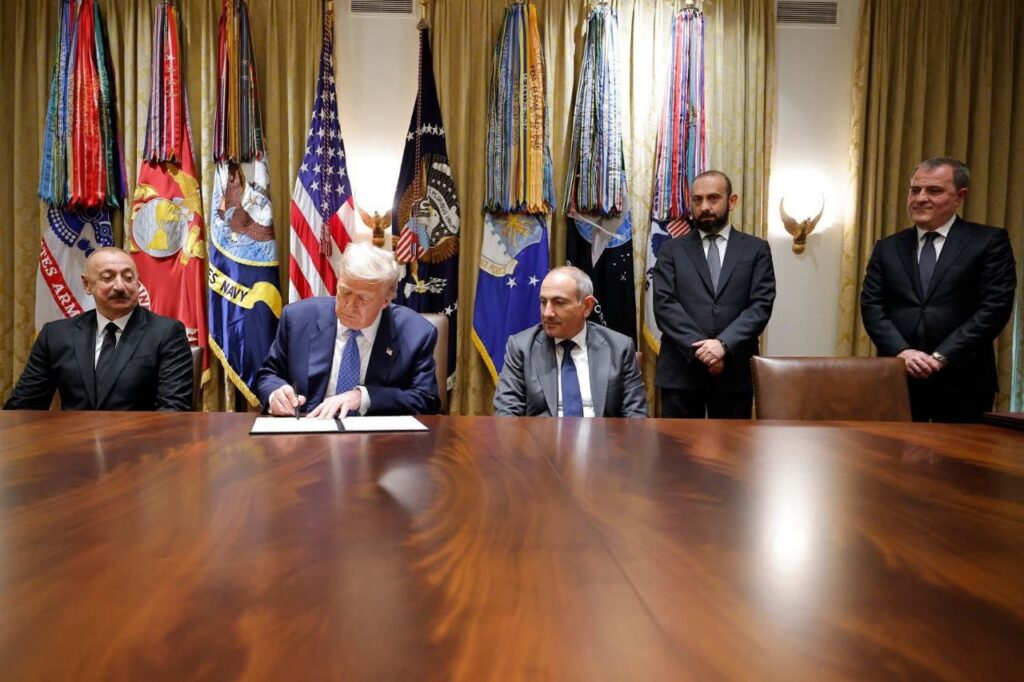
In the November 9, 2020, agreement, there were three parties involved. Russia acted as the third party, whereas in the Washington agreement there are only two parties, and the United States was merely present. This, according to political analyst Alen Ghévondyan.
“From the perspective of international law, there are nuanced differences, which are also connected to the idea of a guarantor ensuring the implementation of the agreement’s provisions. In practice, this guarantor does not exist. What we have is an Armenian-Azerbaijani agreement mediated by the United States,” he said.
According to Ghévondyan, agreements never automatically bring peace. Peace always comes through a balance of power, meaning that the parties understand that engaging in war or military operations primarily harms their own interests rather than solving the problems.
“For the current authorities, this agreement was very important, and over the past two years, Armenia’s current prime minister did everything to obtain it, because it could serve as a key political instrument during elections—shaping the narrative on peace in his favor. In reality, there is no peace. Peace is not just the absence of gunfire; peace means having internationally established, guaranteed obligations, institutions, and mechanisms that can deter any party—in this case, Azerbaijan—from taking military action,” Ghévondyan emphasized.
He stressed that the regional situation remains tense: “Two days ago, the Azerbaijani leader in Karvachar spoke about the Armenian society being ‘sick’ and mentioned the need to arm themselves. We see what is happening in the region—Iran is producing new long-range, precision missiles and releasing PR videos about them, deepening its military-political and technical cooperation with Russia and Belarus, deploying drones and air defense systems. Turkey is producing strategic drones. Meanwhile, some representatives in Armenia speak of peace, as if peace has already arrived in the region. Unfortunately, peace has not yet come,” Ghévondyan noted.
The analyst predicted that the Washington agreements are unlikely to be fully implemented. “The regional factors and interests are diverse, and even U.S. policy could change. Trump needed the agreement, and he got it—because he wanted to position himself for a Nobel Prize,” he said.