
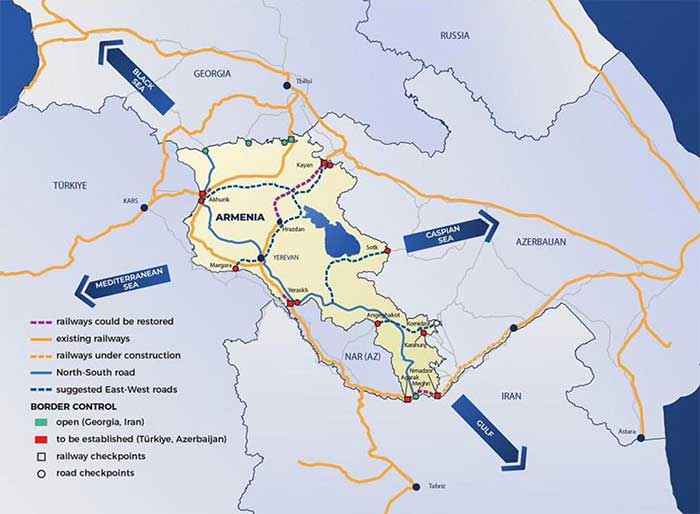
The idea of the Syunik corridor is not new; it has always been part of Azerbaijan’s strategic agenda and is included in the joint long-term plan of Ankara and Baku. Their goal in this direction is to gain control over the roads in Syunik without the participation of Yerevan or any other party. This was stated by Iranian political analyst Pouya Hosseini.
According to Hosseini, this is not only a threat to Armenia’s territorial integrity but also a challenge to Iran’s national security. He emphasizes that both Tehran and Yerevan must always be prepared to confront such risks.
Turkish President Recep Tayyip Erdoğan has called on Iran to support this initiative, presenting it as a means of integrating the Turkic world. However, as Hosseini reminds us, Azerbaijan has long had a road connection to Nakhchivan through Iranian territory, and Tehran is now offering an even more developed route. In this context, it becomes clear that the issue of the “corridor” is not technical but political: its goal is to strengthen Turkic control in the region. That is why Iran has repeatedly stated that the issue of Syunik is a “red line” for the country.
Hosseini notes that Azerbaijan’s policy is not independent and that Baku is significantly influenced by Turkey and Israel. Iran, in turn, is trying to balance the situation through diplomatic and military means to prevent large-scale military escalation. Despite local incidents, Tehran has so far managed to contain escalation while simultaneously strengthening its position in the South Caucasus.
Azerbaijan’s statements claiming that the road being built with Iran is an alternative to the Armenian route are, according to the analyst, propaganda. In reality, Armenia is not isolated and has more strategic road projects, such as the North–South Corridor, which connects India and Europe through Iran and Armenia. The Azerbaijani side is trying to impose an agenda that goes beyond road issues and could lead to new demands—from security control to ethnic repatriation. According to Hosseini, such a scenario threatens the very foundations of Armenian statehood.
According to the analyst, the military exercises Iran conducts with Armenia and Azerbaijan play an important role in maintaining strategic presence in the region. Although the initial exercises with Armenia were limited, Hosseini is confident that they will expand in the near future due to the absence of geopolitical backlash. This aligns with Iran’s overall strategy to ensure stability in the South Caucasus and to neutralize external influences.