
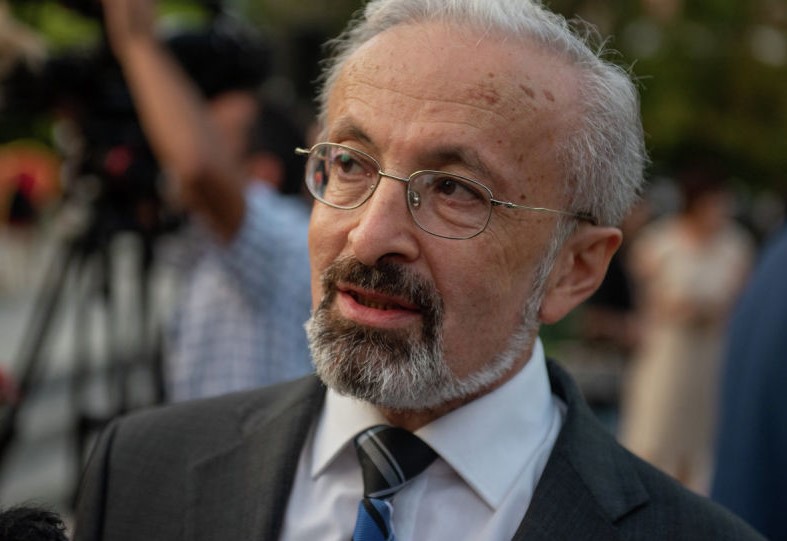
The publication of archival materials and the political debate around them returned the Karabakh settlement to the center of public attention. How should the documents be assessed? What is their diplomatic context, and could they have changed the course of history? These questions are addressed by Dr. Tigran Torosyan, former Speaker of the Armenian Parliament.
Not Every Material Can Be Called a Document
According to Torosyan, the published package was compiled carelessly, without clear principles or logic. It remains unclear why these specific materials were chosen among many others. He stresses that although the package was labeled as “documents,” it actually contains 13 unrelated items.
“Not every text can be called a document,” he notes. “Four of them are just materials that do not qualify as documents at all, and another four have nothing to do with the discussed issue.”
He adds:
“No one can seriously present a Q&A episode from parliament as an official document.”
This Is Not a Document but Ordinary Correspondence
Torosyan explains that the letter from Serzh Sargsyan to Vladimir Putin is not a document but regular diplomatic correspondence.
“Such exchanges between heads of state are routine. There is nothing extraordinary in these materials to justify presenting them as something sensational,” he says.
He adds that one of the texts concerns a proposal to amend another document, yet the original is not included.
“No proposal can be evaluated as a document without the main text next to it,” he emphasizes.
Documents from the 1990s Are Not Relevant — That Page Was Closed Long Ago
Some materials can be considered documents, but they relate to the 1990s. Torosyan notes that OSCE leaders had long set those aside.
“In the 1990s, negotiations followed a completely different logic, and the proposed models did not include the right to self-determination.”
He recalls that the current prime minister claimed the 1995 documents meant Karabakh’s status had already been defined as part of Azerbaijan.
“This is either ignorance or political hypocrisy. That negotiation phase ended in 1998. All versions implying Artsakh within Azerbaijan were already obsolete.”
The Real Starting Point Is After 2007
The right to self-determination entered negotiation texts only after the 2004–2005 PACE resolution on Karabakh. It stated that any settlement must rely on the free expression of will by the people of Artsakh.
Later the Committee of Ministers of the Council of Europe adopted a document listing the core principles of settlement. Among them, for the first time officially, was the principle of self-determination.
“In November 2007, the three key principles — non-use of force, territorial integrity and self-determination — were included in the negotiation document.
OSCE, UN, EU, Council of Europe — all recognized the existence of a self-determination issue.”
Thus, he says, all later developments must be assessed from 2007 onward.
In 2016, the Process Was Close to a Final Outcome
Torosyan notes that the published package includes a 2016 document consisting of three parts:
- a declaration on settlement principles,
- a joint statement of the Minsk Group co-chairs,
- a draft UN Security Council resolution — the key element.
“The important point is that in the 2019 package, this resolution draft appears unchanged but dated 2016,” he emphasizes.
This shows that by then the structure of the settlement was already formed. Comparing the 2016 and 2019 packages reveals the same resolution draft and only minor editorial differences in other components.
“When negotiations reach this phase, it means the process is nearing completion.”
He explains that the talks were tense due to constant Azerbaijani provocations. In such conflicts the same pattern repeats: when the dominant side turns to force, the international community prepares a format for imposed settlement — peacekeepers, mandates, enforcement mechanisms.
He cites examples: Kosovo, East Timor, South Sudan.
Pashinyan’s “Zero Point” Triggered Disaster
Torosyan believes that the process collapsed when the new authorities in 2018 announced a return to a “zero point,” nullifying previous progress.
“Nevertheless, the 2019 package appeared — largely repeating the 2016 version — but no negotiations were held around it. Instead, abstract ‘Munich principles’ were promoted as a universal solution. The implication is absurd: that the current disaster supposedly reflects the wishes of the peoples of Armenia and Artsakh.”
He insists the war could have been prevented had the negotiation process continued.
“When Azerbaijan used force in 2016, the co-chairs intervened immediately. The natural question is: why did they not intervene the same way in 2020?”
He concludes:
“If you declare the annulment of a process shaped by three permanent UNSC members, you must understand whom you are challenging.
If you return to principles unrelated to actual documents, the international attitude will change accordingly.”