
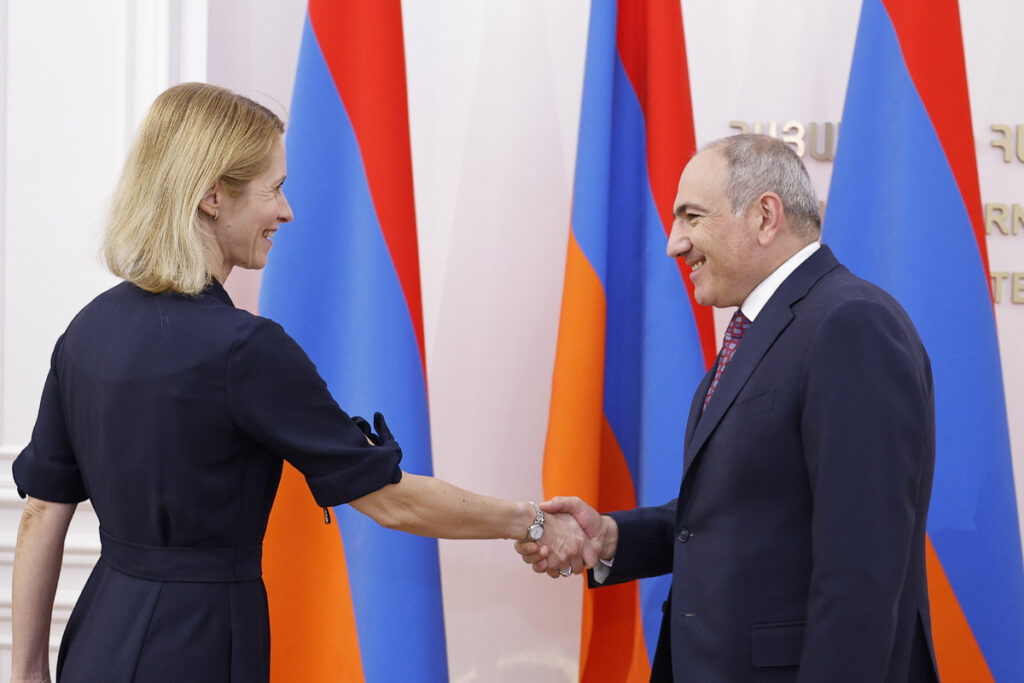
EU High Representative for Foreign Affairs Kaja Kallas has stated that Armenia has applied to the European Union for assistance. The request concerns countering external interference. Earlier, it was also announced that Armenia would receive 15 million dollars. The funds are intended to counter cyberattacks, hybrid threats, and Russian disinformation.
Which countries are actually waging a hybrid war against Armenia? How does the current government plan to use these funds? The assessment is offered by Hrant Melik-Shahnazaryan, head of the Voskanapat Analytical Center.
The Total Devaluation of Democracy
According to him, Pashinyan will exploit anti-Russian sentiment in Europe. This will be done to neutralize political opponents during the pre-election period. Instead of countering real hybrid threats, the authorities will target internal rivals. They will be portrayed as “agents of Moscow.”
In this way, true motives will be packaged in a form acceptable to Europe. “Nikol Pashinyan is a talented packager,” Melik-Shahnazaryan stresses.
“The most alarming issue is that institutions and states we trusted have become involved in this process. These were countries we viewed as guardians of democratic values. Today, a process of total devaluation is underway. As a result, democracy risks losing its value and turning into an object of ridicule,” he said.
The political analyst argues that the prerequisites for the authorities’ future actions are already visible.
“They speak about democracy, yet opposition figures are arrested under the same article. At the same time, those who carried out organized attacks against opposition activists are released,” he notes. According to him, Vazgen Saghatelyan and Narek Samsonyan were imprisoned under the hooliganism article. The reason was the use of a single word on air.
Meanwhile, the same article was applied to four or five individuals acting as an organized group. They followed their victim, Mihran Hakobyan, and attacked him from behind. He sustained bodily injuries. “These people prepared, attacked a person, and remain free. Narek and Vazgen are imprisoned under the same article for just one word,” he emphasizes.
The Real Sources of Hybrid Influence
Melik-Shahnazaryan states that there is no doubt in Armenia about the origin of hybrid influence. In his view, it comes from Azerbaijan and Turkey.
“Hybrid influence is a combination of tools used to affect the state, society, or decision-making. These include information and propaganda mechanisms. Certain agendas are financed in the media space, regardless of their real existence,” he explains.
As an example, he refers to narratives about the “former authorities.” According to him, this topic is constantly promoted. It is then claimed to serve the Russian agenda.
He also points to direct threats from Baku as part of hybrid warfare. These include warnings about a new war or the collapse of peace. Such threats are linked to demands for new concessions and constitutional changes. “They say: if you do not change the Constitution, there will be a new war. We will destroy you again. Look at our military budget,” he says.
However, this is not the only form of hybrid warfare used by Baku and Ankara. Economic pressure is also applied. “Attempts to build factories in Armenian regions are disrupted by threats and gunfire. Mining projects are blocked or restricted. This is the case in Sotk as well. These are also elements of hybrid warfare,” he adds.
“I have cited many examples of hybrid influence,” the analyst concludes. He believes that Pashinyan is not actually countering this influence. According to his assessment, not a single cent of the 15 million euros promised by the EU will be used to counter pressure from Azerbaijan and Turkey.