
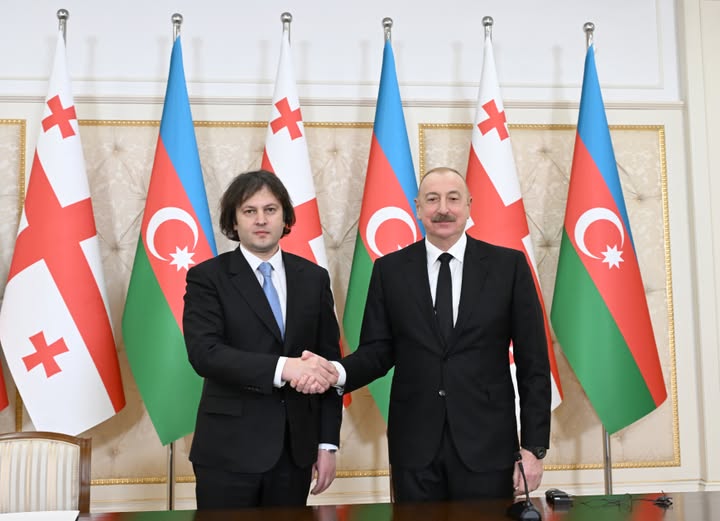
Georgia–Azerbaijan relations following the Armenia–Russia scenario have long been described as a strategic partnership. However, according to Johnny Melikyan, Georgia expert at the Orbeli Analytical Center, these relations have always contained internal problems and contradictions. For many years, such issues were not publicly discussed and remained within closed diplomatic formats.
Melikyan notes that this approach was characteristic of different political periods, including the years of Mikheil Saakashvili’s presidency. Problems existed at the time as well, but they did not become subjects of public debate.
Georgia–Azerbaijan Relations Following the Armenia–Russia Scenario
According to Melikyan, during the Saakashvili era, outlines of new military and political cooperation were even taking shape in the Azerbaijan–Turkey–Georgia format. However, the current Georgian authorities later abandoned this concept. The expert believes that this decision could not have been received positively in Baku.
In his assessment, especially under the rule of the Georgian Dream party, certain contradictions became more visible. Melikyan draws a direct parallel with Armenian–Russian bilateral relations. For many years, similar issues there were also managed through closed diplomatic mechanisms. Only in recent years did they begin to move into the public sphere. Georgia–Azerbaijan relations, he argues, are now developing in a comparable manner.
The expert does not rule out that difficulties in relations between Tbilisi and Baku may deepen further in the future.
Information and Hybrid Influence Attempts
Melikyan explains that while economic and business disputes are natural between states, the issue of transporting petroleum products through Georgia to Armenia goes beyond the economic sphere. In his view, it has moved to the interstate level. This creates opportunities for hybrid influence simultaneously within Armenia, Georgia, and Azerbaijan.
In particular, various narratives have circulated in the information space. One claims that Azerbaijan intended to supply petroleum products to Armenia, but Georgia allegedly obstructed the process. Another version suggests that Georgia raised transit tariffs under pressure from Russia. According to Melikyan, such narratives are actively used by different actors, including certain domestic political circles in Armenia, in order to work against Georgia.
Unblocking as an Alternative Opportunity
At the same time, the expert emphasizes that the new situation may also create alternative opportunities. If Azerbaijan is dissatisfied with the current circumstances, it may attempt to activate a broader unblocking process in the region.
Until now, Baku’s attention has largely focused on obtaining a corridor through Syunik. However, a wider philosophy of comprehensive unblocking had previously been discussed. If alternative routes for freight transportation through Armenia and Azerbaijan become available, the region could make several steps forward, Melikyan argues.
Georgia’s Role Under New Conditions
According to the expert, in the event of unblocking, Georgia’s role in the region could change and partially diminish. He recalls that Georgian experts speak of potential losses of up to one million tons of cargo per year, although he considers this figure exaggerated.
With a balanced tariff policy and competitive conditions, Georgian companies may gradually restore their positions. This does not mean that Georgia will lose its importance. On the contrary, Tbilisi should pursue a more active competitive policy and create attractive conditions for Armenian and other companies. This is particularly relevant in the import of petroleum products and in the use of the ports of Poti and Batumi.
The Anaklia deep-sea port project also holds special importance. If implemented within the next five to ten years, serious competition could emerge between Poti and Anaklia. This would create new opportunities for Armenian economic actors as well.
Armenia and Georgia’s Response to Azerbaijan’s Ambitions
Melikyan stresses that today there is a noticeably critical attitude in Tbilisi toward Azerbaijan’s potential hegemonization. According to him, after 2020, Baku has sought to position itself as a regional power. Current developments also reflect Georgia’s response to this policy.
In this context, the expert believes that Armenia–Georgia relations also require substantial effort. Such cooperation could help form a counterbalance to Azerbaijan’s hegemonic ambitions in the region.