
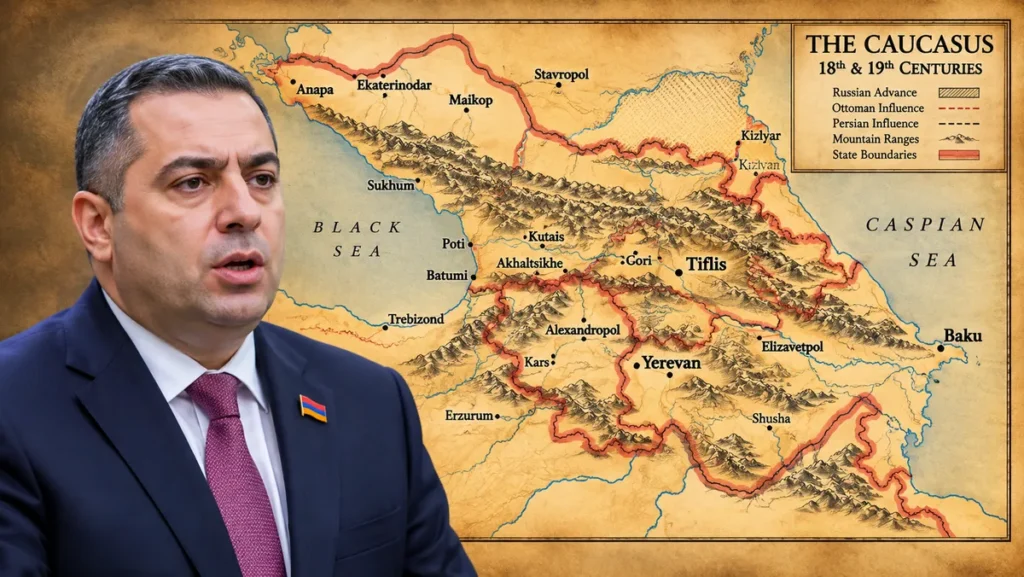
Domestic political developments in Armenia are closely tied to events in the region. But unlike constitutional reform, the future of the TRIPP project also depends on external factors that Yerevan cannot directly influence. Sergey Minasyan, deputy director of the Caucasus Institute and a doctor of political science, made the remarks as TRIPP entered its implementation phase and discussions began on Armenia’s draft constitution.
Constitutional reform and TRIPP are part of the same political agenda
In Minasyan’s view, the two processes follow a common political logic that reflects both the direction of Armenian domestic politics and the government’s peace agenda.
He said Armenia’s domestic politics and regional affairs are so closely connected that elections, constitutional changes and shifts in the balance of political forces inevitably draw a response in the region. Foreign policy developments, in turn, shape Armenia’s domestic agenda.
This extends beyond the South Caucasus. In Minasyan’s view, even the results of the US congressional midterms could directly affect the future of TRIPP. He said developments in Armenia’s relations with Azerbaijan and Türkiye should be viewed in the same context.
Yerevan has limited influence over the project
Minasyan noted that the Armenian public, political parties and authorities can shape domestic political developments. Yerevan’s ability to influence the implementation of TRIPP, however, is limited.
He identified military and political developments involving Iran and shifts in US domestic politics as risks to the project.
In his assessment, the Armenian authorities need to manage domestic political processes without undermining regional stability or security. At the same time, they should continue diplomatic and political engagement with international partners.
Minasyan welcomed the fact that constitutional reform and elections in Armenia are matters of open political debate and competition.
Despite its problems, Armenia’s political process remains largely open and democratic, he said. This sets the country apart from several states in the former Soviet Union and the broader Middle East and gives its political stance added weight.
TRIPP’s association with Trump could create additional risks
Minasyan believes TRIPP has already served part of its intended security role. The August 8 agreements and the idea behind the project helped stabilize the region, Armenia’s relations with Azerbaijan and, to some extent, its ties with Türkiye.
Shifts in regional and global politics, however, bring new risks. Minasyan singled out a point he believes has received too little attention in Armenia: TRIPP is a transport project with political and geopolitical implications, and it is directly associated with US President Donald Trump.
That raises the question of how implementation will proceed as US domestic politics change.
Minasyan said the US political and constitutional system gives the president considerable latitude in foreign policy. A shift in the balance of power in Congress, however, gives Democrats a way to influence Washington’s regional policy, primarily through funding. For TRIPP, this could affect funding for transport links or other projects.
Even so, Minasyan said his impression was that bipartisan support for TRIPP in the United States was holding.
In his view, Armenia would still have room for diplomacy even without that consensus. Democratic political circles, think tanks and civil society organizations in the United States have traditionally favored more active US engagement in the former Soviet Union.
Minasyan emphasized the role of Armenian diplomats, diaspora organizations, experts and civil society groups in explaining Armenia’s position to both the Republican administration and Democratic political circles.
Iran’s position on TRIPP goes beyond its relations with Armenia
Turning to Iran, Minasyan said Yerevan is using the channels available to explain to Tehran how it sees TRIPP being implemented. Iran’s position, however, reflects broader strategic, military and political concerns that extend beyond its bilateral relationship with Armenia.
In Minasyan’s assessment, continuing hostilities between the United States and Iran, as well as domestic political developments in the United States, directly affect Tehran’s calculations.
He sees signs that Iran’s position has shifted since the US midterms. He did not rule out that some circles in Iran expect changes in the US military and political presence across the broader Middle East, including the Persian Gulf and neighboring regions.
Iran’s stance on TRIPP should therefore be assessed in light of its ties with Armenia, the US–Iran conflict and wider military and political developments in the region, Minasyan said.