
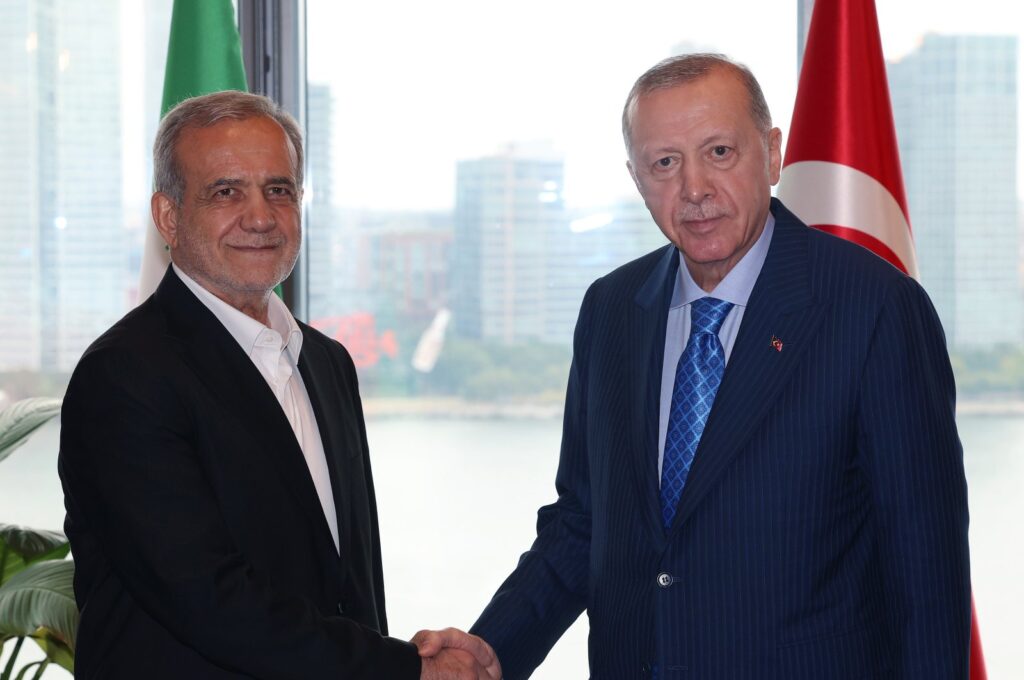
These days, the international agenda is focused on Iran. Without exaggeration, it can be said that the entire world is waiting, minute by minute, for a possible strike by the United States against Iran. Naval forces are concentrated in the Persian Gulf, military build-ups are visible across the region, and political and diplomatic tensions have reached a dangerous level. In this situation, Turkey’s position deserves special attention—a country whose relations with Iran have historically been complex and contradictory.
Turkey expert Tiran Lokmagyozyan suggests viewing the developments around Iran not through emotions or superficial political assessments, but through the logic of realpolitik.
Realpolitik: No Friends, Only Interests
According to the expert, current developments clearly demonstrate what realpolitik truly means and how it functions in practice. “There are no friends, no enemies—only permanent interests,” Lokmagyozyan emphasizes.
When the interests of states coincide, they become partners; when those interests clash, they turn into adversaries. This logic is simple at its core but extremely complex in its practical application. At first glance, it may seem strange that Turkey, which has historically had problems with Iran, is now supporting it on certain issues. Yet this is precisely where the multilayered nature of politics becomes evident.
Against the backdrop of recent events, reports have circulated in Iran suggesting that Turkish intelligence services have shared certain information with the Iranian side regarding Kurdish movements. In some circles, this step is viewed as a friendly gesture; however, the expert urges caution against such a superficial interpretation.
Turkey and Iran, in reality, remain strategic rivals, but the Kurdish factor represents one of the points where their interests intersect. When Kurdish groups attempt to move from Turkish territory into Iran to support their ethnic counterparts, Ankara often prevents these moves and shares the relevant information with Tehran. Iran, in turn, neutralizes the potential threat.
Turkey’s Agent Networks and Iran’s Weak Countermeasures
At the same time, the very Turkey that occasionally assists Iran on the Kurdish issue has, for decades, pursued an entirely different policy in northern Iran—particularly in the Atropatene (Iranian Azerbaijan) region.
According to Lokmagyozyan, about 30 years ago the population of these areas primarily identified themselves as Iranian. “They did not see themselves as Turks, nor did they feel close even to Azerbaijanis from Azerbaijan or Nakhichevan. Today, however, the picture has changed dramatically. When visiting these regions, it becomes clear that a significant portion of the population now considers itself Turkish, speaks about unification with Turkey, and often feels closer to Ankara than even to Azerbaijan,” he notes.
The expert argues that this shift in identity in Atropatene is not accidental. For nearly three decades, agents of Turkish influence have been actively operating in these areas, shaping processes of Turkification and radicalization. Iran, despite its totalitarian governance system, has proven relatively weak in countering these actions. “Yes, the country has strict control, repression, and preventive mechanisms, but in border regions this control has often been ineffective,” he says.
The problem is not limited to areas bordering Turkey. According to the expert, similar patterns can also be observed along Iran’s borders with Afghanistan, Baluchistan, and other regions, where destabilizing processes periodically emerge.
Turkey as a Model of Control
In contrast to Iran, Turkey, according to Lokmagyozyan, has an extremely strict and effective system of control. The Turkish state fully monitors both its borders and its internal population, especially national minorities.
In this context, the situation of Armenians in Turkey is particularly noteworthy. Today, according to the expert’s assessment, no more than 30,000 Armenians live in the country among millions of Turks. Yet even this small community is under near-total surveillance.
The state monitors what Armenians say, what they do, and who comes and goes. In especially sensitive regions—Western Armenia and Hamshen—any movement of Armenians is constantly under the scrutiny of security services.