
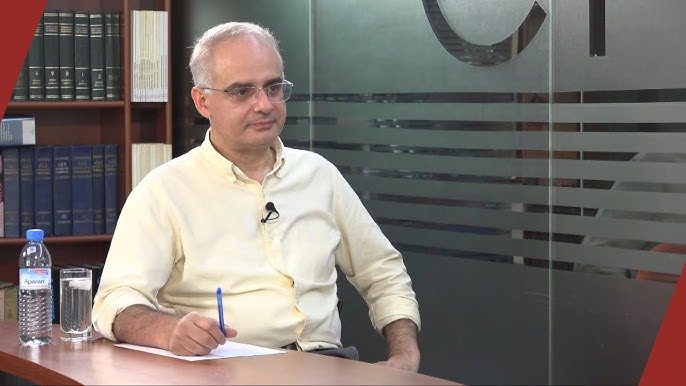
The opposition in the Republic of Armenia is presenting an alternative agenda for peace and development capable of ensuring the country’s security and economic progress. This was stated by Levon Zurabyan, deputy chairman of the Armenian National Congress party. He thoroughly analyzed the risks and shortcomings of the government-proposed “TRIPP” program and offered an alternative solution. “Armenia needs an ‘Armenian Contract of the Century,’ which can address a range of critical challenges facing the country,” he emphasized.
Issues with the TRIPP Program
Levon Zurabyan criticized the government’s proposed “TRIPP” program, which, although presented as a peace initiative, carries significant risks for Armenia. He noted that the program’s details are being concealed, and the government resorts to demagoguery, failing to provide the public with complete information. According to Zurabyan, the program involves Armenia providing a corridor to Azerbaijan to connect with Nakhchivan, but it does not address the issues of Armenia’s internal and external communications.
Zurabyan highlighted that the implementation of the TRIPP program does not resolve Armenia’s internal railway connectivity issues. For instance, Yerevan still lacks a rail connection with the Syunik region, meaning that if the program is implemented, Syunik would be economically more tied to Azerbaijan than to the rest of Armenia. In his view, this could lead to serious problems in the future, increasing Armenia’s economic dependence on neighboring countries.
Zurabyan pointed out that Armenia’s railway connections to the outside world, except for the route through Georgia, would depend on Azerbaijan and Turkey. This would make Armenia vulnerable, giving these countries leverage for political and economic pressure. He stressed that Azerbaijan and Turkey are known for their anti-Armenian policies, creating significant risks for Armenia.
Zurabyan introduced the concept of “double locked” countries, meaning nations that must pass through two other states to access the sea. According to him, the TRIPP program would turn Armenia into such a country, as reaching the Persian Gulf would require passing through Turkey or Azerbaijan and then Iran. According to World Bank estimates, this could increase transportation costs by 60–100%, posing a barrier to Armenia’s economic development.
Zurabyan stated that the TRIPP program is a geopolitical time bomb that threatens Armenia’s statehood. He noted that the program serves the interests of Western countries but ignores the interests of BRICS nations—Russia, Iran, China, and India. This could lead to geopolitical tensions, proxy wars, coups, and other forms of instability in the South Caucasus. He cited the example of Azerbaijan in the 1990s, where competition for oil resources caused instability until the 1994 “contract of the century” brought stability.
The Armenian Contract of the Century as an Alternative
Zurabyan proposed the “Armenian Contract of the Century,” which involves creating a transport hub through Syunik with the participation of Russia, Iran, China, India, and Georgia. According to him, the project is estimated at approximately $3.2 billion and can address multiple issues. It would provide Armenia with internal railway connectivity to Syunik, promote economic revitalization, and make Armenia an attractive transit hub for connecting the Persian Gulf with the Black Sea. The project would also resolve the “double locked” issue, as Armenia would access the Persian Gulf solely through Iran.
Zurabyan emphasized that this project is not a dream but a meticulously developed initiative, with work beginning as early as 2008 under Serzh Sargsyan’s administration. The Austrian company F Consulting Engineers conducted the preliminary project development, and in 2012–2013, agreements were signed with Russian and Chinese companies to finalize the project. The project includes a detailed route from Gagarin to Agarak, with the construction of 84 bridges and 60 tunnels. Calculations of cargo transportation volumes and train numbers indicate that the project could be profitable.
Zurabyan noted that financing the $3.2 billion project is feasible. In 2019, China offered to fund the project with Armenian state guarantees, but Nikol Pashinyan’s government ignored the proposal. He criticized the government’s foreign policy decisions, which hindered deeper Armenian-Chinese cooperation, particularly Armenia’s joining an organization for the protection of religious minorities in China and official meetings with Taiwanese representatives.