
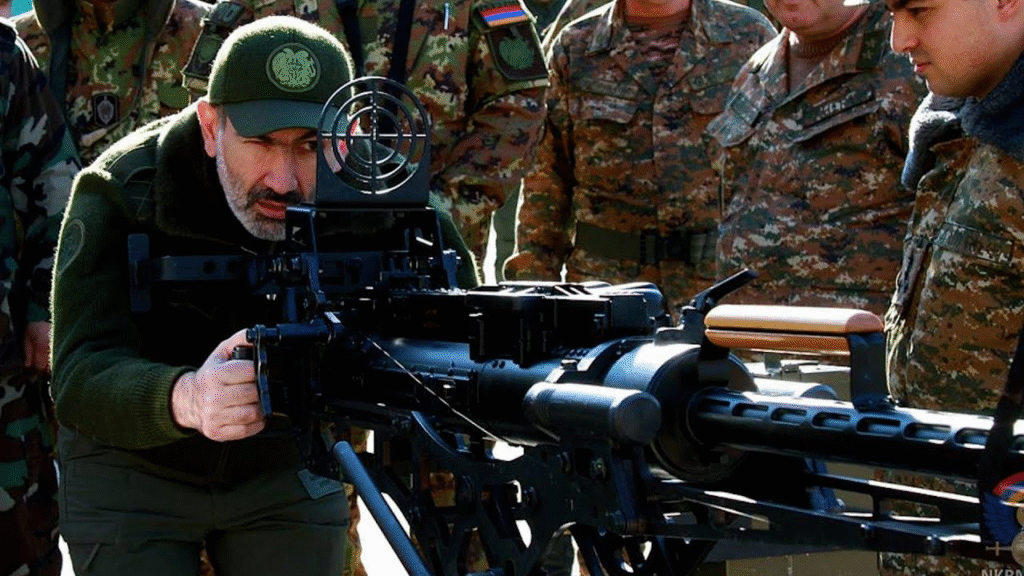
During a government conference with state employees, Prime Minister Nikol Pashinyan delivered a speech lasting about an hour. Many points sounded familiar, yet several statements require separate analysis. The main issue concerns Armenia’s arms procurement and the political context described by the Prime Minister. Political analyst Tigran Grigoryan evaluated how accurate Pashinyan’s claims are.
Pashinyan speaks in half-truths
According to Grigoryan, Pashinyan once again uses “the language of half-truths.” To understand this, his statement should be split into two parts.
Pashinyan’s first claim: Armenia could not buy weapons because suppliers feared Armenia would use them “outside its territory,” meaning in Nagorno-Karabakh. Grigoryan argues that if this were the only reason, identical restrictions would have applied to Azerbaijan. In reality, the embargo was linked to the existence of the conflict itself, not its geography.
The U.S. 907th amendment proves this further — it imposed limits specifically on Azerbaijan due to its actions.
Despite restrictions, Armenia did purchase non-Russian weapons. Examples include the first Indian imports in 2018–2019, openly reported by the Indian side.
Recent acquisitions, Grigoryan says, are not the result of “closing the Karabakh issue,” but Russia’s failure to fulfill its supply obligations. After 2022, when Yerevan realized Russian guarantees no longer function, Armenia started a rapid diversification process.
French weapons and cooling relations with Russia
Pashinyan’s claim that restrictions were lifted after the Karabakh issue was resolved is misleading. According to Grigoryan, it reflects Armenia’s cooling relationship with Russia. France’s readiness to supply modern systems is viewed in this geopolitical context.
Western concerns were never about Armenia using the weapons “outside its borders.” The real concern was that sensitive technologies could reach Russia.
Restrictions were also never absolute. For example, before the 2020 war, France supplied certain satellite technologies to Azerbaijan.
Azerbaijan diversified. Armenia could have — but didn’t
Azerbaijan successfully diversified its military suppliers — Israel, Turkey, and several European producers. Armenia also had this option, but lacked political will, strategy, and an effective procurement system.
As a result, while Azerbaijan bought cutting-edge systems, Armenia received mostly outdated Russian equipment.
The “legitimacy” argument contradicts global trends
Pashinyan again emphasized “legitimacy,” “international legal framework,” and avoiding action outside “internationally recognized borders.” But this position, Grigoryan notes, does not match current geopolitical realities.
In the U.S. 28-point plan and EU initiatives, the proposed settlement of the Ukraine conflict effectively recognizes Russian control over at least part of the occupied territories. Moreover, the West urges Ukraine not to attempt military retaking of these regions.
In this context, Pashinyan’s statement that “legitimacy is the key to our security” appears unrealistic. The world is entering an era defined by military capability and technological autonomy, not declarative legitimacy