
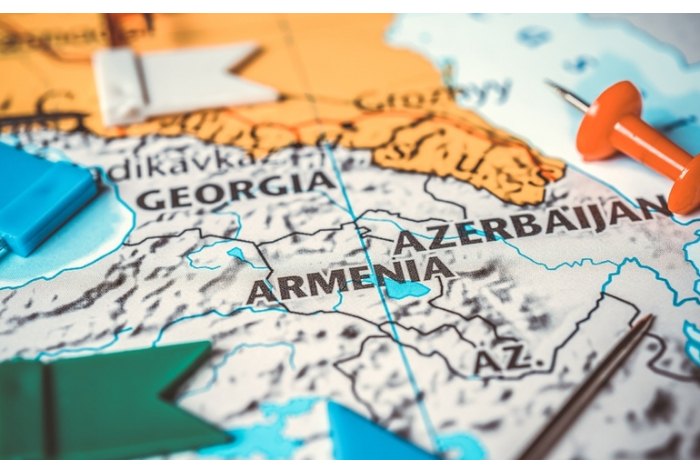
Following Donald Trump’s re-election as President of the United States, the world has entered a period of fundamental change. The globalist order that existed before his return to power is eroding, and developments around the South Caucasus are a direct consequence of this shift. In this context, South Caucasus relations following the Armenia–Russia scenario are increasingly shaped by major geopolitical calculations, according to political analyst Yervand Bozoyan.
Why the South Caucasus Is Absent from the US National Security Strategy
Bozoyan draws attention to the US National Security Strategy published on December 5. The document addresses Russia, China, the Russia–Ukraine war, Europe, Southeast Asia, and the Middle East. However, it contains no reference to the South Caucasus. This omission directly affects South Caucasus relations following the Armenia–Russia scenario.
According to Bozoyan, this absence is deliberate. Within Trump’s circle, there is a serious internal debate over the Caucasus. One faction actively lobbies for Turkey’s interests. This group argues that the United States should support Ankara. It also believes Turkey should become the dominant actor in the South Caucasus, pushing Russia out.
An opposing camp strongly rejects this approach. Bozoyan notes that Israeli and Greek lobbying circles view Turkey’s growing role as a threat to Israel’s security. Their alternative proposal calls for a US compromise with Russia in the Caucasus. This would apply if Russian decisions regarding Armenia do not strengthen Iran.
Israel’s Security as the Primary US Priority
Bozoyan highlights another key point. For the first time in nearly seventy years, the US National Security Strategy clearly states that Israel’s security is Washington’s primary priority in the Middle East.
He also notes that the United States has declared it will no longer depend on Arab energy resources. This shift significantly influences South Caucasus relations following the Armenia–Russia scenario. Energy considerations now carry less strategic weight for Washington.
The analyst adds that Israel’s security doctrine explicitly opposes the strengthening of Turkey, Iran, and Pakistan in the Muslim world. Developments in southern Syria illustrate this approach.
According to Bozoyan, Israel rejected the expansion of Turkish influence in southern Syria. As a result, a compromise was reached. Russian influence was restored in that area. This approach, he says, was also accepted by the United States.
The Caucasus as a Negotiating Asset
Bozoyan argues that this context explains Trump’s decision. The South Caucasus was deliberately excluded from the National Security Strategy. The region was turned into a bargaining chip in negotiations with Russia. This logic further defines South Caucasus relations following the Armenia–Russia scenario.
“Trump views this region as something that can be sold to Russia at a high price,” Bozoyan states.
He also comments on Turkey’s recent moves. Ankara, he says, is trying to appeal to Trump. Reports suggested that Turkey was willing to return the S-400 systems to Russia. In exchange, it hoped to restore relations with the United States and obtain F-35 fighter jets. Bozoyan expresses strong doubts about this scenario.
He concludes that Israeli, Greek, and Armenian lobbying groups in the US Congress and Senate are influential. Because of this, approval of F-35 sales to Turkey remains highly unlikely.