
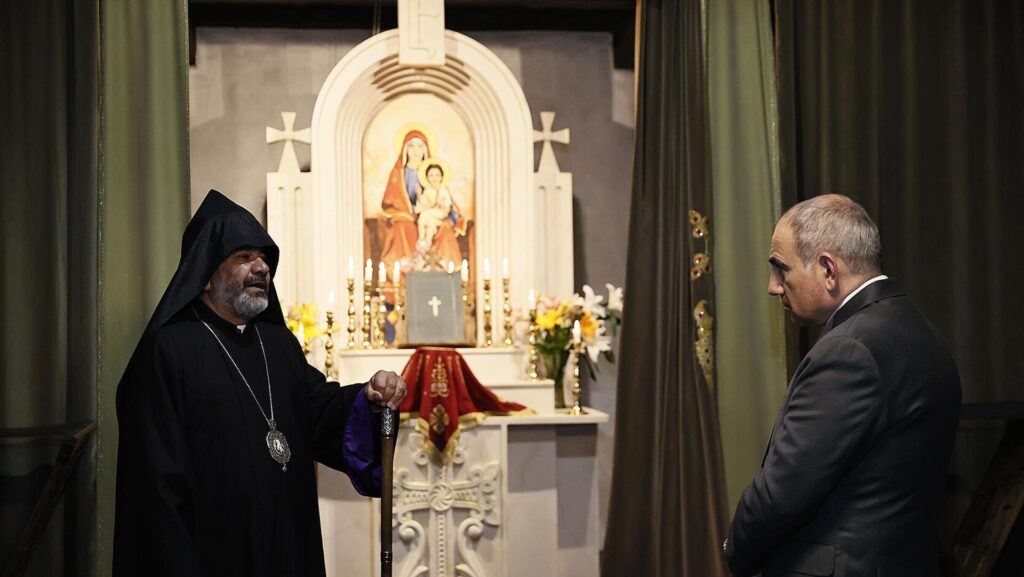
Processes unfolding around the Armenian Apostolic Church have gained new momentum since the New Year. Armenian Prime Minister Nikol Pashinyan and ten bishops have formed a so-called coordinating group for “church renewal.” According to official statements, the group is meant to promote a church reform agenda previously announced by the prime minister.
However, the legal status of this body remains unclear. What constitutional or legislative norms does it rely on? Political analyst Hrant Melik-Shahnazaryan offers his assessment.
Creating a “council” as a mechanism of failure
Commenting on the initiative, the analyst recalls an earlier remark by Artur Vanetsyan, leader of the Homeland party: “If you want something to fail, create a commission.” According to Melik-Shahnazaryan, this is a managerial pathology inherited from the Soviet era.
“A council in itself has no legal force. You cannot simply gather ten or eleven people around a goal and present it as an institutional process,” he notes.
Two political scenarios: maximum and minimum
According to the analyst, Nikol Pashinyan’s actions are driven by at least two political objectives.
The first is the “plan maximum.” Under this scenario, the ultimate goal is to make the Armenian Apostolic Church controllable, up to the election of a new Catholicos and the establishment of full control over the church. “This is precisely what the authorities openly talk about — the maximum plan,” Melik-Shahnazaryan says, adding that its feasibility remains uncertain.
At the same time, there is a second, no less important objective — the “plan minimum.”
The church as a tool to divert attention from elections
Melik-Shahnazaryan argues that in an election year, just months before voting, the authorities are deliberately shifting public attention in a different direction.
“This is done so that no one talks about elections, so that the opposition does not prepare for them but instead focuses on defending the church. It was Nikol Pashinyan who brought this issue into the political arena,” he says.
The problem is not merely the creation of a church-centered agenda but the displacement of key political issues through it, including discussions about mechanisms for removing the government, such as impeachment.
Impeachment pushed aside
“If the goal is to remove the current authorities, we should be discussing the ways to achieve that. In my deep conviction, that path is impeachment, which remains relevant,” Melik-Shahnazaryan stresses.
Yet, he argues, this topic has been pushed out of the political agenda by the artificially created noise around the church. As a result, political actors, experts, and even journalists are debating church protection rather than regime change.
The risk of elections without alternatives
The analyst warns that if the opposition fails to articulate a clear strategy and take practical steps soon, the situation may lead to the reproduction of power.
“If society does not see an alternative, it simply will not participate in elections. Those who will participate are the administrative resource of Nikol Pashinyan and his stable electorate,” he says.
In such circumstances, Melik-Shahnazaryan believes, the authorities may not even need electoral fraud, securing victory through the emptying of the political field. Thus, the so-called coordinating group around the church becomes not only a legally questionable initiative but also a powerful political instrument. Regardless of whether the “plan maximum” succeeds, the “plan minimum” — diverting attention from the real political agenda — is already being largely implemented.