
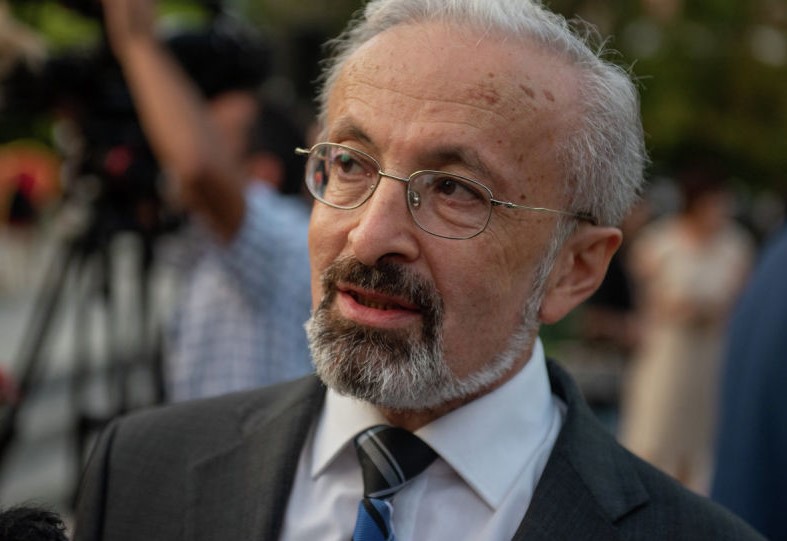
In the 2021 parliamentary elections, the ruling authorities received the votes of only 26 percent of citizens eligible to vote, which cannot be considered a real victory. This was stated by former Speaker of the National Assembly Tigran Torosyan.
According to him, what happened should be formulated correctly: the authorities did not win; rather, the opposition lost because a significant portion of citizens did not participate in the elections. In Torosyan’s assessment, the authorities’ statements about “legitimacy” do not reflect reality, as the meaning of that term is often misunderstood. “Yes, they were elected as a result of elections, but they did not receive the approval of three quarters of Armenia’s citizens. In reality, they have no right to speak on behalf of the people,” he said.
The myth of “unity” and the real logic of elections
Commenting on frequent criticism directed at the opposition, Torosyan noted that calls for “unity” have nothing to do with reality. According to him, such a situation has never existed and does not exist in any country.
“They say the opposition must unite. This is a good wish, but it has nothing to do with reality. Elections are interesting precisely because different forces take part,” he said, adding that the theme of “unity” is often exploited by the authorities to portray the opposition as fragmented.
In Torosyan’s view, there is one fundamental issue in which the opposition has either fallen short or some forces simply did not manage to go through the necessary process. This issue is active engagement with society.
According to him, one should not complain that a citizen does not come to vote. The very fact that the citizen does not support the authorities is itself a political act that should receive an appropriate response.
“This person must be convinced that there is an opportunity to avoid all the disasters that have already occurred, at least to correct some of them, and to have a dignified state,” he emphasized.
The issue of vote “fragmentation” and the role of new forces
Addressing concerns about vote “fragmentation,” Torosyan noted that there are not many significant forces within the opposition that are capable of collecting a substantial number of votes but still failing to enter parliament. According to him, the issue mainly concerns small parties whose very purpose is to fragment votes.
He recalled that in 2021 this problem did exist, and after fulfilling their “mission” of fragmenting votes, those forces created an extra-parliamentary council that later regularly met with representatives of the authorities. Now the influence of these forces will be far less significant. If each of these small parties collects around 1,000–2,000 votes, and there are about ten such forces, then a total of roughly 20,000–30,000 votes are distributed as a result of so-called “fragmentation.”
At the same time, forces that did not participate in the 2021 elections but are participating now have a двойной effect on the opposition. On the one hand, they increase the number of votes cast for the opposition; on the other hand, they increase the total number of voters, which reduces the share of the ruling authorities.
Thus, the participation of new voters and new political forces creates a dual effect in favor of the opposition. In this matter, it is important to correctly account for both components — the accumulation of votes and the change in the total number of voters, he said.