
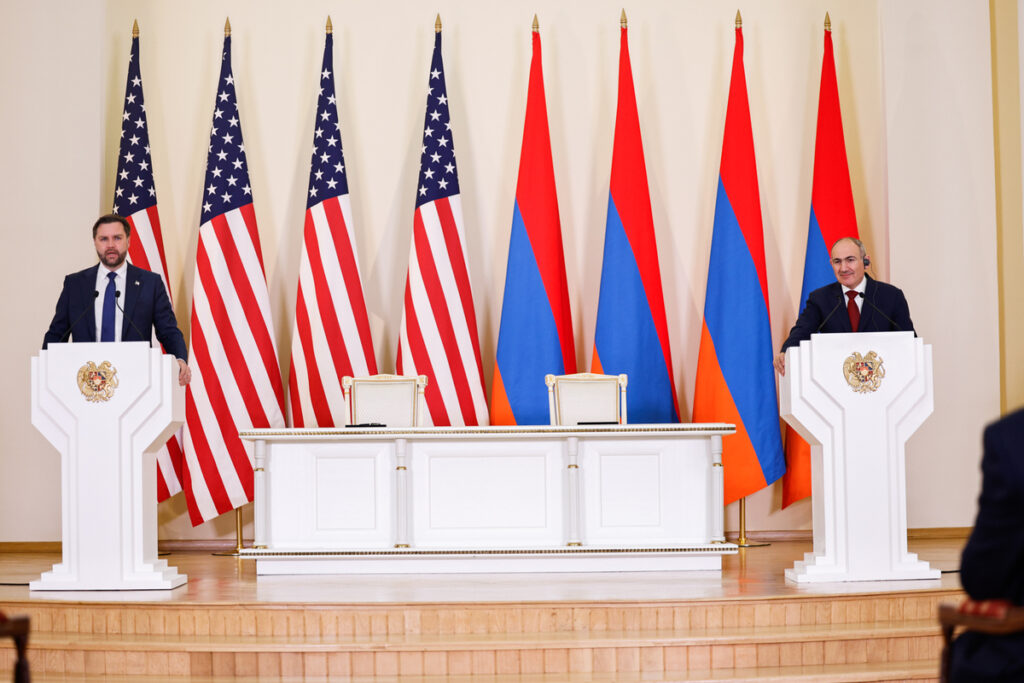
The visit of US Vice President JD Vance could mark the beginning of long-term economic realignments for Armenia. It involves several major projects simultaneously, with a total volume that could reach up to $9 billion. This is stated by economist Hayk Fanian.
According to him, although at this stage the discussions are still at the level of statements and promises, these statements are based on concrete calculations and imply strategic planning for at least a decades-long horizon.
Atomic Power Units: a $5 Billion Project
One of the discussed projects, the largest in scale, concerns the construction of new power units for the nuclear power plant. According to preliminary estimates, the cost of the reactors could amount to about $5 billion, said Fanian.
Such a project, he continues, has a dual nature. On one hand, it serves as an export for the technology-supplying country, since the equipment and nuclear technologies are produced and exported from its territory. On the other hand, for the host country, it is viewed as an investment — depending on the structure of the deal.
The economist notes that in international practice, in strategic infrastructure programs of this kind, the main financier is usually the country that supplies the technologies. “Financing can be carried out through various instruments — debt or equity, but the essence is in the structure. Most likely, a joint management model will be formed based on public-private partnership logic, and in that case, the investments will be classified as foreign direct investments, regardless of the financial instruments used to transfer the funds,” Fanian points out.
According to him, the host country can participate in financing, but the key role remains with the party supplying the technologies. This is international practice and does not apply only to Armenia. Similar models have been applied in various countries regardless of the region or political conjuncture.
Closed Sector and the Issue of Sovereignty
Commenting on whether such cooperation would simply replace one dependence with another from a superpower, Fanian noted that nuclear energy is a closed sector with strict regulations and restrictions; it does not operate on free-market logic, and nuclear technologies cannot simply be purchased if financial capabilities are available. He added that access to this sector is conditioned by political, security, and strategic factors.
In this context, continued Fanian, small and medium-sized economies almost never can fully independently implement projects of such scale. Therefore, the question is often framed not as avoiding dependence, but as choosing the direction of dependence.
High Technologies: Another $4 Billion
The second major direction concerns the deployment of high-tech infrastructure with an investment volume of about $4 billion. It involves tens of thousands of GPU capacities, which represent a large energy-consuming system.
Fanian noted that according to preliminary calculations, such infrastructure could annually consume about 800 million kilowatt-hours of electricity, which accounts for roughly 8–10% of Armenia’s total consumption. This, according to the economist, is an extremely large figure for one project and requires stable, long-term, and predictable energy supply.
Therefore, the expert is convinced that the construction of atomic power units and the deployment of high-tech capacities are viewed as interconnected parts of one chain. “The generated electricity can be directed precisely to servicing these systems, ensuring the economic viability of the projects,” he notes.
From Economic Benefit to Political Influence
Such multibillion-dollar projects have not only an economic but also a political component, emphasizes Fanian. The transfer of technologies and long-term financing imply influence on the host country, noted the expert, adding that this applies to any technology-supplying state and any region.
This influence, he asserts, can manifest in deepening economic ties, reforming the energy system, and strengthening strategic partnership. From this perspective, the possible results of the visit should be viewed not within the framework of one or two programs, but as a comprehensive economic realignment for at least the coming decade, said Fanian.
If these programs are brought to life, Armenia will find itself on the threshold of forming a new economic model, combining the development of energy infrastructure and the attraction of high-tech investments.