
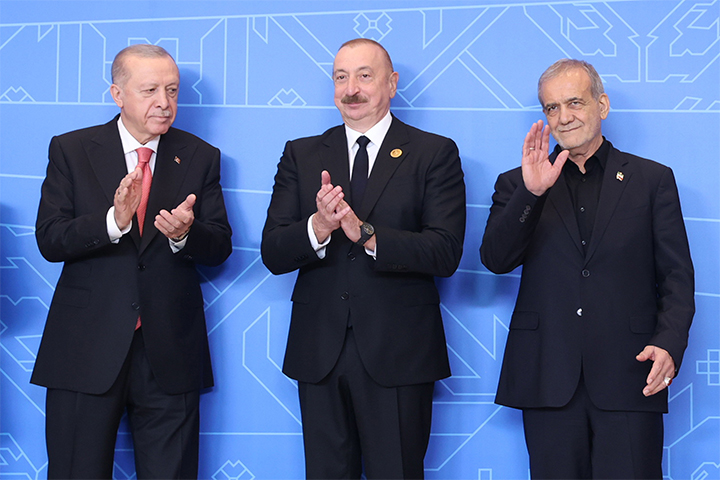
In the regional game launched by the United States and Israel, Turkey and Azerbaijan play a significant role as states acting against Iran. This was stated by Ambassador Extraordinary and Plenipotentiary Dzyunik Aghajanyan.
According to her, Azerbaijani President Ilham Aliyev agreed to this “adventure” long ago, and this is not a new process.
“I have repeatedly stated that Artsakh was essentially gifted to Azerbaijan precisely for the implementation of this large geopolitical project. It was the bonus in exchange for which Azerbaijan agreed to participate in this game,” Aghajanyan claims.
According to her, Turkey is also involved in these processes, not only to advance its pan-Turkic programs.
“Let us recall the autumn of 2022, when the Russian side was in a rather difficult situation. At that time, the leaders of the Grey Wolves presented Erdoğan with a ‘map of the Turkic world,’ clearly showing their territorial ambitions. In this context, Turkey also received its bonuses — particularly control over the northern part of Syria and the reduction or elimination of the influence of Kurdish forces operating there. We saw how these processes were presented by the American side with rather ‘elegant’ wording, while in reality actions were taking place there that were essentially a genocide,” she said.
According to her, Baku is currently trying to create a pretext to justify its possible involvement in the process, and the incident in Nakhchivan belongs to this category.
“The Nakhchivan incident involuntarily created a sense of déjà vu. It reminded us of the scenes we saw during the 44-day war in Artsakh. If you remember, there was a ‘nicely’ drilled rocket mark in the asphalt without any serious damage. The same picture appeared here: fire trucks were shown already standing ready at the airport for some reason; ambulance crews were also there and seemed to be waiting for something to happen. When the explosion occurred, they immediately began moving toward the scene. All this essentially creates the impression that we are dealing with a staged action aimed at creating a pretext or justifying Azerbaijan’s possible involvement in the ongoing processes,” the diplomat noted.
However, according to her assessment, Azerbaijan and Turkey will openly enter the process only when they are certain that the outcome is guaranteed and that it will not harm their states or their leaders personally — Erdoğan and Aliyev. For this reason, Aghajanyan notes, these countries often act according to the principle of “one step forward, two steps back.” Outwardly they create the impression that they are preparing the ground for further actions, but in reality they try to avoid risks and potential strikes.
“Over the years we have repeatedly seen such maneuvers, even in situations where the actions of Turkey and Azerbaijan appeared uncoordinated from the outside, while in fact they were coordinated steps. All this is done to avoid direct involvement, while at the same time taking advantage of the fact that in Armenia power is often held by people who are susceptible to external pressure. Under such conditions it becomes possible to tear away another ‘piece’ from Armenia,” she emphasized.
However, the possibilities for maneuvering will eventually become limited.
“It must be remembered that the West never gives anything for free. All the resources that have been invested over decades in both Turkey and Azerbaijan were directed toward the implementation of specific programs. One day the bill for those investments will be presented. Moreover, they will try to collect that bill to the very last drop — even taking more if possible. At the moment, however, it seems that the United States is trying to gradually withdraw from the game, leaving the responsibility to Israel and later presenting the bill to Arab countries as well — for the restoration of military bases in the region. That is why today we can see the United States trying to declare victory while simultaneously shifting the focus to other directions, for example to the issue of Cuba. The rhetoric will certainly continue, but signs of certain steps back are already noticeable,” Aghajanyan concluded.